
The transition from traditional on-premise infrastructure to cloud-native environments represents one of the most significant shifts in modern information technology. For enterprise architects, this is not merely a technical migration; it is a fundamental restructuring of how business value is delivered, secured, and scaled. Integrating cloud strategies into enterprise architecture requires a disciplined approach that aligns technical capabilities with long-term business objectives. This guide explores the critical components of this integration, providing a framework for organizations to navigate complexity without sacrificing stability or agility.
🔍 Defining the Intersection of Cloud and Architecture
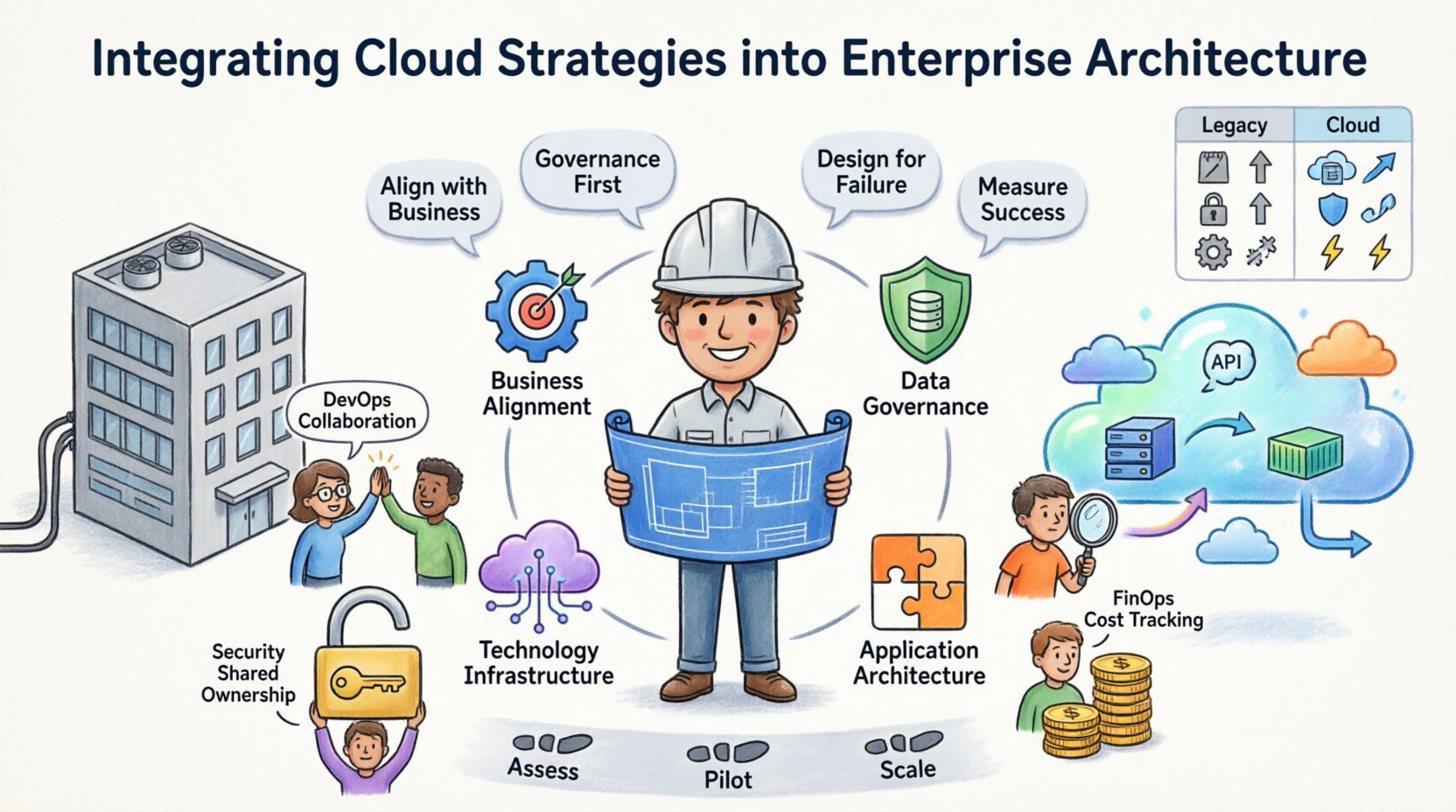
Enterprise Architecture (EA) serves as the blueprint for an organization’s structure and operations. It defines how business processes, data, applications, and technology infrastructure interact. When cloud strategies enter this equation, the static nature of traditional architecture must evolve into a dynamic model capable of adapting to rapid changes in service offerings and market demands. The core objective is to ensure that cloud adoption drives efficiency rather than creating fragmentation.
Several key distinctions emerge when moving from legacy systems to cloud-integrated architectures:
- Scalability: Traditional infrastructure often relies on fixed capacity planning. Cloud strategies introduce elastic resources that scale on demand.
- Service Models: The shift from owning hardware to consuming services changes the operational model significantly.
- Decentralization: Development teams gain more autonomy, requiring stronger governance frameworks to maintain consistency.
- Cost Structure: Capital expenditure (CapEx) transitions toward operational expenditure (OpEx), altering financial planning and forecasting.
Understanding these distinctions is the first step in weaving cloud capabilities into the broader architectural fabric. It requires a mindset shift from “building and maintaining” to “selecting and orchestrating”.
🏗️ The Four Pillars of Cloud-Integrated Architecture
To successfully integrate cloud strategies, architects must address four primary domains. These pillars ensure that the cloud environment supports the business without introducing unmanageable risk or technical debt.
1. Business Architecture Alignment
Every technical decision must trace back to a business capability. Cloud strategies should not be adopted for technology’s sake but to enable specific business outcomes. This involves mapping cloud services to business processes and identifying where agility is most needed.
- Capability Mapping: Identify which business functions require rapid iteration versus those needing high stability.
- Process Optimization: Re-engineer workflows to take advantage of cloud-native features like automation and serverless computing.
- Market Responsiveness: Ensure the architecture supports the speed required to launch new products or services.
2. Data Architecture and Governance
Data remains the most critical asset for most organizations. Moving data to the cloud introduces questions regarding sovereignty, residency, and integrity. The architecture must define clear boundaries for data flow between on-premise systems and cloud environments.
- Data Classification: Determine sensitivity levels to apply appropriate security controls.
- Integration Patterns: Establish standards for how data moves between legacy databases and cloud storage solutions.
- Compliance: Ensure data handling meets regulatory requirements across all jurisdictions.
3. Application Architecture
Applications are the interface between the user and the data. In a cloud-integrated environment, applications may exist as monolithic systems, microservices, or serverless functions. The architecture must define how these different forms coexist and communicate.
- Refactoring vs. Rehosting: Decide whether to lift-and-shift existing applications or refactor them for cloud-native performance.
- API Management: Create robust interfaces to expose services securely.
- State Management: Design applications to handle statelessness where possible to improve resilience.
4. Technology Infrastructure
This pillar encompasses the underlying compute, network, and storage resources. It requires a hybrid view that accommodates both physical data centers and cloud regions.
- Network Topology: Design secure connections between on-premise and cloud environments.
- Identity Management: Centralize authentication and authorization across all environments.
- Monitoring: Implement unified observability tools to track performance across diverse infrastructures.
📊 Comparative Analysis: Legacy vs. Cloud-Integrated Models
Understanding the differences between traditional and cloud-integrated models helps in planning the transition. The following table outlines the key operational shifts.
| Dimension | Legacy On-Premise Model | Cloud-Integrated Model |
|---|---|---|
| Procurement | Long lead times, bulk purchasing | On-demand, pay-as-you-go |
| Capacity Planning | Forecasted peaks, over-provisioning | Dynamic scaling, auto-scaling |
| Security Responsibility | Full internal responsibility | Shared responsibility model |
| Deployment Cycle | Months or quarters | Days or hours |
| Failure Domain | Data center or hardware level | Service or region level |
🛡️ Governance and Security Frameworks
As infrastructure becomes more distributed, the risk surface expands. Governance frameworks must be robust enough to enforce policies without stifling innovation. Security cannot be an afterthought; it must be embedded into the architecture design phase.
Centralized Policy Enforcement
Organizations should implement a central policy engine that governs resource provisioning across all environments. This ensures that no resource is created that violates compliance or security standards. Automation is key here; policies should be defined as code.
- Resource Tagging: Enforce strict tagging standards for cost allocation and asset tracking.
- Access Control: Implement least-privilege principles for all users and services.
- Change Management: Maintain audit trails for all infrastructure changes.
The Shared Responsibility Model
A common misconception is that the cloud provider secures everything. In reality, the responsibility is shared. The provider secures the cloud, while the organization secures what is in the cloud. Architects must clearly define these boundaries.
- Provider Responsibility: Physical security, network infrastructure, hypervisor security.
- Organization Responsibility: Data encryption, identity management, operating system patches, application security.
- Overlap: Configuration management and access control policies.
💰 Financial Operations (FinOps)
The shift to cloud changes how IT costs are managed. Without rigorous financial governance, cloud spending can spiral out of control. Integrating cloud strategies requires a dedicated FinOps function that bridges finance, technology, and business.
Cost Visibility and Accountability
Every department must understand the cost of the resources they consume. This requires detailed reporting and chargeback models that reflect actual usage.
- Budgeting: Move from annual fixed budgets to flexible monthly forecasts.
- Anomaly Detection: Use tools to alert on unexpected spending spikes immediately.
- Right-Sizing: Continuously review resource allocation to ensure efficiency.
Optimization Strategies
Once costs are visible, the focus shifts to optimization. This involves analyzing usage patterns and adjusting resources accordingly.
- Reserved Capacity: Commit to long-term usage for predictable workloads to reduce costs.
- Spot Instances: Utilize unused capacity for non-critical, flexible tasks.
- Storage Tiering: Move infrequently accessed data to lower-cost storage classes.
🚀 Implementation Roadmap
Integrating cloud strategies is a journey, not a destination. A phased approach allows organizations to learn, adapt, and mitigate risks at each stage.
Phase 1: Assessment and Discovery
Before making any changes, understand the current state. Inventory all applications, data flows, and dependencies. Identify which workloads are candidates for migration and which should remain on-premise.
- Workload Analysis: Categorize applications by criticality and cloud readiness.
- Skill Gap Analysis: Assess the current team’s competency in cloud technologies.
- Network Assessment: Evaluate bandwidth and latency requirements for hybrid connectivity.
Phase 2: Foundation and Pilot
Build the foundational capabilities and run a pilot project. This phase validates the architecture, governance, and security models on a small scale.
- Core Services: Set up identity, networking, and monitoring foundations.
- Pilot Migration: Move a low-risk application to test the workflow.
- Feedback Loop: Gather lessons learned to refine the strategy.
Phase 3: Scale and Optimize
Expand the migration to critical workloads and optimize for performance and cost. This is where the full value of the cloud strategy is realized.
- Large-Scale Migration: Move remaining legacy systems.
- Automation: Implement Infrastructure as Code (IaC) for consistency.
- Continuous Improvement: Regularly review architecture against business goals.
🧠 Cultural and Organizational Shifts
Technology is only one part of the equation. People and processes often present the biggest challenges. The cloud enables faster delivery, which requires a cultural shift towards agility and collaboration.
DevOps Integration
Breaking down silos between development and operations is essential. DevOps practices ensure that code moves from development to production seamlessly and reliably.
- Collaboration: Encourage shared ownership of services.
- Automation: Reduce manual intervention in deployment pipelines.
- Feedback: Establish rapid feedback loops from production to development.
Training and Upskilling
The skills required for cloud architecture differ from traditional IT. Investing in continuous learning ensures the team remains effective.
- Certification Paths: Encourage relevant technical certifications.
- Internal Workshops: Share knowledge across teams to build collective expertise.
- Community Engagement: Participate in industry forums to stay updated on trends.
📈 Measuring Success and Maturity
To ensure the cloud strategy is delivering value, define clear metrics and maturity models. These indicators help track progress and identify areas for improvement.
Key Performance Indicators (KPIs)
Select metrics that align with business goals rather than just technical outputs.
- Deployment Frequency: How often is new value delivered to users?
- Lead Time for Changes: Time from code commit to production.
- Mean Time to Recovery: How quickly can the system recover from failure?
- Cost per Transaction: Efficiency of resource usage relative to output.
Architecture Maturity Model
Assess the organization’s current state against a maturity model to understand the path forward.
- Initial: Ad-hoc processes, high risk.
- Managed: Basic controls in place, reactive.
- Defined: Standardized processes, proactive.
- Quantitatively Managed: Data-driven optimization.
- Optimizing: Continuous improvement and innovation.
🔄 Managing Risk and Dependency
Cloud integration introduces new risks, particularly regarding vendor lock-in and dependency on external providers. Architects must design for portability and resilience.
Vendor Lock-In Mitigation
While specific providers offer unique features, over-reliance on proprietary services can limit future flexibility.
- Abstraction Layers: Use APIs or platforms that abstract underlying provider details.
- Open Standards: Prefer open standards over proprietary formats where possible.
- Multi-Cloud Strategy: Consider distributing workloads across multiple providers.
Resilience and Disaster Recovery
Cloud environments can experience outages. The architecture must be designed to withstand these events.
- Redundancy: Deploy resources across multiple availability zones.
- Backup Strategies: Maintain offline backups for critical data.
- Testing: Regularly test disaster recovery plans to ensure they work.
🌐 The Future Landscape
The cloud is not a static destination. Emerging technologies like edge computing, artificial intelligence, and quantum computing will further reshape the architectural landscape. Architects must remain flexible and anticipate these shifts.
- Edge Integration: Bringing compute closer to data sources.
- AI-Native Apps: Designing applications that leverage machine learning natively.
- Sustainability: Optimizing for energy efficiency and carbon footprint reduction.
By adhering to these principles and maintaining a focus on alignment between business and technology, organizations can successfully integrate cloud strategies into their enterprise architecture. The result is a resilient, scalable, and efficient IT environment capable of supporting future growth and innovation.
🔑 Summary of Critical Actions
To conclude the strategic overview, consider these actionable takeaways for immediate implementation:
- Establish Governance First: Define policies before provisioning resources.
- Align with Business Goals: Ensure every cloud investment supports a business outcome.
- Invest in People: Train teams on cloud-native practices and security.
- Monitor Financials: Treat cloud costs as a critical operational metric.
- Design for Failure: Assume components will fail and build accordingly.
- Document Everything: Maintain clear records of architecture decisions and changes.
- Review Regularly: Conduct periodic architecture reviews to ensure alignment.