
In the world of Agile and Scrum, the Product Owner often finds themselves in a high-pressure position. They stand between a development team seeking focus and stakeholders demanding change. The natural instinct is to please everyone, to say “yes” to every new feature, bug fix, or strategic pivot. However, constant agreement leads to chaos, technical debt, and a team that is perpetually overworked.
Saying no is not an act of aggression; it is an act of protection. It protects the team’s capacity, it protects the product’s vision, and ultimately, it protects the value delivered to the customer. This guide explores the nuanced art of declining stakeholder requests while maintaining strong, productive relationships.
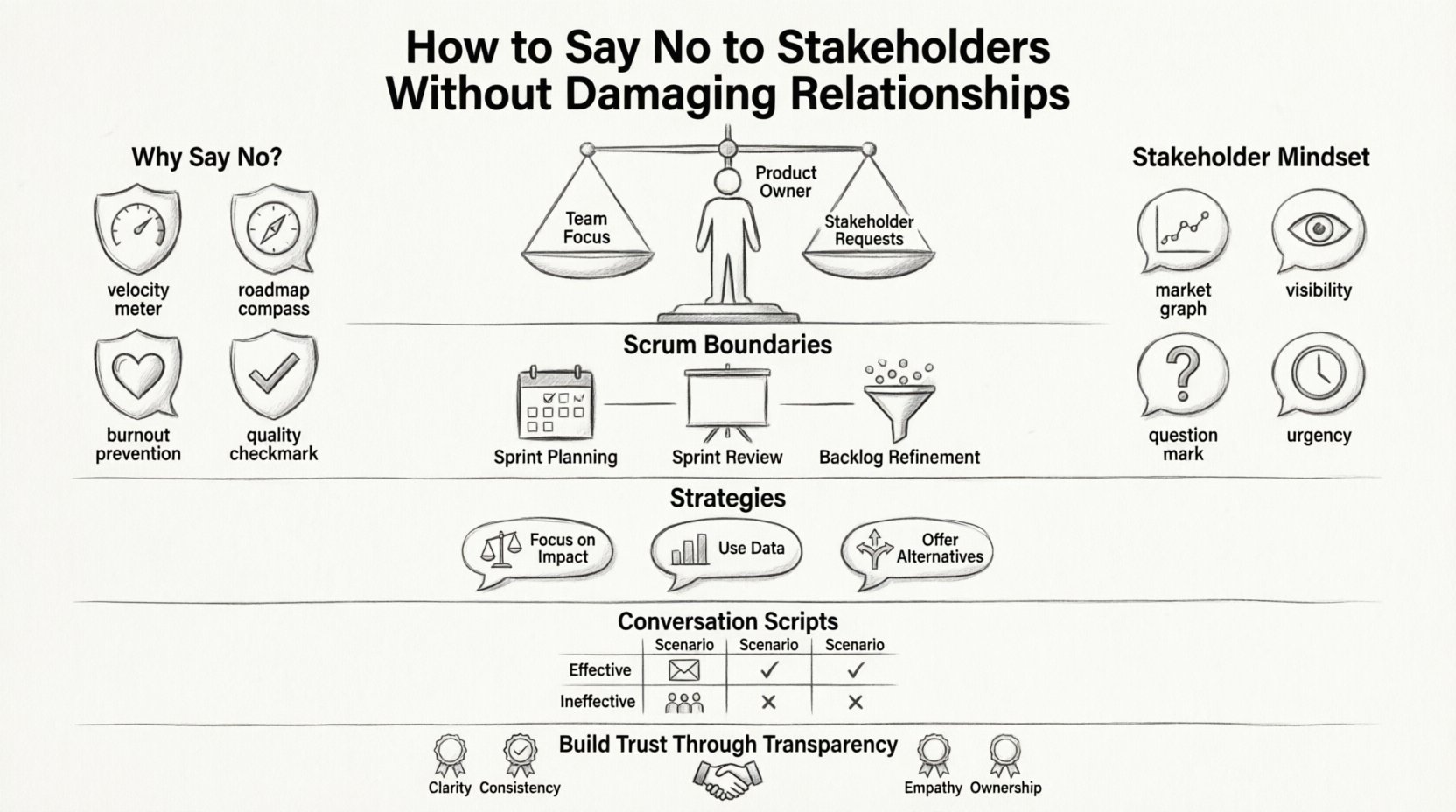
Why Saying No Is Critical for Scrum Success 🛡️
Many teams view the Product Owner as a gatekeeper. This perception creates tension. However, the Scrum Guide emphasizes the value of focus. A team working on five different priorities is less effective than a team working on one. Here is why declining requests is essential:
- Preserves Team Velocity: Context switching destroys productivity. Every new request pulls the team away from the committed Sprint Goal.
- Maintains Product Vision: A product built by committee lacks direction. The Product Owner must champion the roadmap.
- Prevents Burnout: Continuous scope expansion leads to fatigue and turnover. A sustainable pace is a requirement, not a luxury.
- Ensures Quality: Rushing to accommodate every request often sacrifices testing and design time, leading to fragile software.
Understanding the Stakeholder Mindset 🧠
To say no effectively, you must understand why stakeholders say yes to everything. They are often driven by:
- Market Pressure: Competitors are moving fast, and they fear falling behind.
- Visibility: They want to see tangible progress on their ideas immediately.
- Uncertainty: They do not fully understand the development process or the time required for implementation.
- Urgency: They perceive a problem as an emergency, even if it is not.
When a stakeholder requests a change, they are not trying to be difficult. They are trying to solve a business problem. Your role is to help them solve that problem without breaking the team’s workflow. This requires empathy, transparency, and data.
The Scrum Framework as a Boundary Tool 📐
Scrum provides specific ceremonies that serve as natural boundaries for decision-making. Using these events to manage expectations reduces the need for direct confrontation.
1. Sprint Planning
This is the primary moment to define what the team will do. Once the Sprint Backlog is selected, the Sprint Goal is set. Stakeholders should be aware that anything added after this point impacts the commitment. The team does not accept new work mid-Sprint unless the work is more urgent than the Sprint Goal itself.
2. Sprint Review
This is the place for feedback. Stakeholders can see the product increment and provide input. However, feedback here is for the next iteration, not the current one. This distinction is vital. “We can build this, but it goes into the next backlog,” is a powerful phrase.
3. Backlog Refinement
This is the collaborative space where new ideas are discussed before they become commitments. If a stakeholder brings up a new idea here, it can be evaluated for priority without derailing the current Sprint.
Strategies for Declining Requests 🗣️
When you cannot fulfill a request, how you communicate it matters more than the refusal itself. A flat “no” creates resistance. A “no, but here is the alternative” creates collaboration.
1. Focus on Impact, Not Ability
Do not say, “The team doesn’t have time.” Instead, say, “If we do this, we will have to delay X.” This shifts the decision from the team’s capability to business trade-offs. It forces the stakeholder to weigh the value of the new request against the value of the existing work.
2. Use Data to Support Your Position
Emotions are hard to argue with, but metrics are objective. Show the team’s velocity, the current Sprint Burndown, or the estimated effort required. Data depersonalizes the refusal.
3. Offer Alternatives
Never leave a stakeholder with a dead end. Offer options:
- Defer the request to the next Sprint.
- Reduce the scope of the original request to fit the capacity.
- Swap the new request with a lower-priority item already in the backlog.
Handling Mid-Sprint Interruptions 🔄
Mid-Sprint changes are the most disruptive. They occur when a stakeholder calls during a Sprint and demands immediate attention. Here is how to handle them:
- Pause the Work: Ask the stakeholder to wait for a moment to discuss.
- Assess Urgency: Is this a production outage? Or a new feature idea?
- Consult the Team: The team owns the work. They must agree to the change.
- Communicate the Cost: If the team agrees to swap the work, they must understand what is being removed from the Sprint Goal.
If the work is not critical to the business survival, it should be moved to the backlog. If it is critical, the Sprint Goal is invalidated, and the work is re-planned.
Scripts for Difficult Conversations 📝
Having prepared phrases can reduce anxiety during high-stakes meetings. Below are examples of how to phrase refusals professionally.
| Scenario | What to Avoid | What to Say Instead |
|---|---|---|
| General Request | “We can’t do that.” | “That is a great idea. To add it now, we would need to swap it with [Current Item]. Does that trade-off make sense?” |
| Mid-Sprint Change | “Not right now.” | “We are committed to the Sprint Goal. I can add this to the backlog for immediate prioritization in the next planning session.” |
| Urgent Fix | “It’s too late to fix.” | “We can address this, but it will impact our delivery date for [Feature]. Let’s review the risk together.” |
| Feature Creep | “That’s out of scope.” | “This falls outside the current roadmap. I can schedule a discussion to see if it fits the Q3 objectives instead.” |
| Deadline Pressure | “We will miss the deadline.” | “To meet this date, we need to remove [Low Priority Item]. We can proceed with that trade-off.” |
Managing Expectations Long-Term 📅
One-off conversations are not enough. You must build a system where stakeholders understand the process. This involves education and transparency.
1. Visual Management
Make the backlog and Sprint progress visible. When stakeholders can see the work queue, they understand that work is not infinite. They see the “in-flight” items and the “to-do” items. This visual context naturally discourages requests that break the flow.
2. Regular Cadence
Schedule regular syncs with key stakeholders. Instead of ad-hoc meetings, hold a bi-weekly or monthly alignment session. This creates a predictable channel for feedback. Stakeholders feel heard because they have a dedicated time to speak, rather than interrupting the team.
3. Define the Definition of Done
Ensure stakeholders agree on what “done” means. If they think a task is done when it is coded, but you consider it done when it is tested and documented, they may request “quick fixes” that are actually incomplete. Aligning on quality standards prevents scope disputes.
When to Say Yes (The Nuance) ⚖️
Saying no is not the only goal. Sometimes, you must say yes. Knowing when to bend the rules is part of the role.
- Strategic Shifts: If the market changes fundamentally, the Sprint Goal may no longer be relevant. The Product Owner must adapt.
- Customer Emergency: If a critical customer is at risk, business value overrides the process.
- Team Capacity: If the team is underutilized and the request is low risk, taking it on might be acceptable.
The key is consistency. If you say yes to everything, you lose credibility. If you say no to everything, you lose support. The balance is found in transparency.
Building Trust Through Transparency 🤝
Trust is the currency of stakeholder relationships. You build trust not by giving people what they want, but by giving them what they need to know.
- Be Honest About Risks: If a feature is risky, say so. Do not hide technical debt.
- Share the Why: When you say no, explain the reasoning. “We are delaying this because the current focus is on stability.”
- Admit Mistakes: If you overpromised and the team cannot deliver, admit it early. Do not wait for the end of the Sprint to deliver bad news.
The Role of the Scrum Master in This Process 🛠️
The Scrum Master supports the Product Owner in these interactions. They help facilitate the conversations and ensure the team is protected.
- Coach the Team: Ensure the team understands they have the right to say no to work that disrupts the Sprint.
- Coach Stakeholders: Help stakeholders understand the Scrum process and why interruptions are costly.
- Facilitate Negotiation: If a conflict arises, the Scrum Master can mediate to find a solution that respects the process.
Conclusion: Protecting Value Through Boundaries 🚀
Saying no is one of the hardest parts of being a Product Owner. It feels like rejection. But in reality, it is an act of stewardship. You are stewarding the team’s time, the product’s quality, and the business’s investment.
By using data, offering alternatives, and maintaining transparency, you can decline requests without damaging relationships. The goal is not to be a barrier, but a guide. Guide the stakeholders toward decisions that maximize value for everyone involved. When you stand firm on the process, you create a space where the team can do their best work, and where stakeholders can trust that their investment is being managed with care and precision.
Remember, a healthy product is built on a foundation of focus. Protect that focus, and the results will follow.