
Enterprise Architecture (EA) serves as the blueprint for organizational strategy and technology execution. However, a blueprint without oversight is merely a sketch. Governance and compliance form the backbone of a mature EA practice, ensuring that architectural decisions align with business objectives, regulatory requirements, and security standards. This guide explores the mechanisms required to sustain control over complex IT landscapes without stifling innovation.
Effective governance is not about restriction; it is about enabling safe progress. Compliance ensures that the organization remains within the boundaries set by laws, industry standards, and internal policies. Together, they create a framework where technology serves the business reliably and securely.
🎯 Defining Governance Structures
Governance in Enterprise Architecture refers to the decision-making framework that guides the creation and maintenance of architecture artifacts. It establishes authority, accountability, and responsibility for architectural choices. Without a defined structure, projects proceed in silos, leading to technical debt and integration failures.
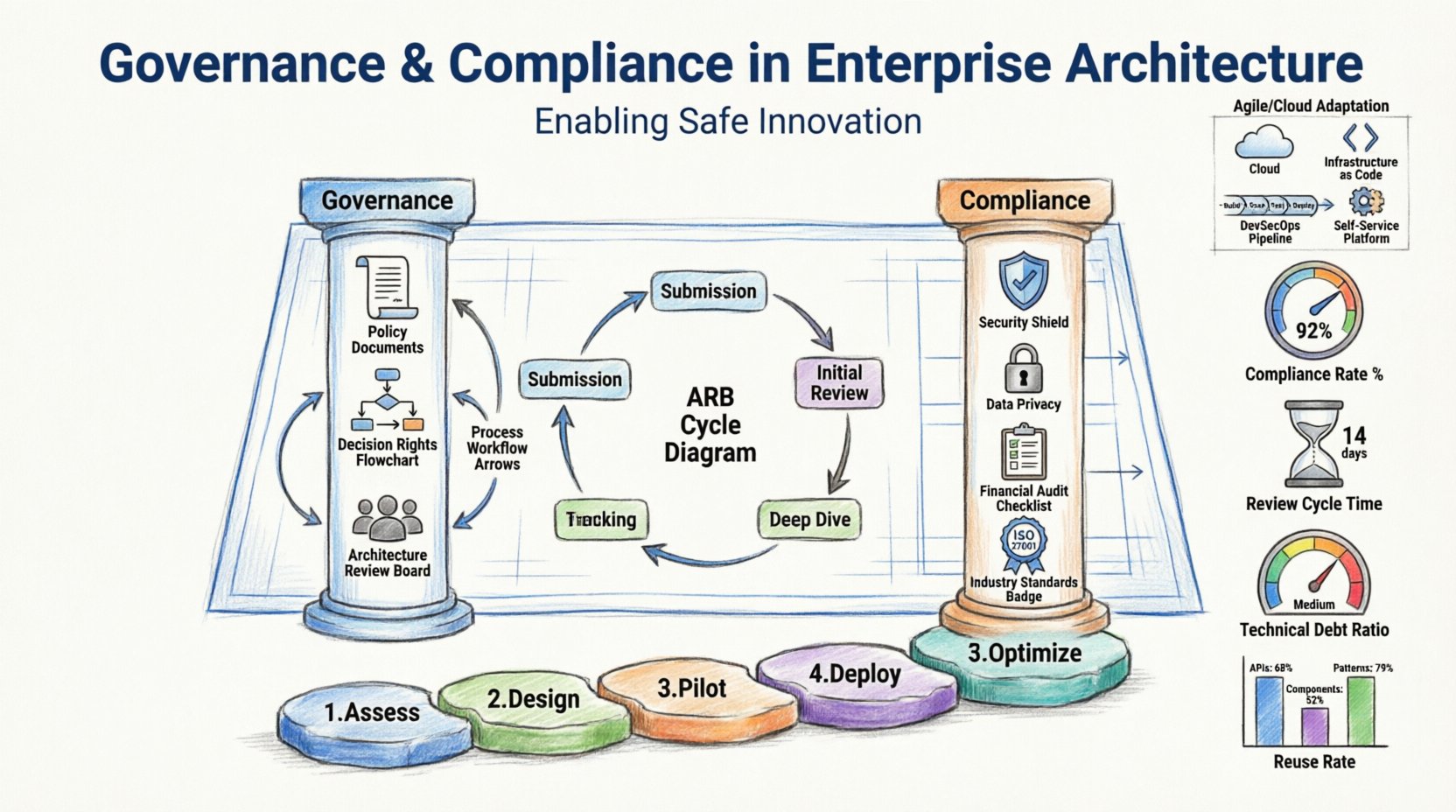
Key components of a governance structure include:
- Policy Definition: Clear statements on acceptable technologies, data handling, and security protocols.
- Decision Rights: Specification of who has the authority to approve or reject architectural changes.
- Process Flow: Defined steps for submitting, reviewing, and approving architecture artifacts.
- Roles and Responsibilities: Clear delineation of duties among architects, stakeholders, and leadership.
Organizations often establish a central governance body to oversee these functions. This body ensures consistency across departments. It prevents duplication of effort and ensures that investments in technology yield measurable value.
📜 Understanding Compliance Obligations
Compliance involves adhering to external regulations and internal policies. In the context of EA, this means designing systems that meet legal standards such as data privacy laws, financial reporting requirements, and industry-specific regulations.
Failure to comply can result in significant penalties, reputational damage, and operational disruption. Therefore, compliance must be embedded into the architecture from the initial design phase, rather than treated as an afterthought.
Common areas of compliance focus include:
- Data Privacy: Ensuring personal information is collected, stored, and processed according to regulations.
- Security Standards: Implementing controls to protect assets from unauthorized access.
- Financial Regulations: Maintaining audit trails for transactions and financial reporting.
- Industry Standards: Adhering to specific frameworks relevant to sectors like healthcare or finance.
Compliance is not static. Regulations evolve, and architectures must adapt. Continuous monitoring is essential to identify gaps between current states and required standards.
⚖️ Governance vs. Compliance
While related, governance and compliance serve distinct purposes. Governance focuses on strategy and decision-making, whereas compliance focuses on adherence and validation. Understanding the difference helps in allocating resources effectively.
| Aspect | Governance | Compliance |
|---|---|---|
| Focus | Strategic alignment and value creation | Adherence to rules and regulations |
| Goal | Optimizing performance and reducing risk | Avoiding penalties and maintaining integrity |
| Scope | Internal policies and business objectives | External laws and industry standards |
| Enforcement | Through review boards and standards | Through audits and legal requirements |
Integrating both ensures that the organization moves forward strategically while staying protected legally.
👥 The Architecture Review Board
The Architecture Review Board (ARB) is the operational engine of EA governance. It consists of senior architects, business leaders, and technical stakeholders. The ARB evaluates proposed architectures against established standards before implementation begins.
The ARB process typically follows these steps:
- Submission: Project teams submit architecture documentation and design proposals.
- Initial Review: Architects check for completeness and alignment with high-level standards.
- Deep Dive: The board analyzes risks, costs, and benefits.
- Decision: Approval, conditional approval, or rejection with feedback.
- Tracking: Monitoring implementation to ensure the approved design is followed.
For the ARB to be effective, it must remain agile. Excessive bureaucracy can slow down delivery. The board should focus on high-impact decisions that affect the broader enterprise, rather than micromanaging individual project details.
⚠️ Risk Management and Audit Trails
Risk management is integral to governance. Every architectural decision carries risk, whether related to security, cost, or availability. Identifying and mitigating these risks requires a systematic approach.
Audit trails provide the evidence needed to prove compliance and accountability. They record who made decisions, when they were made, and the rationale behind them. This is crucial for investigations and regulatory inquiries.
Key risk management practices include:
- Threat Modeling: Analyzing potential security threats during the design phase.
- Vendor Assessment: Evaluating third-party risks associated with suppliers and partners.
- Dependency Mapping: Understanding how components rely on one another to prevent cascading failures.
- Contingency Planning: Preparing for failures through disaster recovery and business continuity plans.
Documentation serves as the primary tool for audit trails. Every change to the architecture should be logged. This creates a history that allows teams to trace issues back to their source.
☁️ Adapting to Agile and Cloud Environments
Traditional governance models often struggle in fast-paced environments. Agile and cloud computing demand speed and flexibility, which can conflict with rigid oversight processes. Bridging this gap requires a shift in approach.
In Agile contexts, governance must be embedded within the workflow. Instead of a gate at the end of a project, checks occur at every sprint. This is often achieved through automated policy enforcement and continuous integration pipelines.
Cloud environments introduce shared responsibility models. The organization is responsible for the data and access, while the provider manages the infrastructure. Governance must clarify these boundaries.
Strategies for modern governance include:
- Infrastructure as Code: Using code to define infrastructure ensures consistency and allows for automated compliance checks.
- DevSecOps: Integrating security and compliance checks into the development pipeline.
- Self-Service Platforms: Providing pre-approved components that teams can use without constant approval, reducing bottlenecks.
- Real-Time Monitoring: Using tools to detect non-compliant configurations immediately.
The goal is to enable speed without sacrificing control. Governance becomes a facilitator rather than a blocker.
📊 Measuring Governance Effectiveness
To improve governance, it must be measured. Metrics provide insight into how well the framework is functioning and where adjustments are needed. Without data, governance efforts are based on assumptions.
Effective metrics should cover process efficiency, compliance status, and architectural quality.
- Compliance Rate: Percentage of projects that pass compliance checks without major deviations.
- Review Cycle Time: Average time taken to review and approve architectural proposals.
- Technical Debt Ratio: Amount of debt incurred due to deviations from standards.
- Reuse Rate: Percentage of solutions built using existing assets versus new development.
- Incident Frequency: Number of security or operational incidents linked to architectural flaws.
Regular reporting on these metrics keeps stakeholders informed. It highlights trends and allows leadership to allocate resources to areas requiring attention.
🚧 Common Pitfalls to Avoid
Implementing governance is challenging. Organizations often make mistakes that undermine their efforts. Recognizing these pitfalls early can save significant time and resources.
- Over-Engineering: Creating frameworks that are too complex for the organization to use effectively.
- Lack of Leadership Support: Without executive buy-in, governance policies are ignored.
- Static Policies: Failing to update rules as the business and technology landscape changes.
- Poor Communication: Not explaining the value of governance to project teams leads to resistance.
- Tool Dependency: Relying solely on tools without establishing the necessary human processes.
Success requires a balance. Governance must be robust enough to manage risk but flexible enough to support innovation. Continuous feedback from the teams using the architecture is vital for refining the process.
🔍 Building a Sustainable Culture
Ultimately, governance is a cultural issue. It requires everyone in the organization to understand their role in maintaining standards. Training and education play a major part in this.
Architects should act as mentors, guiding teams rather than policing them. When teams understand the “why” behind a rule, they are more likely to follow it. This shifts the dynamic from enforcement to collaboration.
Key cultural elements include:
- Transparency: Making decision-making processes visible to all stakeholders.
- Accountability: Ensuring individuals own their architectural decisions.
- Continuous Improvement: Regularly reviewing and refining governance practices.
- Shared Ownership: Viewing architecture as a collective responsibility, not just an IT function.
By fostering a culture of quality and compliance, organizations can build systems that are resilient and adaptable. This foundation supports long-term growth and stability.
🛠️ Implementation Roadmap
Starting or refining a governance program requires a structured approach. A phased implementation allows for adjustments based on feedback.
Phase 1 involves assessing the current state. Identify existing policies, gaps in compliance, and areas of high risk. This establishes a baseline.
Phase 2 focuses on designing the framework. Define roles, establish the review board, and draft initial policies. Ensure these align with business goals.
Phase 3 is the pilot. Roll out the governance model on a select set of projects. Gather data on effectiveness and friction points.
Phase 4 is full deployment. Expand the framework across the enterprise based on lessons learned from the pilot. Implement training and support mechanisms.
Phase 5 is ongoing optimization. Continuously monitor metrics and adjust the framework as needed. Governance is a journey, not a destination.
Following this roadmap ensures a methodical approach to building a robust governance and compliance structure. It minimizes disruption and maximizes value.