
In the fast-paced world of software development and product management, focus is often the scarcest resource. Teams juggle technical debt, stakeholder requests, and user feedback, often leading to a fragmented effort. Scrum provides a framework to manage this complexity, but the framework itself is only as effective as the intention behind it. At the heart of this intention lies the Sprint Goal.
A Sprint Goal is not merely a line item in a backlog or a placeholder for a list of tasks. It is the single objective that guides the Scrum Team through the Sprint. When defined clearly, it aligns the team’s efforts, empowers decision-making during the Sprint, and provides a measurable definition of success. Without it, a Sprint risks becoming a collection of disconnected tasks rather than a cohesive effort toward value delivery.
This guide explores the mechanics, importance, and execution of defining clear goals for every Scrum Sprint. We will examine the roles involved, the common pitfalls to avoid, and how to maintain focus when the unexpected arises.
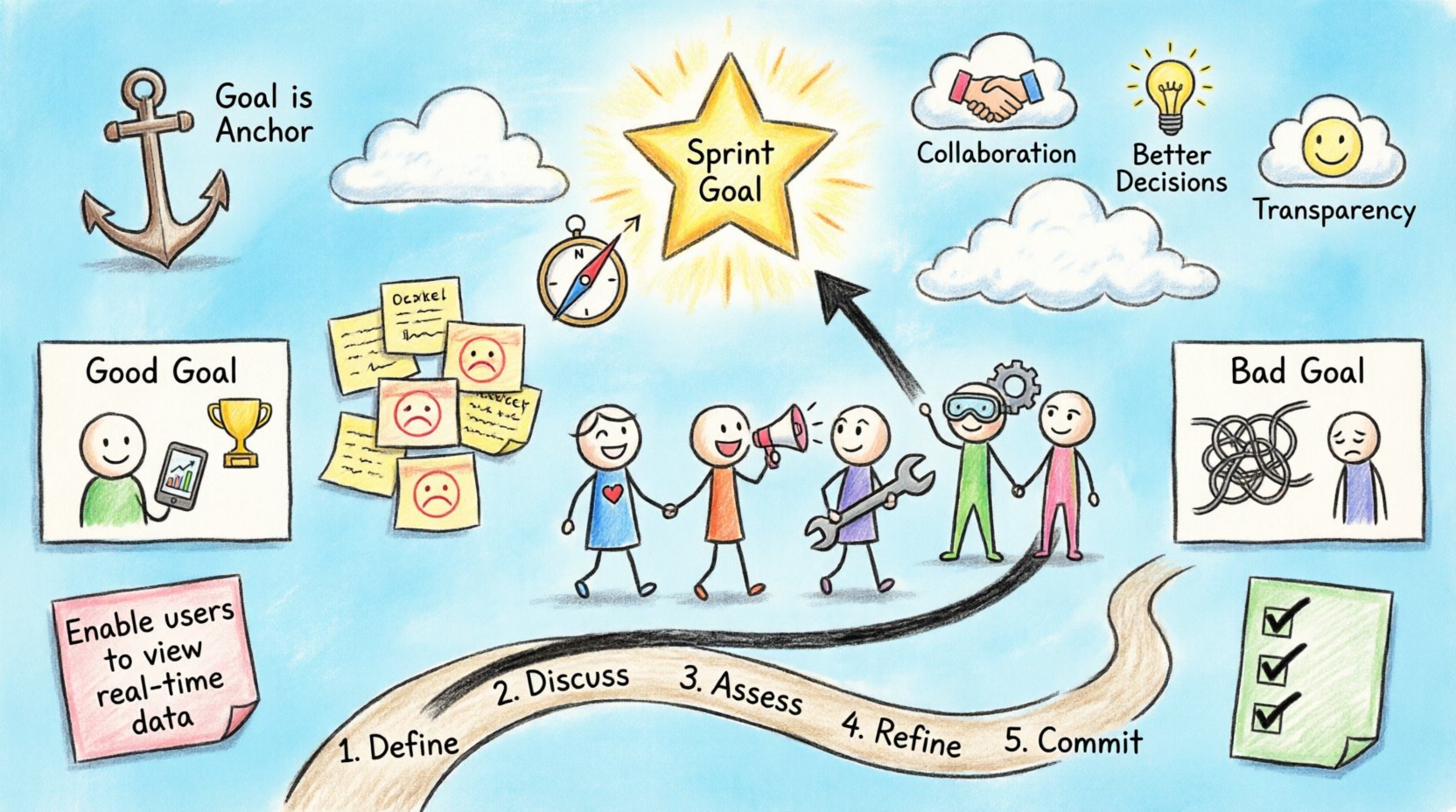
🧩 Understanding the Sprint Goal
The Scrum Guide defines the Sprint Goal as a high-level objective for the Sprint. It is established during Sprint Planning and serves as a target for the Sprint Backlog. Unlike a traditional project plan where every task is fixed, a Sprint allows flexibility in *how* the work is done, provided the Goal is met.
- It is a commitment: The Developers commit to achieving the Goal, not just completing a specific list of items.
- It is flexible: If the work changes, the plan changes, but the Goal remains the constant.
- It is valuable: The Goal should represent a step toward the Product Goal, delivering tangible value to the customer.
Consider the Sprint Goal as the North Star. If the team gets lost in the weeds of technical implementation or scope creep, the Goal helps them reorient. It answers the question: “What are we trying to achieve in these two weeks?” rather than “What tickets are we closing?”
🚀 Why Sprint Goals Drive Value
Many teams struggle with productivity not because they work too slowly, but because they work on too many things at once. A clear Sprint Goal acts as a filter. It allows the team to say “no” to distractions that do not contribute to the objective. This focus yields several tangible benefits:
- Enhanced Collaboration: When everyone knows the target, cross-functional cooperation increases. Developers, testers, and designers understand how their pieces fit into the larger picture.
- Better Decision Making: When priorities shift mid-Sprint, the team can evaluate options based on whether they still lead to the Goal. This reduces the need for management intervention.
- Improved Morale: Completing a coherent objective feels more rewarding than checking off a random list of tasks. It provides a sense of accomplishment.
- Transparency for Stakeholders: Stakeholders understand what value they will receive by the end of the Sprint, reducing the anxiety of “black box” development.
Without a goal, a Sprint is often defined by the capacity of the team to absorb work. With a goal, a Sprint is defined by the value the team intends to create.
🛠️ Crafting Effective Goals
Writing a Sprint Goal is a collaborative exercise. It requires input from the Product Owner (who knows the value) and the Developers (who know the feasibility). The goal should be specific enough to be meaningful but broad enough to allow the team to adapt their approach.
1. Focus on Outcomes, Not Outputs
Avoid goals that read like a task list. Instead of saying “Build the login page,” frame it around the user experience or the capability enabled.
- Weak: “Complete the API integration for the dashboard.”
- Strong: “Enable users to view real-time data on their dashboard.”
The strong version allows the team to decide the best technical path (API, mock data, caching) to achieve the user experience, whereas the weak version locks them into a specific technical solution.
2. Keep it Concise
A Sprint Goal should fit on a single slide or a sticky note. If it requires a paragraph to explain, it is likely too complex. Complexity introduces ambiguity. Ambiguity leads to misalignment.
3. Ensure It is Testable
By the end of the Sprint, the team must be able to look at the increment and say, “Yes, the Goal is met.” This means the Goal must be tied to a potentially shippable increment of value.
4. Align with the Product Goal
Every Sprint Goal should contribute to the broader Product Goal. This ensures that the team is not working in silos. If a Sprint Goal does not move the Product forward, it may be better to question its necessity.
👥 Roles and Responsibilities
Defining a Sprint Goal is not the sole responsibility of one role. It is a shared ownership that requires interaction between the Product Owner and the Scrum Team.
| Role | Responsibility in Sprint Goal Creation | Responsibility During Sprint |
|---|---|---|
| Product Owner | Proposes the Goal based on stakeholder needs and Product Backlog priorities. Ensures the Goal delivers value. | Clarifies the Goal if questions arise. Protects the Goal from scope creep that does not add value. |
| Scrum Master | Facilitates the discussion to ensure the Goal is understood and feasible. Removes impediments to the planning process. | Coaches the team on maintaining focus. Helps resolve conflicts if the Goal is at risk. |
| Developers | Estimates feasibility. Provides technical insight on how the Goal can be achieved. Commits to the Goal. | Self-manages the work to achieve the Goal. Adapts the plan as needed while keeping the Goal in mind. |
The Negotiation Phase
The most critical moment for the Sprint Goal is during Sprint Planning. This is a negotiation, not a directive. The Product Owner presents the “Why” and the “What.” The Developers present the “How” and the “When.” If the Developers feel the Goal is impossible given the current capacity, they must communicate this early. A goal that is set but immediately known to be unachievable destroys trust.
It is acceptable to adjust the scope of the Sprint Backlog to ensure the Goal is met. If a specific User Story is no longer necessary to achieve the Goal, it can be removed from the Sprint Backlog. This flexibility is a key advantage of Scrum over Waterfall methodologies.
📅 Sprint Planning Workshop Structure
To ensure the Sprint Goal is defined effectively, the Sprint Planning event should be structured to prioritize this discussion. It should not begin immediately with task breakdown.
- Define the Objective: The Product Owner presents the top items from the Product Backlog.
- Discuss the Goal: The team discusses what value these items provide. Together, they draft a potential Sprint Goal.
- Assess Feasibility: The Developers review their capacity and the complexity of the work. They ask: “Can we achieve this goal with the available time?”
- Refine the Goal: If the scope is too large, the Product Owner and Developers negotiate down to a achievable target.
- Commit: Once the Goal is clear and the plan is solid, the team commits to it.
This sequence ensures that the Goal drives the plan, rather than the plan driving the Goal.
⚠️ Handling Obstacles & Changes
Even with the best planning, disruptions occur. New bugs are found, critical stakeholders change requirements, or technical challenges arise. How does a team handle this without abandoning the Sprint?
The Goal is the Anchor
When obstacles arise, the team should refer back to the Sprint Goal. If a new urgent task appears, does it help achieve the Goal? If not, it should be deferred to the next Sprint. If it does help, the team must assess if the original Goal can still be met or if the Goal itself needs to be revised.
Revising the Goal
Can a Sprint Goal be changed mid-Sprint? Technically, yes, but it should be rare. If the Goal is no longer viable due to external factors, the Product Owner may cancel the Sprint. This is a drastic measure and should be avoided. Usually, the team should adapt their approach within the existing Goal.
For example, if the Goal is “Improve page load speed,” and the team discovers a database bottleneck, they might pivot from optimizing CSS to indexing the database. The Goal remains the same, but the work changes.
🔄 Reviewing & Retrospecting
The Sprint Goal is evaluated in two key ceremonies: the Sprint Review and the Sprint Retrospective.
Sprint Review
The primary purpose of the Review is to inspect the Increment. The team demonstrates the work against the Sprint Goal. Stakeholders provide feedback. If the Goal is met, the Increment is potentially shippable. If the Goal is not met, the team must explain why and discuss how to address the gap in the next Sprint.
Sprint Retrospective
Here, the team reflects on the process. Did the Goal help the team focus? Was the Goal realistic? Did the team understand it? If the Goal was vague, the team might agree to spend more time refining goals in the next planning session. If the Goal was too ambitious, they might adjust their velocity estimation.
❌ Common Mistakes to Avoid
Teams often struggle with Sprint Goals due to recurring habits. Identifying these patterns helps in self-correction.
- Too Many Goals: Some teams try to have a goal for every feature. A Sprint should have one clear Goal. Multiple goals dilute focus.
- Too Technical: “Refactor the payment module” is not a good Goal. It is a technical activity. The Goal should be “Enable users to pay via credit card securely.” This focuses on the business value.
- Ignoring the Team: If the Product Owner dictates the Goal without consulting the Developers, the team may lack ownership. Ownership is essential for commitment.
- Static Goals: Treating the Goal as a rigid contract. The Goal should guide the team, not strangle them. If the market changes, the Goal should be re-evaluated.
- Forgetting the Increment: A Goal without an Increment is just a wish. Ensure the work results in a usable piece of the product.
📝 Example Scenarios
Let us look at how Sprint Goals vary across different contexts to illustrate the principle.
Scenario 1: New Feature Launch
- Context: The team is working on a mobile app.
- Bad Goal: “Create screens for the checkout flow.”
- Good Goal: “Allow users to complete a purchase within three taps.”
The good goal allows the team to decide whether to use a modal, a new page, or a bottom sheet, as long as the three-tap constraint is met.
Scenario 2: Technical Debt Reduction
- Context: The system is experiencing slow load times.
- Bad Goal: “Update the database schema.”
- Good Goal: “Reduce average API response time by 50%.”
The good goal focuses on the performance outcome. The team can choose to cache data, optimize queries, or upgrade infrastructure to achieve this.
Scenario 3: User Experience Improvement
- Context: Users are dropping off at the sign-up screen.
- Bad Goal: “Fix the validation error on the email field.”
- Good Goal: “Increase sign-up completion rate by removing friction.”
The good goal invites investigation into why users drop off. It might be the validation error, but it might also be a confusing password requirement or a lack of social login.
✅ A Practical Checklist for Sprint Goals
Before finalizing a Sprint Goal, run it through this checklist to ensure clarity and viability.
- Is the Goal concise and easy to understand?
- Does it represent value to the customer or user?
- Is it achievable within the Sprint timeframe?
- Does it align with the Product Goal?
- Can we measure if the Goal has been met at the end of the Sprint?
- Is it agreed upon by the Product Owner and the Developers?
- Does it allow the team flexibility in how they work?
- Are there any dependencies that could block the Goal?
🔍 Measuring Success
How do you know if your Sprint Goals are working? Success is not just about completing tasks; it is about the quality of the collaboration and the value delivered.
Track the following metrics over time:
- Goal Completion Rate: What percentage of Sprints actually achieve their Goal? If it is consistently low, the planning process needs adjustment.
- Focus Time: Are team members spending time on tasks unrelated to the Goal? Low distraction indicates good focus.
- Stakeholder Satisfaction: Do stakeholders feel they understand what is being delivered? Clear goals improve communication.
- Team Velocity: Does velocity stabilize? Clear goals often lead to more predictable delivery.
Remember, these metrics are for inspection, not for judgment. They are tools to help the team improve, not to punish them for missing a target.
🌟 Conclusion
Defining clear goals for every Scrum Sprint is a foundational practice for high-performing Agile teams. It transforms a Sprint from a to-do list into a mission. It empowers the team to make autonomous decisions, reduces the noise of unnecessary work, and ensures that every effort contributes to the Product Goal.
Implementing this practice requires discipline. It requires the Product Owner to articulate value clearly and the Developers to be honest about capacity. It requires the Scrum Master to facilitate the conversation without dictating the outcome. When done well, the Sprint Goal becomes the heartbeat of the Sprint, pulsing with purpose and direction.
Start small. Pick one Sprint and commit to a single, clear Goal. Review how it felt. Did it help? Did it clarify priorities? Iterate on the process. Over time, this discipline will become second nature, leading to more predictable delivery and higher quality outcomes.
The path to Agile maturity is paved with clear intentions. Ensure your Sprint Goals are the compass that guides your journey.