
In the fast-paced world of software development and product management, the tension between long-term vision and short-term execution is constant. Many teams struggle to maintain a coherent direction while remaining responsive to the inevitable shifts that occur during iterative development. A rigid plan often breaks under the weight of new information, user feedback, or technical discovery. This is where the concept of an adaptive product roadmap becomes essential.
This guide explores how to construct a roadmap that serves as a strategic compass rather than a fixed contract. By integrating Scrum principles with strategic planning, you can ensure your team delivers value consistently without losing sight of the broader mission. We will examine the mechanics of flexible planning, stakeholder communication, and the structural elements required to sustain agility over time.
Why Static Roadmaps Fail in Agile Environments 📉
Traditional project management often relies on waterfall methodologies where requirements are defined upfront, and the timeline is fixed. In a Scrum environment, this approach creates significant friction. Scrum is built on empiricism, which means progress is based on observation and experimentation rather than prediction. When you lock a roadmap into specific dates and features months in advance, you are making predictions that the market and the technology will not honor.
Here are the common reasons why static plans lead to failure in iterative cycles:
- Predictive Fallacy: Assuming that requirements discovered today will remain relevant six months from now is rarely accurate in complex product development.
- Stakeholder Disappointment: When features are delivered later than a fixed date, trust erodes, even if the quality is high.
- Team Frustration: Developers often feel constrained when forced to deliver specific outputs by a date rather than focusing on solving problems.
- Opportunity Cost: A rigid roadmap prevents the team from pivoting to address higher-value opportunities that emerge mid-cycle.
An adaptive roadmap acknowledges that uncertainty is a fundamental part of the process. It shifts the focus from “what date will this be done?” to “what value will we deliver in this timebox?”.
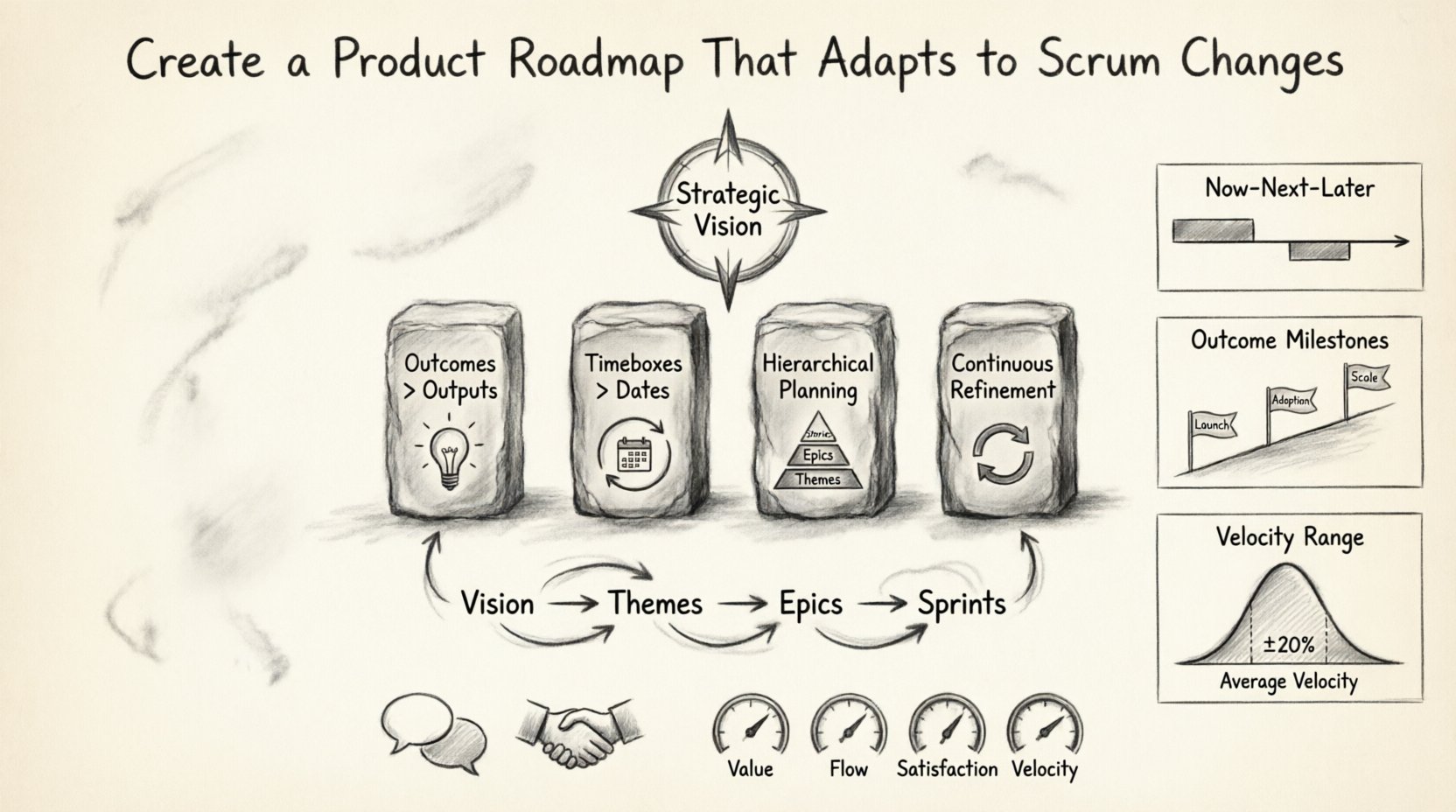
Core Principles of an Adaptive Roadmap 🧱
To build a plan that withstands change, you must establish foundational principles. These principles guide decision-making when conflicts arise between the plan and reality. They ensure that every adjustment maintains alignment with the product vision.
1. Focus on Outcomes, Not Outputs
Instead of committing to a specific feature list, commit to the problem you are solving. For example, rather than promising “Build a dark mode toggle,” promise “Improve user experience in low-light environments.” This allows the team to choose the best technical approach to achieve the outcome without being locked into a specific implementation detail.
2. Timeboxes Over Dates
Scrum relies on fixed iterations. The roadmap should reflect this by using timeboxes (e.g., “Q3 2024” or “Next 3 Sprints”) rather than specific calendar dates for features. This acknowledges that velocity varies and scope fluctuates.
3. Hierarchical Planning
Break down the roadmap into layers of abstraction. High-level themes sit at the top, epics in the middle, and user stories at the bottom. As you move closer to execution, the detail increases. As you move further away, the detail decreases.
4. Continuous Refinement
A roadmap is not a document to be written once and filed. It is a living artifact that requires regular review. Stakeholders and the Product Owner must revisit the plan frequently to ensure it reflects current priorities.
Step-by-Step Guide to Building a Flexible Plan 📝
Constructing a roadmap that adapts requires a specific process. This process moves from broad strategy to actionable backlog items. Following these steps ensures that the plan remains useful without becoming obsolete.
Step 1: Define the Vision and North Star
Before detailing features, articulate the long-term goal. What does success look like one year from now? This vision acts as the filter for all subsequent decisions. Every item added to the roadmap must contribute to this vision.
- Identify the core user problem.
- Define the market opportunity.
- Set measurable success criteria.
Step 2: Group Initiatives into Themes
Organize work into thematic buckets. Themes represent strategic goals rather than specific tasks. This grouping helps stakeholders understand the “why” behind the work.
| Theme | Strategic Goal | Example Metrics |
|---|---|---|
| Performance Optimization | Reduce load times to improve retention | Page load speed, Bounce rate |
| Onboarding Experience | Reduce time-to-value for new users | Activation rate, Churn |
| Mobile Expansion | Reach users on iOS and Android | Mobile traffic, App store rating |
Step 3: Estimate Epics and Rough Order of Magnitude
Break themes down into epics. Use rough estimates to understand the effort required. Do not commit to exact story points yet. Use relative sizing to understand the magnitude of the work relative to other work.
Step 4: Align with Sprint Cadence
Map the epics to potential sprint cycles. This helps in resource planning and capacity forecasting. However, treat these mappings as hypotheses, not promises. If a sprint is disrupted, the roadmap adjusts accordingly.
Managing Change Requests Within Sprints 🔁
Change is inevitable. A stakeholder may request a new feature, or a critical bug may emerge. In a traditional model, this disrupts the schedule. In an adaptive Scrum model, this is part of the workflow. Managing these changes requires clear protocols.
Integrating Change into the Backlog
All changes must enter the Product Backlog. They should be evaluated based on value and priority, not urgency alone. The Product Owner is responsible for ordering the backlog to reflect the current highest value.
- Impact Assessment: Does this change align with the current theme?
- Cost-Benefit Analysis: What must be removed to make space for this new item?
- Stakeholder Buy-in: Ensure all parties understand the trade-off involved.
Respecting the Sprint Goal
Once a sprint begins, the scope should remain stable. Introducing changes mid-sprint disrupts focus and can lead to unfinished work. If a change is critical, it should be discussed at the start of the next sprint planning session. Exceptions are made only for production-critical issues.
Backlog Refinement as a Control Valve
Regular refinement sessions allow the team to discuss upcoming work. This is the ideal time to discuss potential roadmap changes. By preparing items in advance, the team can absorb changes more smoothly during planning.
Visualizing Progress Without Locking In Dates 📅
Visualizing the roadmap is crucial for communication, but it should not imply certainty where none exists. Avoid Gantt charts that show precise start and end dates for features. Instead, use visual representations that highlight progress and uncertainty.
Option 1: The Now-Next-Later Model
This model divides the roadmap into three time horizons:
- Now: Work currently in progress. High certainty.
- Next: Work ready to be started. Medium certainty.
- Later: Ideas and concepts. Low certainty.
This visualizes the flow of work without committing to specific delivery dates for the “Later” section.
Option 2: Outcome-Based Roadmaps
Focus the visualization on the goals achieved rather than the features shipped. Use a timeline that marks milestones such as “Beta Launch” or “User Base Doubled.” This allows the team to adjust the features required to reach those milestones without changing the timeline of the milestone itself.
Option 3: Velocity-Based Forecasting
Use historical velocity data to create a probabilistic forecast. Show ranges (e.g., “Q3: 40-50 story points”) rather than single numbers. This communicates the variability inherent in development work.
Communication Strategies for Stakeholders 💬
One of the biggest challenges with adaptive roadmaps is managing expectations. Stakeholders often equate a roadmap with a guarantee. Clear communication strategies are necessary to bridge this gap.
Educate on the Process
Take time to explain why the roadmap is flexible. Share data on how market conditions or technical discoveries influence the plan. When stakeholders understand the value of adaptability, they are more likely to support changes.
Regular Check-Ins
Schedule recurring meetings to review the roadmap. Monthly or quarterly reviews allow for course corrections without surprising stakeholders. Use these sessions to highlight wins and explain delays transparently.
Transparency on Trade-offs
When a change is requested, explicitly state what will be deprioritized. This reinforces the concept of finite capacity. It shifts the conversation from “Can we do this?” to “What should we swap to do this?”.
Common Pitfalls and How to Avoid Them ⚠️
Even with the best intentions, teams often fall into traps that undermine an adaptive roadmap. Recognizing these pitfalls early can save significant time and effort.
- Micromanaging the Backlog: If the Product Owner tries to plan every story for the next quarter, the team loses autonomy. Trust the team to plan their own sprint work.
- Ignoring Technical Debt: A roadmap focused solely on new features will eventually stall. Allocate capacity for maintenance and refactoring to ensure long-term velocity.
- Over-Prioritizing: If everything is a priority, nothing is. Ensure the backlog contains a clear distinction between high and low value items.
- Under-Communicating: Silence creates uncertainty. If the roadmap changes, communicate it immediately. Do not wait for the next scheduled meeting.
Metrics That Matter for Roadmap Health 📊
To know if your adaptive roadmap is working, you need to measure the right things. Traditional metrics like “On-Time Delivery” can be misleading in an agile context. Focus on value and flow.
Value Delivered
Measure the impact of the work on business goals. Did the feature increase retention? Did it reduce support tickets? This aligns the roadmap with actual outcomes.
Flow Efficiency
Track how quickly work moves through the system. High flow efficiency indicates that the team is not blocked and that the roadmap is realistic enough to be executed smoothly.
Stakeholder Satisfaction
Regularly survey stakeholders on their confidence in the plan and their satisfaction with the transparency. If confidence is low, the communication strategy may need adjustment.
Velocity Stability
Monitor the team’s velocity over time. Significant fluctuations may indicate that the roadmap is too ambitious or that scope creep is occurring. Stabilizing velocity allows for better forecasting.
Final Thoughts on Agile Planning 🏁
Creating a product roadmap that adapts to Scrum changes is not about abandoning planning. It is about refining how we plan. It requires a shift from prediction to preparation. By focusing on outcomes, maintaining clear communication, and respecting the limits of the sprint cycle, you build a plan that supports rather than hinders your team.
The goal is not to eliminate change, but to manage it effectively. When your roadmap breathes with the rhythm of your sprints, it becomes a tool for empowerment rather than a source of pressure. This approach ensures that your product remains relevant, your team remains focused, and your stakeholders remain informed.
Start by reviewing your current planning process. Identify where rigidity exists and introduce small changes to increase flexibility. Over time, these adjustments will compound, leading to a more resilient and responsive product development lifecycle.