
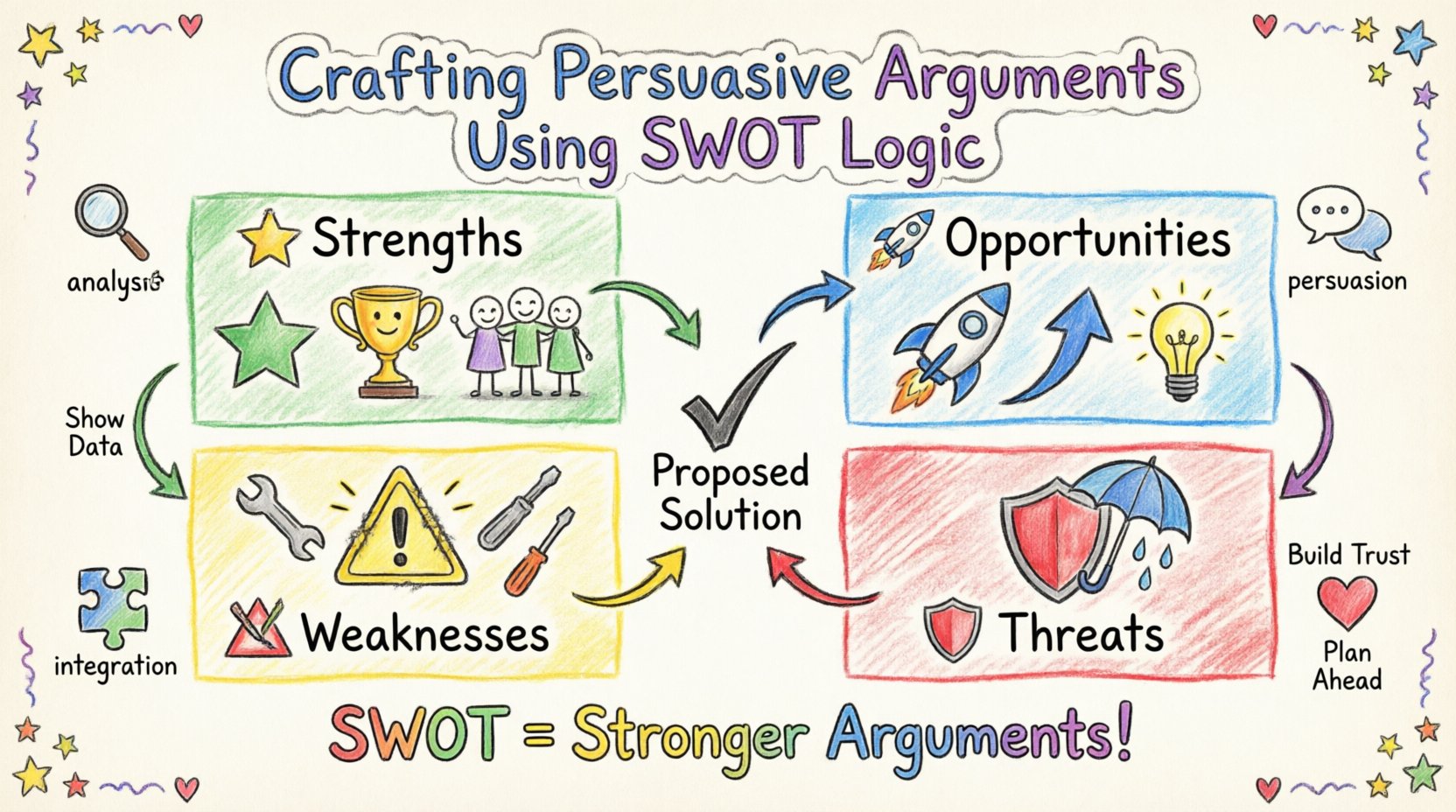
In the landscape of business and strategy, making a case for a new initiative often requires more than just intuition. It demands a structured approach that balances optimism with realism. This is where the SWOT framework becomes a powerful tool for argumentation. While often used for strategic planning, the logic behind Strengths, Weaknesses, Opportunities, and Threats provides a compelling narrative structure for persuasion. By leveraging this model, you can construct arguments that are robust, defensible, and difficult to refute. This guide explores how to utilize SWOT logic to enhance your decision-making processes and influence stakeholders effectively. 📊
Why SWOT Works for Persuasion 🎯
Standard arguments often fail because they lack depth or ignore potential risks. They might focus solely on the benefits without acknowledging the hurdles. A persuasive argument must anticipate counterarguments before they are voiced. SWOT analysis naturally addresses these gaps by categorizing internal and external factors. This structure forces clarity and honesty in your presentation.
Here are the core reasons why applying SWOT logic strengthens your position:
- Comprehensive View: It ensures you consider both internal capabilities and external market conditions.
- Risk Mitigation: By identifying Weaknesses and Threats upfront, you show preparedness rather than naivety.
- Logical Flow: The framework provides a natural progression from current state to future potential.
- Objective Tone: It shifts the conversation from opinion to data-driven analysis.
- Stakeholder Trust: Acknowledging downsides builds credibility with decision-makers.
When you present a case using this structure, you are not just selling an idea; you are demonstrating that you have thought through the entire ecosystem surrounding the proposal.
Breaking Down the SWOT Components for Arguments 🧩
To use SWOT effectively for persuasion, each quadrant must be translated into a specific argumentative point. It is not enough to list factors; you must connect them to the desired outcome. Below is a detailed breakdown of how to frame each component.
1. Strengths: Internal Validation 💪
Strengths are the internal assets that give you the advantage. In a persuasive context, these serve as the foundation of your confidence. You are establishing that you have the capacity to execute the plan.
- Focus on Resources: Highlight team expertise, proprietary technology, or established relationships.
- Proven Track Record: Cite historical data where similar initiatives succeeded.
- Competitive Edge: Explain what you possess that others do not.
When arguing for a budget increase, for example, your strengths might include a high-performing sales team or a loyal customer base that guarantees immediate ROI.
2. Weaknesses: Acknowledging Gaps 📉
This is the most counterintuitive part of persuasion. Admitting weaknesses does not weaken your argument; it fortifies it. It signals that you are realistic and have a plan to manage limitations.
- Identify Constraints: Be transparent about current bottlenecks or skill gaps.
- Propose Solutions: Pair every weakness with a mitigation strategy.
- Build Trust: Stakeholders appreciate honesty over sugar-coated reports.
For instance, if proposing a new software implementation, admitting that the current team lacks coding experience allows you to argue for training funds as a necessary investment rather than an optional expense.
3. Opportunities: External Potential 🚀
Opportunities represent the favorable conditions in the environment that you can exploit. This is where you paint the picture of the future if your argument is accepted.
- Market Trends: Align your proposal with growing industry demands.
- Competitor Actions: Highlight gaps left by competitors that you can fill.
- Technological Shifts: Leverage new tools or regulations that benefit your case.
Use this section to create urgency. If the market is shifting, and your proposal addresses that shift, the cost of inaction becomes clear.
4. Threats: External Risks 🛡️
Threats are external challenges that could hinder success. Addressing these demonstrates that you understand the risks involved and are ready to navigate them.
- Economic Factors: Acknowledge potential recessions or inflation.
- Regulatory Changes: Consider new laws or compliance requirements.
- Competitive Moves: Anticipate how rivals might react to your success.
By outlining threats, you position your proposal as a shield against future instability, rather than just a path to growth.
Structuring the Argument Flow 📝
Once you have gathered your points, the arrangement matters. A disorganized presentation can dilute even the strongest logic. Use the following structure to guide your audience through your reasoning.
Phase 1: The Current State (Strengths & Weaknesses)
Begin by grounding the audience in reality. Describe the internal situation using the Strengths and Weaknesses quadrants. This establishes the baseline. It answers the question, “Where are we now?”
- State what you do well.
- State what limits your current performance.
- Transition to the need for change based on these limitations.
Phase 2: The Future Landscape (Opportunities & Threats)
Next, expand the view outward. Discuss the Opportunities and Threats. This answers the question, “What is happening around us?” This section justifies why the current state cannot remain unchanged.
- Highlight the window of opportunity.
- Warn of the consequences of ignoring threats.
- Connect external factors to internal needs.
Phase 3: The Proposed Solution
Finally, present your specific recommendation. This is the logical conclusion of the previous sections. It is not a leap of faith; it is a calculated response to the SWOT analysis.
- Explain how the solution leverages Strengths.
- Explain how the solution addresses Weaknesses.
- Explain how the solution captures Opportunities.
- Explain how the solution mitigates Threats.
Practical Frameworks for Application 🛠️
To make the SWOT logic actionable, consider using specific frameworks that organize your thoughts. The following table illustrates how to map SWOT factors directly to argumentative outcomes.
| SWOT Quadrant | Question to Ask | Argumentative Goal |
|---|---|---|
| Strengths | What do we own that helps us win? | Establish Capability and Readiness |
| Weaknesses | What holds us back internally? | Identify Necessity for Investment |
| Opportunities | What can we gain externally? | Create Urgency and Vision |
| Threats | What could stop us from succeeding? | Justify Risk Management |
This matrix helps you ensure that every part of your argument serves a distinct purpose. It prevents you from listing random facts and forces you to focus on how each fact supports the final decision.
Common Pitfalls to Avoid ⚠️
Even with a solid framework, there are common mistakes that can undermine your persuasive efforts. Being aware of these helps you refine your approach.
- Generic Statements: Avoid vague points like “We need to improve.” Be specific, such as “Response time must decrease by 15%.”
- Ignoring Weaknesses: Hiding internal flaws destroys credibility. If stakeholders sense you are hiding something, they will question the Opportunities.
- Overemphasizing Threats: While risk is important, dwelling too much on threats can induce fear rather than action. Balance the negative with the positive potential.
- Disconnected Logic: Ensure the solution directly addresses the points raised in the SWOT. If you list a weakness in the analysis but your proposal does not fix it, the argument falls apart.
- Static Analysis: SWOT is a snapshot. Ensure you mention that conditions change and the plan remains adaptable.
Real-World Scenarios 🌍
To understand the versatility of SWOT logic, consider how it applies to different business scenarios.
Scenario A: Budget Approval
When requesting funds for a new department, use the analysis to justify the cost.
- Strength: Existing client demand is outpacing current support.
- Weakness: Current staff is overworked, leading to burnout risks.
- Opportunity: Hiring allows us to capture untapped market segments.
- Threat: Competitors are poaching clients due to slow response times.
- Argument: The investment is required to maintain service levels and secure future revenue.
Scenario B: Product Launch
When proposing a new product line, focus on market fit.
- Strength: We have a loyal customer base that trusts our brand.
- Weakness: We lack a dedicated marketing channel for this niche.
- Opportunity: A competitor recently exited this market segment.
- Threat: Supply chain volatility could delay launch.
- Argument: We should launch now to seize the exit, while securing backup suppliers to manage risk.
Scenario C: Policy Change
When advocating for internal process changes, focus on efficiency.
- Strength: The team is skilled in manual data entry.
- Weakness: Manual entry is prone to human error.
- Opportunity: Automation tools can reduce costs by 20%.
- Threat: Data breaches increase with manual handling.
- Argument: Automating the process improves accuracy, saves money, and enhances security.
Refining Your Logic for Impact 🔍
After drafting your argument, review it against the SWOT logic. Does every point serve the conclusion? Is the tone balanced? Here are final tips to sharpen your message.
- Use Data: Support every claim with metrics. Numbers validate the SWOT categories.
- Visualize: Use diagrams to show the relationship between the quadrants. Visuals help audiences grasp complex logic quickly.
- Practice Delivery: Rehearse the flow. If you stumble on the transition from Weakness to Opportunity, the audience will lose confidence.
- Anticipate Questions: Prepare answers for the most likely challenges to your SWOT analysis. This shows thorough preparation.
Persuasion is not about winning a debate; it is about guiding a decision. By using SWOT logic, you provide the structure necessary for stakeholders to make informed choices. You transform your argument from a simple request into a strategic roadmap.
Summary of Key Takeaways 📌
- Structure Matters: Organize your argument using the four quadrants for clarity.
- Honesty Builds Trust: Admitting weaknesses makes your strengths more believable.
- Connect to Outcomes: Ensure every SWOT point links back to the proposed action.
- Balance Risk and Reward: Weigh Opportunities against Threats to show realistic planning.
- Adaptability: Keep the analysis dynamic as external conditions change.
By integrating this logical framework into your communication style, you elevate the quality of your contributions. You become a partner in strategy rather than just a participant in meetings. This approach ensures that your ideas are not just heard, but understood and acted upon. 🏆