
Transitioning from high-level business needs to concrete development tasks is a fundamental skill in Agile environments. Without this translation, teams often work on solutions that do not address the actual problem. The Product Backlog serves as the single source of truth for what needs to be built. It is not merely a to-do list; it is a dynamic artifact that evolves with market feedback and stakeholder insight.
This guide explores the methodology of converting raw business requirements into structured Product Backlog Items (PBIs). By following a disciplined approach, teams ensure alignment, clarity, and value delivery. We will examine the lifecycle of a requirement, from initial capture to refined acceptance criteria.
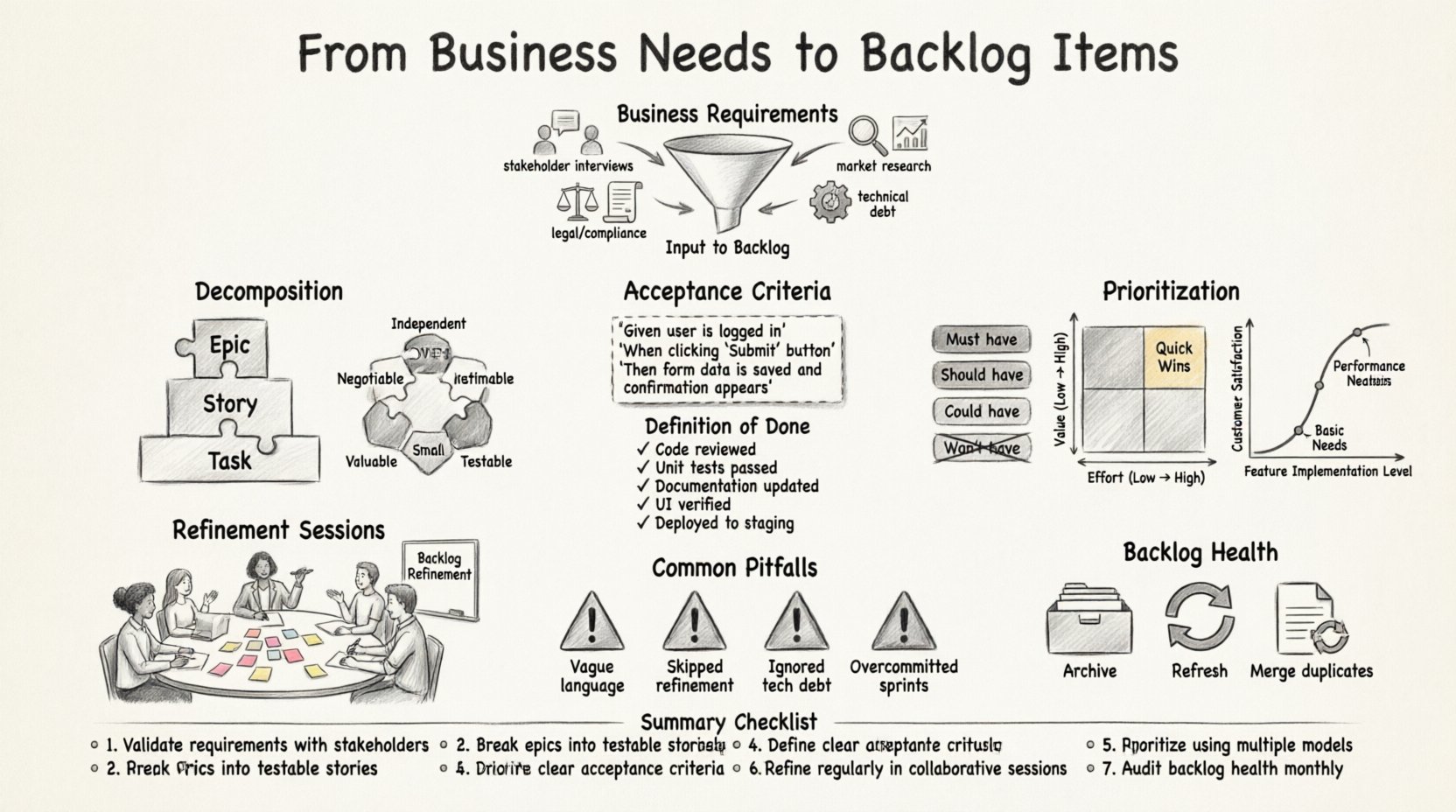
📋 The Foundation: Understanding Business Requirements
Before a single backlog item can be written, the underlying business requirement must be understood. These requirements originate from various sources, including customer feedback, regulatory changes, market analysis, or internal strategic goals.
Key Sources of Requirements:
- Stakeholder Interviews: Direct conversations with those who have a vested interest in the outcome.
- Market Research: Data regarding competitor features or industry trends.
- Legal and Compliance: Mandatory changes required by law or regulation.
- Technical Debt: Internal needs to refactor code or improve infrastructure.
It is critical to distinguish between the problem and the proposed solution. A business requirement often states the problem. For example, “Users are abandoning the checkout process.” The solution (e.g., “Add a one-click pay button”) is what eventually becomes the backlog item. Keeping the problem statement visible ensures the team solves the right issue.
🔨 Decomposing Requirements into Actionable Items
Raw requirements are rarely small enough to be completed in a single sprint. They must be broken down into manageable units. This process is known as decomposition.
Levels of Granularity:
- Epics: Large bodies of work that can be broken down into smaller stories. These usually span multiple sprints.
- Product Backlog Items (Stories): Individual features or capabilities that deliver value to the user.
- Tasks: Technical steps required to complete a story (often managed during sprint planning).
When decomposing, apply the INVEST criteria to ensure quality:
- Independent: Stories should not rely heavily on other stories.
- Negotiable: Details can be discussed and refined.
- Valuable: Delivers value to the stakeholder.
- Estimable: The team can determine the effort required.
- Small: Small enough to be completed within a sprint.
- Testable: Clear criteria exist to verify completion.
Consider the following example of decomposition:
- Requirement: Improve account security.
- Epic: Implement Multi-Factor Authentication (MFA).
- Story 1: Allow users to enable MFA in settings.
- Story 2: Generate backup codes for MFA.
- Story 3: Force login reset if MFA is disabled unexpectedly.
✅ Defining Clear Acceptance Criteria
A backlog item without acceptance criteria is a promise of ambiguity. Acceptance criteria define the boundaries of the story. They answer the question: “How will we know this is finished?”
Best Practices for Criteria:
- Use Given/When/Then: This format (often called Gherkin) structures scenarios clearly.
- Focus on Behavior: Describe what the system does, not how it is built.
- Include Edge Cases: Define behavior for errors or unexpected inputs.
- State Non-Functional Requirements: Mention performance, security, or accessibility constraints.
Example of a well-defined acceptance criterion:
- Given a user with a verified email address,
- When they attempt to log in with a wrong password three times,
- Then the account is locked for 15 minutes.
Additionally, establish a Definition of Done (DoD). This applies to all items in the backlog. It ensures consistency in quality. If an item does not meet the DoD, it cannot be considered complete, regardless of its specific acceptance criteria.
⚖️ Prioritization Strategies for the Backlog
Not all backlog items are equal. Resources are finite, so the Product Owner must decide what to build first. Prioritization ensures the team works on the highest value items.
Common Prioritization Models:
- MoSCoW Method: Categorizes items as Must have, Should have, Could have, or Won’t have.
- Weighted Shortest Job First (WSJF): Calculates value versus time and risk.
- Value vs Effort Matrix: Plots items on a graph to identify “Quick Wins” (High Value, Low Effort).
- Kano Model: Distinguishes between basic needs, performance needs, and delighters.
Regularly review the order. A “Must Have” today might be less critical tomorrow due to market shifts. The backlog is a living document, not a contract.
📊 Comparison: Business Requirement vs. Backlog Item
Confusion often arises between the initial requirement and the refined backlog item. The table below illustrates the difference in structure and detail.
| Feature | Business Requirement | Product Backlog Item |
|---|---|---|
| Focus | Why are we building this? | What exactly will be built? |
| Detail | High-level, abstract | Specific, testable |
| Owner | Stakeholders / Business Analyst | Product Owner / Team |
| Format | Statement of Need | User Story + Criteria |
| Example | “We need to reduce login time.” | “As a user, I want to log in via biometrics so I can access my account faster.” |
🤝 Collaborative Refinement Sessions
Refinement (or grooming) is a dedicated time to prepare backlog items for upcoming sprints. This is not a one-way communication from the Product Owner; it requires collaboration.
Who Should Attend:
- Product Owner: Provides the vision and business context.
- Developers: Assess technical feasibility and effort.
- Testers: Identify potential testing scenarios.
- Designers: Clarify user interface requirements.
Goals of Refinement:
- Ensure items are clear and understood.
- Estimate effort for upcoming planning.
- Split large items into smaller ones.
- Remove obsolete items.
During these sessions, ask the team, “Is there anything missing from this story?” This open inquiry often uncovers dependencies or hidden complexities that were not visible at the surface level.
🛑 Common Pitfalls to Avoid
Even experienced teams make mistakes when managing the backlog. Recognizing these traps helps maintain efficiency.
1. Vague Language
Avoid words like “fast,” “user-friendly,” or “robust.” These are subjective. Replace them with measurable metrics, such as “loads in under 2 seconds” or “supports 1,000 concurrent users.”
2. Skipping Refinement
Waiting until sprint planning to discuss details leads to wasted time. Clarification should happen beforehand so the team can focus on commitment and estimation during the planning meeting.
3. Ignoring Technical Debt
Ignoring infrastructure work causes the backlog to become unmanageable over time. Allocate a percentage of capacity to technical improvements to prevent future slowdowns.
4. Overloading the Sprint
Do not pull in more work than the team can realistically finish. Overcommitment leads to burnout and unfinished work, which demoralizes the team.
🔄 Maintaining Backlog Health Over Time
A healthy backlog requires ongoing maintenance. As the product evolves, items become outdated. Some requirements become irrelevant as market conditions change.
Regular Hygiene Tasks:
- Archive: Move completed or cancelled items to an archive to reduce clutter.
- Re-prioritize: Re-evaluate the top of the backlog monthly or quarterly.
- Update: Ensure acceptance criteria reflect current technical constraints.
- Review: Check for duplicate items that can be merged.
This process ensures that the backlog remains a reliable tool for forecasting and planning. It prevents the “zombie backlog” syndrome, where items sit forever without movement.
📝 Summary of Key Actions
To successfully convert requirements into backlog items, follow this checklist:
- Identify the business problem clearly.
- Decompose the problem into epics and stories.
- Apply INVEST criteria to validate item quality.
- Write specific acceptance criteria using Given/When/Then.
- Prioritize based on value and risk.
- Collaborate with the team during refinement sessions.
- Maintain the backlog regularly to remove obsolete items.
By adhering to these practices, organizations can ensure their development efforts are focused, clear, and aligned with strategic goals. The transition from idea to execution becomes smoother, reducing waste and increasing delivery speed.