


Organizations today face a constant pressure to grow. Demand fluctuates, user bases expand, and data volumes swell. Without a structured approach, this growth often leads to instability. Systems become fragile, maintenance costs skyrocket, and innovation slows down. This is where the discipline of Enterprise Architecture (EA) becomes critical. It provides the blueprint needed to align business goals with technical capabilities, ensuring that the infrastructure can handle future load without collapsing under its own weight.
Scalability is not merely about adding more servers or increasing bandwidth. It is a fundamental property of the system design that allows it to grow efficiently. A scalable system maintains performance and reliability as it expands. Achieving this requires a deliberate strategy that balances immediate needs with long-term vision. This guide explores the core principles, patterns, and governance strategies required to build systems that endure.
📈 Understanding Scalability in Context
Before diving into architectural patterns, it is essential to define what scalability means within an enterprise environment. It is often misunderstood as simple capacity planning. In reality, it encompasses several dimensions:
- Vertical Scaling: Increasing the capacity of a single resource, such as adding RAM or CPU to a server. This is often limited by hardware constraints and can create a single point of failure.
- Horizontal Scaling: Adding more nodes or instances to distribute the load. This requires the application to be designed to function across multiple independent units.
- Elasticity: The ability to automatically adjust resources up or down based on demand. This optimizes cost while ensuring performance during peak times.
- Functional Scalability: The system’s ability to handle increased complexity in features or business rules without degrading performance.
Enterprise Architecture serves as the bridge between these technical requirements and business outcomes. It ensures that the decision to scale is driven by actual business value, not just technical curiosity. Without this alignment, organizations often over-invest in infrastructure that does not support core operations.
🧭 The Role of Enterprise Architecture
Enterprise Architecture is not a static document; it is a living practice. It involves the continuous analysis of the business landscape and the technology landscape to find the best path forward. In the context of scalability, EA plays several vital roles:
- Standardization: EA defines the standards for technology selection, data formats, and communication protocols. This reduces friction when new components are added to the ecosystem.
- Integration Strategy: It maps how different systems interact. A scalable system cannot have siloed data or processes. EA ensures that integration points are robust and capable of handling increased traffic.
- Technical Debt Management: As systems evolve, shortcuts are often taken. EA provides a framework to identify and address technical debt before it becomes a barrier to growth.
- Risk Mitigation: By modeling potential failure points, EA helps organizations prepare for outages and performance bottlenecks before they impact the business.
Think of EA as the city planner for your digital infrastructure. Just as a city needs zoning laws, road networks, and utility grids to grow without chaos, a software ecosystem needs architectural governance to expand without breaking.
🧱 Core Design Principles for Scale
To achieve scalability, specific design principles must be applied from the outset. These principles guide developers and architects in making decisions that favor growth over short-term convenience.
1. Decoupling Components
Loose coupling is perhaps the most critical concept for scalability. When components are tightly coupled, a change in one area requires changes in others. This creates a bottleneck. Decoupling allows teams to modify, replace, or scale individual parts of the system without affecting the whole.
- Interface Contracts: Define clear interfaces between services. If the interface remains stable, the implementation can change.
- Asynchronous Communication: Use message queues or event streams to allow systems to operate independently. This prevents a slow downstream service from blocking an upstream request.
- Statelessness: Design services to be stateless where possible. This allows any instance of a service to handle any request, facilitating easy replication.
2. Abstraction and Modularity
Modularity allows you to treat complex systems as collections of smaller, manageable units. This simplifies testing, deployment, and scaling. By abstracting the underlying complexity, teams can focus on specific business capabilities.
- Domain-Driven Design: Structure the system around business domains. This ensures that the architecture reflects the actual work being done.
- Encapsulation: Hide internal details of a module. Other parts of the system should only know how to interact with the module, not how it works internally.
3. Caching and Data Locality
Data access is often the primary bottleneck in scalable systems. Strategic use of caching can reduce load on primary databases and improve response times.
- In-Memory Stores: Use fast memory-based storage for frequently accessed data.
- Content Delivery Networks: Distribute static assets closer to the user to reduce latency.
- Read Replicas: Separate read operations from write operations to balance the load.
💾 Data Architecture for Scale
Data is often the hardest part of a system to scale. As user counts grow, the volume of data generated grows exponentially. The data architecture must be designed to handle this influx without compromising integrity or speed.
Strategies for Data Management
- Sharding: Splitting a database into smaller, more manageable pieces called shards. Each shard holds a subset of the data, allowing the system to store and query more data across multiple machines.
- Partitioning: Dividing a table into smaller segments based on a specific key, such as date or user ID. This improves query performance by limiting the search space.
- Replication: Maintaining copies of data across different locations. This ensures availability even if one location fails.
- Consistency Models: Deciding how strict the system needs to be regarding data consistency. Strong consistency ensures all users see the same data at the same time. Eventual consistency allows for slight delays in exchange for higher availability.
Comparison of Data Approaches
| Approach | Best Use Case | Pros | Cons |
|---|---|---|---|
| Relational Database | Structured data requiring complex transactions | ACID compliance, strong integrity | Horizontal scaling can be difficult |
| NoSQL Database | High volume, unstructured data | Easy horizontal scaling, flexible schema | May lack complex transaction support |
| Data Warehouse | Analytics and reporting | Optimized for read-heavy queries | Not suitable for real-time transactional workloads |
| Cache Layer | High-frequency read access | Extremely low latency | Data can become stale |
⚖️ Governance and Standards
Without governance, architecture tends to drift. Teams may make local decisions that work for them but hurt the overall system. Governance ensures that scalability is maintained across the entire organization.
Key Governance Areas
- Technology Radar: Maintain a list of approved, experimental, and deprecated technologies. This prevents teams from adopting tools that are not supported or scalable.
- Change Management: Implement a process for reviewing significant architectural changes. This ensures that new components fit within the existing strategy.
- Compliance and Security: Scalability cannot come at the cost of security. Governance ensures that scaling measures do not expose sensitive data or violate regulations.
- Documentation: Keep architecture diagrams and decision logs up to date. Future teams need to understand why decisions were made to avoid repeating mistakes.
📊 Measuring Success
How do you know if your system is scalable? You need to measure it. Relying on intuition is insufficient. Establish key performance indicators (KPIs) that reflect the health of the system under load.
Essential Metrics
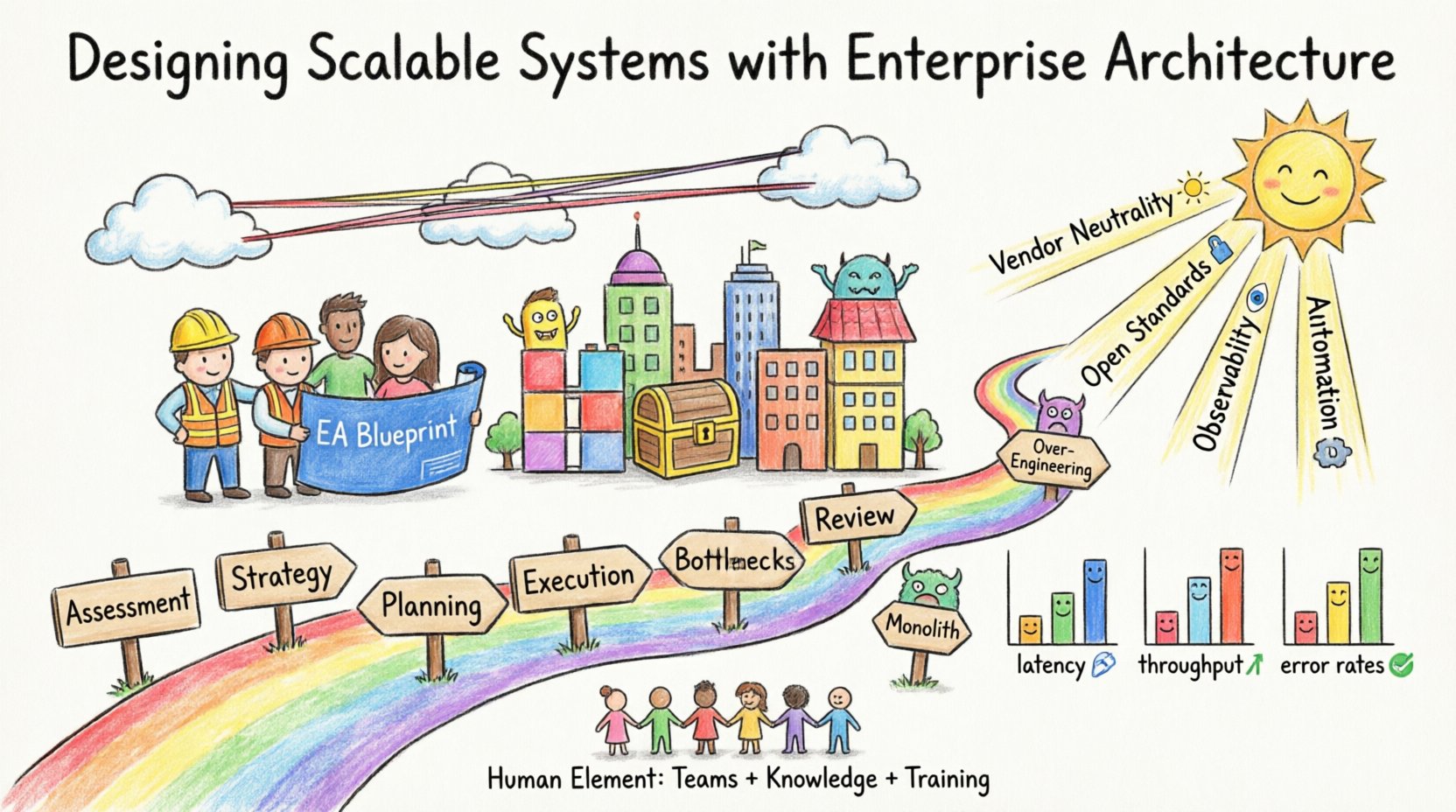
- Latency: The time it takes for a request to be processed. This should remain stable even as load increases.
- Throughput: The number of requests processed per second. A scalable system should see this increase linearly as resources are added.
- Error Rates: The percentage of failed requests. As load increases, error rates should not spike unexpectedly.
- Resource Utilization: CPU, memory, and network usage. High utilization indicates the need for scaling, but consistent 100% utilization indicates a bottleneck.
- Cost Per Transaction: The cost to process a single unit of work. In a scalable system, this cost should decrease or remain flat as volume grows.
⚠️ Common Pitfalls to Avoid
Building scalable systems is difficult, and there are many ways to fail. Recognizing these pitfalls early can save significant time and resources.
- Over-Engineering: Building complex infrastructure for a system that does not need it yet. Start simple and scale only when necessary.
- Ignoring Bottlenecks: Scaling the application while ignoring the database or network. All parts of the stack must scale together.
- Monolithic Tendency: Attempting to scale a tightly coupled monolith. This often leads to diminishing returns. Consider breaking it down if it becomes too large.
- Hardcoding: Hardcoding values for scaling limits, such as connection pool sizes. These should be configurable parameters.
- Single Points of Failure: Ensuring that no single component is critical to the entire system. If it fails, the whole system should not go down.
🔮 Future-Proofing the Architecture
The technology landscape changes rapidly. What works today may be obsolete tomorrow. An architecture designed for scalability must also be designed for adaptability.
- Vendor Neutrality: Avoid locking into a specific vendor’s proprietary tools unless absolutely necessary. This allows for easier migration if costs or capabilities change.
- Open Standards: Use open protocols and standards for data and communication. This ensures interoperability with future systems.
- Observability: Invest in tools that provide deep insight into system behavior. This allows teams to detect issues before they impact users.
- Automation: Automate deployment, testing, and scaling. Manual processes do not scale and introduce human error.
🚀 Implementation Roadmap
Transitioning to a scalable architecture is a journey, not a destination. Here is a suggested path for organizations looking to improve their architectural maturity.
- Assessment: Analyze the current state of the system. Identify bottlenecks and areas of high technical debt.
- Strategy: Define the target state. What does scalability look like for your specific business needs?
- Planning: Create a roadmap that prioritizes high-impact changes. Focus on removing critical bottlenecks first.
- Execution: Implement changes in small, manageable increments. Test each change thoroughly.
- Review: Continuously review the architecture against the business goals. Adjust the strategy as the market changes.
🌐 The Human Element
Technology is only one part of the equation. The people building and maintaining the system play a crucial role in scalability. Teams need the right skills, tools, and processes to support an architectural vision.
- Cross-Functional Teams: Encourage collaboration between developers, operations, and business stakeholders. This ensures that technical decisions support business goals.
- Knowledge Sharing: Create a culture where architectural knowledge is shared. This prevents knowledge silos where only one person understands a critical part of the system.
- Training: Invest in training for new technologies and patterns. As the system evolves, the team must evolve with it.
Scalability is not a feature you add; it is a quality you design. It requires a commitment to principles, governance, and continuous improvement. By adhering to the strategies outlined in this guide, organizations can build systems that support growth without sacrificing stability. The goal is not just to survive the next wave of demand, but to thrive in the changing landscape of enterprise technology.