

In modern organizations, a silent tension often exists between the departments responsible for strategy and those responsible for execution. Business leaders drive vision, market expansion, and revenue goals. IT leaders manage infrastructure, security, and system stability. When these groups operate without a unified framework, projects stall, budgets inflate, and innovation slows. This disconnect is not merely a communication issue; it is a structural one.
Enterprise Architecture (EA) serves as the connective tissue that aligns these distinct functions. It provides a structured approach to designing, planning, implementing, and governing an enterprise’s information technology strategy. By focusing on business capabilities and value streams, EA ensures that every technical decision supports a tangible business outcome. This guide explores how to leverage Enterprise Architecture to dissolve silos and create a cohesive operational model.
🧩 Understanding Enterprise Architecture
Enterprise Architecture is often misunderstood as simply drawing diagrams or managing software inventory. In reality, it is a discipline of decision-making. It defines the structure of the organization and how that structure evolves over time. Think of EA as the blueprint for a building, but one that adapts as the needs of the occupants change.
At its core, EA addresses four key domains:
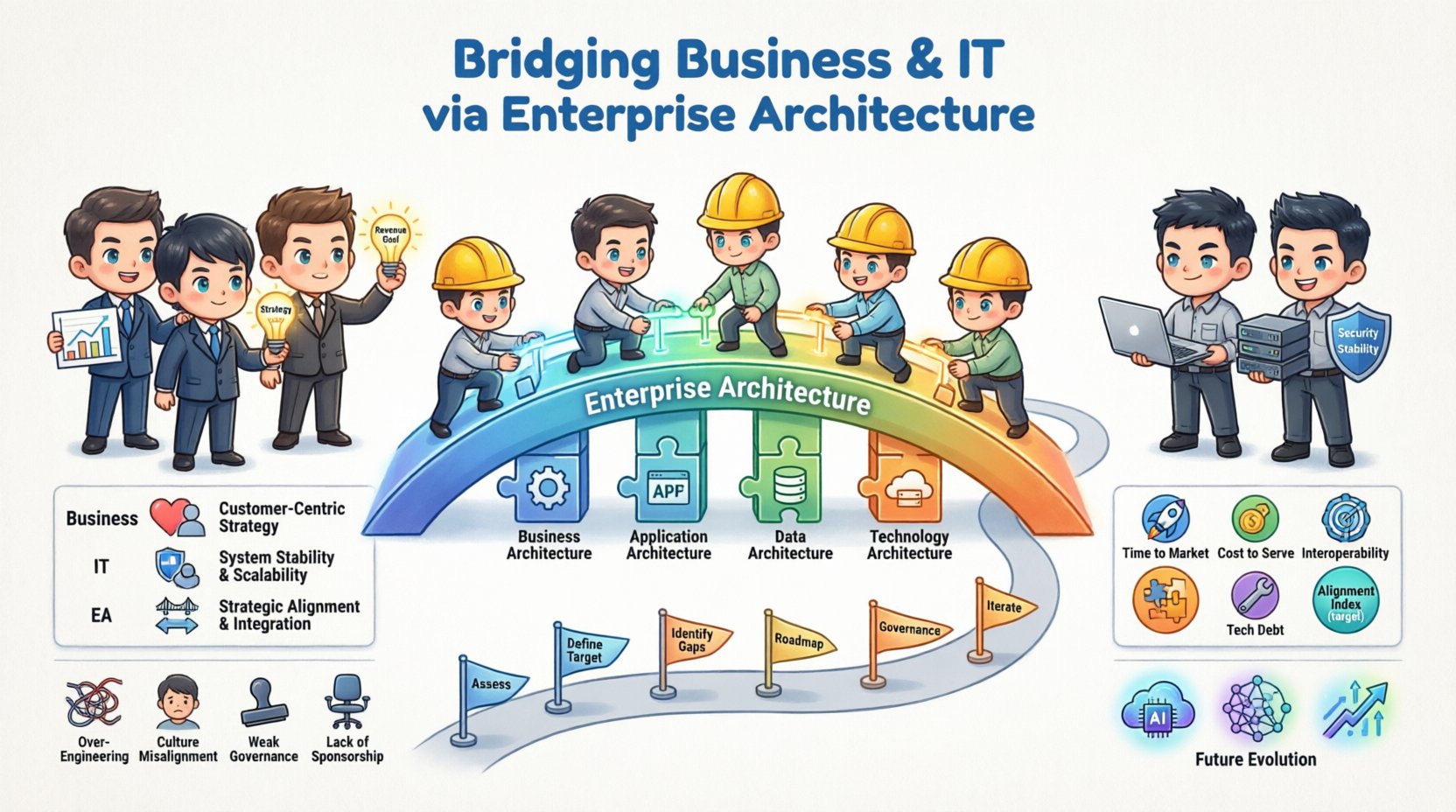
Business Architecture: Defines the strategy, governance, organization, and key business processes.
Application Architecture: Provides a blueprint for individual applications, their interactions, and relationships to core business processes.
Data Architecture: Describes the structure of an organization’s logical and physical data assets and data management resources.
Technology Architecture: Describes the logical software and hardware capabilities required to support the deployment of business, data, and application services.
When these domains are treated in isolation, fragmentation occurs. Business Architecture dictates what is needed, but without Application and Technology Architecture, there is no path to delivery. EA integrates these views into a single source of truth.
🛑 The Core Disconnects
Why do business and IT teams often drift apart? The friction usually stems from differing priorities, vocabularies, and timelines. Understanding these specific pain points is the first step toward resolution.
1. Divergent Goals
Business units prioritize speed to market, customer experience, and revenue generation. IT units prioritize uptime, security compliance, technical debt reduction, and stability. While both are necessary, they often conflict. Business leaders may view IT as a cost center that slows progress. IT leaders may view business requests as unmanageable risks that threaten stability.
2. Vocabulary Barriers
Terms like “cloud,” “API,” “legacy,” or “microservices” carry specific technical weight. Business stakeholders may use these terms loosely or incorrectly. Without a shared lexicon, requirements are misunderstood, leading to delivered solutions that do not meet the actual need. EA establishes a common language that translates business needs into technical specifications.
3. Visibility and Transparency
Business leaders often do not understand the cost or complexity of technical changes. IT leaders may not understand the strategic importance of a specific feature request. This lack of visibility leads to mistrust. Enterprise Architecture provides the visibility layer, showing the impact of changes across the entire organization.
Business Perspective | IT Perspective | EA Alignment |
|---|---|---|
Focus on Customer Value | Focus on System Stability | Map Value Streams to Systems |
Desire Rapid Deployment | Require Change Control | Agile Governance Models |
View Tech as a Cost | View Tech as an Enabler | Investment vs. Expense Tracking |
Short-term KPIs | Long-term Roadmaps | Integrated Planning Cycles |
🌉 The Role of EA in Alignment
Enterprise Architecture acts as the bridge by translating strategic intent into technical reality. It does this through specific mechanisms that create clarity and accountability.
Capability Mapping
Instead of organizing around software products, EA organizes around business capabilities. A capability is what the business does (e.g., “Customer Onboarding” or “Inventory Management”), not the tool used to do it. This abstraction allows the business to change tools without changing the fundamental function. It shifts the conversation from “which software do we buy?” to “what capability do we need to improve?”.
Value Stream Optimization
Value streams represent the end-to-end activities that deliver value to a customer. EA maps IT systems to these streams. If a process is slow, EA identifies which system is causing the bottleneck. This allows IT to invest in the right areas to support business speed, rather than optimizing systems that do not directly impact the customer journey.
Principles and Standards
EA sets ground rules that both sides agree to follow. These principles ensure consistency. For example, a principle might state that “All customer data must be accessible via a single API.” This prevents silos and ensures that the business can access data regardless of which department owns it.
🛠️ Implementation Steps
Building a functional Enterprise Architecture practice requires a phased approach. It is not a one-time project but an ongoing capability. The following steps outline a practical path forward.
Assess the Current State: Understand what exists today. Document existing systems, processes, and pain points. Avoid idealizing the current state; be honest about technical debt.
Define the Target State: What does success look like in three to five years? This should be driven by business strategy, not technology trends.
Identify Gaps: Compare the current and target states. What capabilities are missing? What systems are obsolete? What skills are lacking?
Develop a Roadmap: Create a prioritized plan to close the gaps. This includes both quick wins and long-term transformation projects.
Establish Governance: Create a body responsible for reviewing architecture against the roadmap. This ensures decisions remain aligned with the strategy.
Iterate and Refine: Architecture is dynamic. As the market changes, the architecture must evolve. Regular reviews keep the plan relevant.
Key Roles in the Process
Successful alignment requires specific roles to be filled. These roles do not necessarily need to be full-time positions for every organization, but the functions must be covered.
Chief Architect: Owns the overall vision and ensures technical consistency.
Business Architect: Translates business strategy into capability maps and value streams.
Solution Architect: Designs specific projects to fit within the broader architecture.
Stakeholder Liaisons: Individuals who bridge the gap between IT teams and business units.
📊 Measuring Success
How do you know if the architecture is working? You need metrics that reflect both business value and technical health. Relying solely on uptime or revenue is insufficient. A balanced scorecard approach works best.
Consider tracking the following indicators:
Alignment Index: The percentage of IT projects directly linked to a strategic business initiative.
Time to Market: The duration from idea to deployment for new capabilities.
Cost to Serve: The operational cost required to support a specific business capability.
System Interoperability: The number of integrations required versus the number of integrated systems.
Technical Debt Ratio: The effort required to maintain legacy systems compared to building new features.
These metrics should be reported regularly to leadership. They provide evidence that IT is not just a cost center but a strategic partner driving efficiency.
⚠️ Common Pitfalls to Avoid
Even with the best intentions, architecture initiatives can fail. Recognizing common traps helps organizations navigate the challenges.
Over-Engineering
Creating complex diagrams and exhaustive documentation for every minor change can slow down delivery. Architecture should enable speed, not hinder it. Focus on the high-level structure and let agile teams handle the details.
Ignoring Culture
Tools and processes fail if the culture resists them. If business leaders do not understand the value of EA, they will bypass it. Education and change management are critical components of the implementation.
Disconnected Governance
Architecture governance cannot be a policing exercise. It must be a support function. If the goal is to stop projects rather than help them succeed, teams will find workarounds. Governance should be lightweight and embedded in the delivery process.
Lack of Executive Sponsorship
Without support from the C-suite, EA lacks the authority to enforce standards. Leadership must champion the vision and hold both business and IT accountable for alignment.
🔄 The Future of Alignment
The landscape of business and technology is shifting. Cloud computing, artificial intelligence, and data analytics are changing how value is created. Enterprise Architecture must adapt to these changes.
Modern architecture is less about rigid structures and more about platforms and ecosystems. It involves building reusable components that can be assembled quickly to meet new demands. This shift requires a move from “project-based” thinking to “product-based” thinking.
Furthermore, the definition of “IT” is expanding. It is no longer just internal systems; it includes customer-facing digital experiences and partner integrations. The architecture must be flexible enough to extend beyond the firewall.
🚀 Conclusion
Bridging the gap between business and IT is not about forcing one side to adopt the other’s mindset. It is about creating a shared framework where both can thrive. Enterprise Architecture provides the structure, language, and governance necessary for this collaboration.
By focusing on capabilities, value streams, and shared metrics, organizations can reduce friction and accelerate delivery. The journey requires commitment, patience, and a willingness to evolve. However, the result is a resilient organization capable of navigating uncertainty and delivering consistent value.
Start by assessing your current state. Identify the friction points. Build the bridge one step at a time. With the right approach, business and IT can move in unison toward a common future.