

Organizations today face a complex landscape of digital transformation, regulatory compliance, and shifting market demands. In the midst of this volatility, Enterprise Architecture (EA) stands as a critical discipline, yet it is often misunderstood. Many leaders view it as a bureaucratic hurdle rather than a strategic asset. This guide dismantles the prevailing narratives surrounding EA to reveal its true value.
Enterprise Architecture is the practice of aligning business strategy with technology infrastructure. It is not merely about drawing diagrams or managing servers. It is about creating a blueprint for organizational agility. When implemented correctly, it provides clarity. When misunderstood, it creates friction. We will explore the common falsehoods that hinder effective architectural planning.
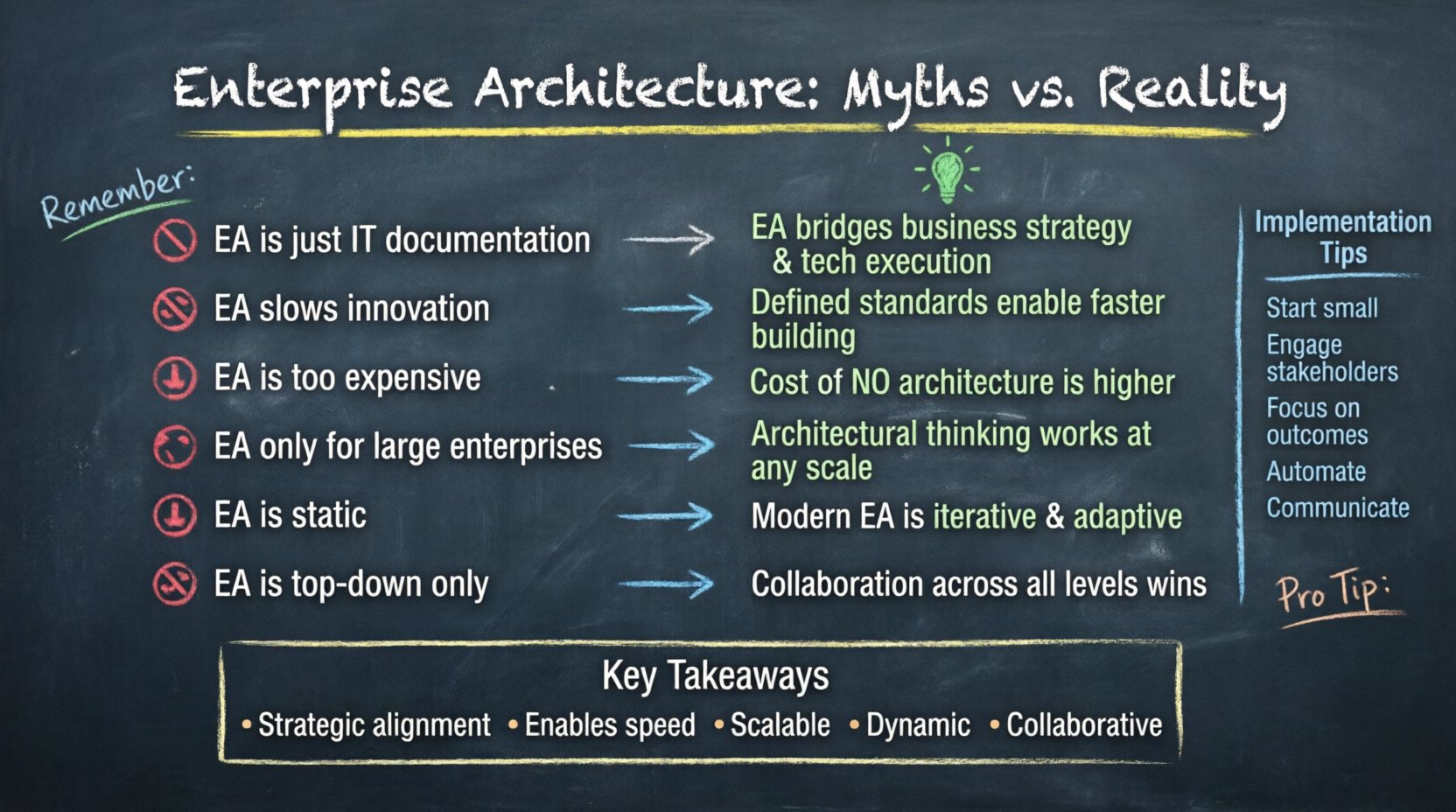
🚫 Myth 1: Enterprise Architecture Is Just IT Documentation
The most pervasive misconception is that EA is solely the responsibility of the IT department and results in static documentation. This view reduces a dynamic discipline to a filing cabinet exercise. It assumes that architecture is about recording what exists, rather than defining what should exist.
- The Reality: EA bridges the gap between business objectives and technical execution.
- The Reality: It involves stakeholders from finance, operations, HR, and leadership, not just engineers.
- The Reality: The output is not just documents, but actionable roadmaps and governance frameworks.
When an organization treats EA as documentation, it misses the strategic alignment. The goal is to ensure that every technology investment supports a specific business capability. If a project does not align with the architecture, it should be scrutinized, not just recorded.
💡 The Strategic Impact
By expanding the scope beyond IT, organizations gain a holistic view of their capabilities. This allows for better resource allocation. It ensures that data flows correctly between departments. It prevents siloed solutions that cannot communicate. The documentation is a byproduct of the thinking process, not the end goal.
🚫 Myth 2: EA Slows Down Innovation and Agility
Many agile teams perceive architecture as a gatekeeper. They believe that strict architectural oversight introduces delays. The assumption is that speed requires a lack of structure. This creates a false dichotomy between speed and stability.
- The Reality: Poor architecture causes technical debt, which slows development over time.
- The Reality: Defined standards allow teams to build faster without reinventing the wheel.
- The Reality: Governance provides guardrails, not stop signs.
Agile methodologies thrive on clear constraints. When teams understand the boundaries and the target state, they can iterate confidently. Without architecture, every sprint risks building features that become obsolete or incompatible with the wider ecosystem.
💡 The Efficiency Factor
Consider a scenario where two teams build different solutions for the same problem. Without architecture, resources are wasted. With architecture, shared services are identified. This reduces redundancy. It allows teams to focus on unique value rather than infrastructure.
🚫 Myth 3: Enterprise Architecture Is Too Expensive
Cost is a primary concern for budget-conscious leaders. The perception is that EA requires a large team and expensive tools. The fear is that the overhead outweighs the benefits. This short-term view ignores the long-term costs of chaos.
- The Reality: The cost of not having architecture is often higher.
- The Reality: EA can be scaled to fit the size of the organization.
- The Reality: It reduces spend on redundant licenses and maintenance.
Organizations that neglect EA often face high integration costs. They struggle with legacy systems that do not speak to modern applications. They pay for multiple vendors to do the same job. Architecture provides a framework to consolidate and optimize.
💡 Return on Investment
Measuring the ROI of EA requires a long-term horizon. It is seen in reduced downtime, faster time-to-market, and lower maintenance costs. It is seen in the ability to pivot quickly when market conditions change. The investment is in stability and adaptability.
🚫 Myth 4: EA Is Only for Large Enterprises
There is a belief that architecture is a luxury for massive corporations with millions in revenue. Small and medium-sized businesses assume they are too small for formal planning. They believe they can grow out of their problems without a plan.
- The Reality: Growth creates complexity faster than small teams can manage.
- The Reality: Early architectural decisions prevent costly rewrites later.
- The Reality: The principles of EA apply at any scale.
Startups that scale rapidly often hit a wall. They realize their data model is flawed. They find their security is inadequate. Applying architectural thinking early ensures that the foundation can support the building.
💡 Scalability
Architectural thinking is about foresight. It asks questions about capacity and security before they become issues. For a growing business, this foresight is a competitive advantage. It allows for organic growth rather than reactive crisis management.
🚫 Myth 5: Enterprise Architecture Is Static
Many view architecture as a set of rules frozen in time. They believe that once a plan is drawn, it cannot change. This creates resistance to evolution. The environment, however, is constantly shifting.
- The Reality: Modern EA is iterative and continuous.
- The Reality: It adapts to new technologies and market trends.
- The Reality: It is a living document that evolves with the business.
Agile architecture emphasizes responsiveness. It acknowledges that requirements change. It allows for modular updates rather than monolithic overhauls. This flexibility is key to longevity.
💡 Continuous Improvement
The best architectures are those that welcome change. They are designed to be extensible. They do not lock an organization into a specific vendor or technology stack. They provide patterns that can be applied to new contexts.
🚫 Myth 6: EA Is Top-Down Only
The traditional view of EA is command and control. Leadership dictates the strategy, and IT executes. This ignores the insights that come from the front lines. It assumes that strategy is disconnected from execution.
- The Reality: Bottom-up feedback is essential for realistic planning.
- The Reality: Practitioners know the constraints better than executives.
- The Reality: Collaborative planning yields better results.
A balanced approach combines strategic direction with operational reality. Leaders set the vision. Architects define the path. Teams provide the feedback loop. This ensures the plan is both ambitious and achievable.
💡 Collaboration
When architects work closely with developers and business analysts, the resulting solutions are more robust. They understand the user experience. They understand the technical limitations. This collaboration reduces friction during implementation.
📊 Comparison: Myths vs. Realities
| Myth | Reality |
|---|---|
| EA is just IT documentation. | EA aligns business strategy with technology capabilities. |
| EA slows down innovation. | EA reduces technical debt, enabling faster long-term delivery. |
| EA is too expensive. | EA reduces waste and prevents costly integration errors. |
| EA is only for large enterprises. | Architectural thinking prevents scaling issues at any size. |
| EA is static and rigid. | Modern EA is iterative and adaptable to change. |
| EA is purely top-down. | Effective EA requires collaboration across all levels. |
🛠️ Implementing Architecture Without the Baggage
How does an organization move forward without triggering the resistance associated with these myths? The implementation strategy matters as much as the strategy itself. Here are key principles for success.
- Start Small: Begin with a specific domain or capability. Prove value before expanding.
- Engage Stakeholders: Involve business leaders early. Make them partners, not just approvers.
- Focus on Outcomes: Tie architectural decisions to business metrics. Show how they drive revenue or efficiency.
- Automate Where Possible: Use tooling to manage complexity, not to add manual overhead.
- Communicate Constantly: Transparency builds trust. Share progress and challenges openly.
🔄 Iterative Planning
Adopt a cycle of planning, execution, and review. Do not aim for perfection in the first pass. Aim for direction. Adjust the course based on feedback. This reduces the pressure on the initial design and allows for learning.
🤝 Governance Models
Governance does not have to mean bureaucracy. Lightweight governance focuses on critical decisions. It ensures compliance with security and regulatory standards. It leaves room for experimentation in non-critical areas.
📈 Measuring Success in Enterprise Architecture
How do you know if the architecture is working? Metrics are essential for validation. They move the conversation from subjective opinion to objective fact.
- System Availability: Are systems stable and reliable?
- Time to Market: How long does it take to deploy new features?
- Integration Costs: Are the costs of connecting systems decreasing?
- Technical Debt Ratio: Is the ratio of new work to debt reduction balanced?
- Stakeholder Satisfaction: Do business leaders feel supported by technology?
📉 The Cost of Inaction
Equally important is measuring the cost of not having architecture. Track incidents caused by poor design. Measure the time spent on manual workarounds. Quantify the waste in redundant systems. These numbers build the case for continued investment.
🌐 The Future of Architectural Practice
The discipline continues to evolve. New challenges arise from cloud computing, artificial intelligence, and data privacy. The principles of EA remain constant, but the tools and contexts shift.
- Data-Centricity: Data is becoming the primary asset. Architecture must prioritize data governance and flow.
- Cloud-Native Design: Infrastructure is no longer on-premise. Elasticity and scalability are default requirements.
- Security by Design: Security cannot be an afterthought. It must be embedded in the architecture.
- Ecosystem Thinking: Organizations do not exist in a vacuum. APIs and partnerships require external integration planning.
🚀 Adapting to Change
Architects must remain learners. The technology landscape changes rapidly. Understanding the potential of new tools is part of the job. However, the core skill is understanding the business problem, not just the solution.
🔍 Deep Dive: The Role of the Enterprise Architect
The role itself is often misunderstood. It is not just a technical title. It is a bridge role. It requires a unique blend of skills.
- Communication: Translating technical constraints into business language.
- Vision: Seeing the future state of the organization.
- Analysis: Breaking down complex problems into manageable components.
- Leadership: Influencing without direct authority.
🎓 Skills for the Modern Architect
Technical knowledge is the baseline. Strategic thinking is the differentiator. Business acumen allows the architect to prioritize correctly. Emotional intelligence helps navigate organizational politics.
⚖️ Balancing Control and Freedom
The tension between control and freedom is central to EA. Too much control stifles creativity. Too much freedom leads to chaos. The goal is a balanced state.
- Standardize the Core: Foundation technologies should be consistent.
- Customize the Edge: User-facing applications can be more flexible.
- Define Interfaces: Clear contracts allow teams to work independently.
- Monitor Compliance: Automated checks reduce manual oversight.
🛡️ Risk Management
Architecture is a risk management tool. It identifies potential points of failure. It plans for contingencies. It ensures that the organization can survive disruptions. This is a critical value proposition.
🔗 Connecting Strategy to Execution
The ultimate goal is alignment. Every line of code should serve a business purpose. Every infrastructure change should support a strategic goal. This connection is often lost in execution.
- Strategy Maps: Visualize the link between goals and capabilities.
- Capability Models: Define what the organization does, not just what it owns.
- Value Streams: Map the flow of value from customer request to delivery.
- Architecture Principles: Set the rules for decision-making.
🧭 Decision Making
When faced with a choice, architecture principles provide guidance. They reduce the need for debate on every issue. They create a consistent culture of decision-making. This speeds up the process and improves quality.
🌟 Building a Culture of Architecture
Architecture cannot exist in a vacuum. It requires a culture that values planning and design. This culture must be nurtured from the top down and the bottom up.
- Education: Train teams on architectural concepts.
- Recognition: Reward good design and clean code.
- Openness: Encourage sharing of lessons learned.
- Patience: Understand that change takes time.
🤝 Cross-Functional Teams
Architecture is a team sport. It involves product managers, developers, operations, and security. When these groups collaborate, the results are superior. Silos must be broken down.
📝 Summary of Key Takeaways
Enterprise Architecture is a strategic discipline, not a bureaucratic exercise. It drives alignment, reduces risk, and enables growth. The myths surrounding it often stem from poor implementation or misunderstanding of its purpose.
- EA is strategic: It connects business and technology.
- EA enables speed: It removes technical debt that slows progress.
- EA is scalable: It works for organizations of all sizes.
- EA is dynamic: It evolves with the business environment.
- EA is collaborative: It requires input from all levels of the organization.
Organizations that embrace these truths gain a significant competitive advantage. They build systems that are resilient, adaptable, and valuable. They move from reactive maintenance to proactive innovation.
🔮 Looking Ahead
The journey of Enterprise Architecture is ongoing. There is no final destination. The landscape will continue to shift. The principles, however, remain a constant guide. By understanding the myths and embracing the reality, leaders can harness the full potential of architectural planning.
Investment in this discipline pays dividends in stability and agility. It is not about controlling the future. It is about preparing for it. With a clear architecture, the path forward becomes visible. The organization can navigate complexity with confidence.
Let us move forward with a clear understanding of what Enterprise Architecture truly is. It is the backbone of modern digital transformation. It is the foundation for sustainable growth. And it is an essential capability for any serious organization.