


Backlog refinement is the heartbeat of a healthy Scrum team. It is where uncertainty transforms into actionable work. However, the quality of a sprint depends entirely on the quality of the stories entering it. If a user story is vague, technically unfeasible, or lacks clear acceptance criteria, the development team will struggle. This guide details the process to validate user stories during backlog refinement sessions, ensuring every item delivered adds value.
Validation is not merely a checkbox exercise. It is a collaborative effort involving Product Owners, Developers, and Quality Assurance. By implementing strict validation protocols, teams reduce rework, minimize technical debt, and increase predictability. Let us explore the methods to ensure every story is ready for the sprint.
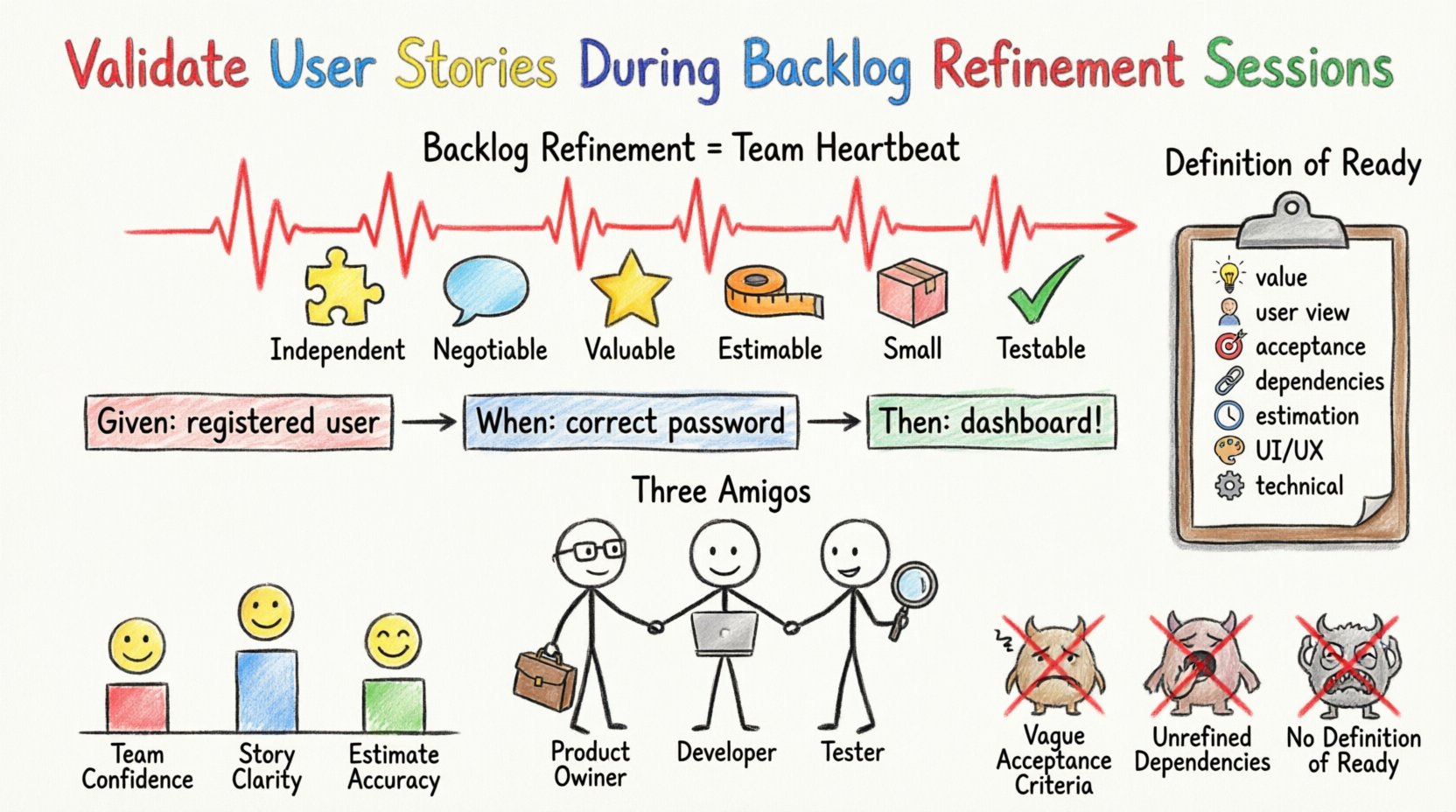
🔄 Understanding Backlog Refinement
Backlog refinement, often called grooming, is an ongoing activity. It is not a one-time event before a sprint begins. It is a continuous process of reviewing, reordering, and clarifying items in the product backlog. The goal is to ensure the backlog is transparent and that the top items are well-understood.
During these sessions, the team discusses the details of upcoming work. They estimate effort, identify dependencies, and break down large themes into smaller stories. Validation sits at the core of this process. Without validation, refinement becomes a guessing game. Teams must ask critical questions about feasibility and value before committing to work.
⚖️ Why Validation Matters
Skipping validation leads to significant downstream costs. When a story enters a sprint without proper checks, several risks emerge:
- Technical Debt: Developers may implement a solution that works for the moment but creates architectural issues later.
- Scope Creep: Ambiguous requirements often lead to feature creep during development.
- Wasted Time: Testing and rework consume time that could be spent on new features.
- Team Morale: Frequent blockers due to unclear requirements frustrate the team.
Validation acts as a filter. It ensures that only high-quality, valuable, and feasible stories move forward. This protects the team’s focus and ensures that the Product Owner’s vision is accurately translated into technical tasks.
📐 Applying the INVEST Criteria
The INVEST model is a standard framework for evaluating user stories. Each letter represents a characteristic that a well-formed story should possess. Validating against these points is essential during refinement.
Independent
A story should stand alone. It should not rely on another story to be completed first. Dependencies slow down flow and complicate scheduling. During validation, ask if the story can be developed and tested without blocking other work. If dependencies exist, they must be explicitly noted and managed.
Negotiable
User stories are not contracts. They are placeholders for a conversation. They should be open to discussion regarding the implementation details. If a story is written as a rigid specification, it limits the team’s ability to find better solutions. Validation ensures the story remains flexible enough for the team to negotiate the best approach.
Valuable
Every story must deliver value to the end user or the business. If a story does not contribute to a goal, it should not exist in the backlog. The Product Owner must articulate why this feature matters. Validation requires a clear link between the story and the overall product strategy.
Estimable
The team must have enough information to estimate the effort required. If the requirements are too vague, estimation is impossible. During refinement, the team assesses if they have sufficient context to provide a relative effort estimate. If not, the story needs further breakdown.
Small
Stories should be small enough to be completed within a single sprint. Large stories, often called epics or themes, need to be sliced. Validation checks if the scope fits the timebox. If a story is too large, it introduces risk. Breaking it down reduces risk and allows for incremental delivery.
Testable
A story is not done until it is tested. This means there must be clear criteria to determine success. If a story cannot be tested, it cannot be validated. This is closely linked to acceptance criteria, which we will discuss next.
✅ Crafting Rock-Solid Acceptance Criteria
Acceptance criteria are the conditions that must be met for a story to be considered complete. They serve as the contract between the business and the development team. Poor acceptance criteria lead to misunderstandings. Good acceptance criteria provide clarity.
Structure of Acceptance Criteria
Effective criteria are specific, measurable, and unambiguous. They often follow a format such as Given-When-Then (Gherkin syntax). This structure helps bridge the gap between business language and technical implementation.
- Given: The initial context or state.
- When: The action or event that occurs.
- Then: The expected outcome or result.
Examples of Validation
Consider a story about logging in. A weak criterion might be “The user can log in.” This is not testable. A strong criterion would be:
- Given a registered user with a valid email
- When they enter the correct password
- Then they are redirected to the dashboard
During refinement, the team reviews these criteria. They ask: “Can we automate this test?” “Is the security requirement clear?” “What happens if the password is wrong?” These questions drive the validation process.
🧩 The Definition of Ready Checklist
The Definition of Ready (DoR) is a checklist that a user story must meet before it enters a sprint. It is the team’s agreement on what constitutes a valid story. Using a DoR ensures consistency across the backlog.
Here is a comprehensive checklist for validating user stories:
| Checklist Item | Description | Validation Question |
|---|---|---|
| Value Definition | Clear business value is stated | Does this story help the user or business? |
| User Perspective | Story is written from the user’s view | Who is the user and what is their goal? |
| Acceptance Criteria | Clear pass/fail conditions exist | Can we test this without guessing? |
| Dependencies | External dependencies are identified | What must happen before this starts? |
| Estimation | Story points or hours assigned | Does the team agree on the effort? |
| UI/UX Design | Visual mockups or wireframes available | Do developers know what it looks like? |
| Technical Feasibility | Architecture review completed | Can we build this with current tech? |
Teams should customize this list to fit their specific context. Some stories may not need a UI mockup, while others might require a security review. The key is that the team agrees on the rules.
⏱️ Facilitation Strategies for Effective Sessions
Refinement sessions can become unproductive if not facilitated correctly. A structured approach keeps the energy high and the focus sharp. Here are strategies to improve the session flow:
- Timeboxing: Limit the session to 45-60 minutes. Fatigue reduces the quality of validation. If the backlog is large, split the work across multiple shorter sessions.
- Preparation: The Product Owner should prepare the stories before the meeting. Developers should not spend the session writing the story, but rather reviewing it.
- Focus on the Top: Only refine stories that are candidates for the next sprint or two. Do not waste time on items far down the backlog.
- Rotate Facilitators: Let different team members lead the session. This keeps engagement high and shares the responsibility of process improvement.
- Visual Aids: Use a whiteboard or digital canvas to map out flows. Visualizing the user journey helps identify gaps in logic quickly.
Facilitation is about guiding the conversation, not dictating it. The goal is to reach a consensus on the readiness of the stories.
🚧 Common Pitfalls and How to Avoid Them
Even experienced teams face challenges during refinement. Recognizing these pitfalls allows for proactive correction.
| Pitfall | Impact | Solution |
|---|---|---|
| Rushing | Stories enter sprint with missing details | Enforce a strict Definition of Ready |
| Over-Engineering | Focus shifts to technical implementation too early | Focus on value first, implementation second |
| Product Owner Absence | Decisions are made without business context | Ensure PO attends every refinement session |
| Developer Dominance | Technical constraints overshadow user needs | Balance technical and business perspectives |
| Documentation Heavy | Writing specs takes longer than building | Keep documentation lightweight and visual |
Avoiding these traps requires discipline. It is better to have fewer refined stories than many poorly refined ones. Quality always outweighs quantity in this context.
📊 Metrics to Track Validation Success
To improve the refinement process, you need data. Tracking specific metrics helps identify trends and areas for improvement. Here are key indicators to monitor:
- Carryover Rate: How many refined stories are not started in the sprint? A high rate suggests over-commitment or poor validation.
- Change Request Frequency: How often are requirements changed after a story enters development? High frequency indicates poor initial validation.
- Refinement Velocity: How many stories does the team refine per session? This helps in capacity planning for refinement activities.
- Rework Rate: Percentage of stories requiring rework due to bugs or missing features. This directly correlates to the quality of acceptance criteria.
- Sprint Burndown Accuracy: Does the team complete the work they committed to? Accurate refinement leads to more accurate planning.
Review these metrics in retrospectives. Use the data to adjust the Definition of Ready or the refinement process itself.
🤝 Building a Collaborative Validation Culture
Validation is not a siloed activity. It requires input from all disciplines. A culture of collaboration ensures that blind spots are caught early.
The Three Amigos
This concept involves bringing together the Product Owner (Business), the Developer (Implementation), and the Tester (Quality) before development begins. This triad discusses the story to ensure all perspectives are covered. It prevents the “throw it over the wall” mentality where business needs are handed to developers who then hand them to testers.
Knowledge Sharing
Validation sessions are also learning opportunities. Junior developers can learn from seniors. Developers can learn from the Product Owner about business context. This cross-pollination reduces bottlenecks and builds a more resilient team.
Psychological Safety
Team members must feel safe to say “I don’t understand” or “This is risky.” If a developer feels pressured to agree to a story they know is flawed, validation fails. Leaders must encourage open questioning. If a story is unclear, it should be sent back for clarification, not forced into the sprint.
🤔 Handling Ambiguity in Requirements
Not all requirements are clear from the start. Ambiguity is natural, but it must be managed. During refinement, the goal is to reduce ambiguity to an acceptable level.
- Ask “Why?”: When a requirement seems odd, ask why it is needed. Often, the underlying problem is different from the proposed solution.
- Use Prototypes: If the flow is complex, create a quick clickable prototype. Visual interaction reveals logic gaps faster than text descriptions.
- Scenario Walkthroughs: Walk through the story step-by-step. “What happens if the user clicks cancel?” “What if the network fails?” These edge cases often hide in the details.
- Time for Research: If a story requires technical research, break it out as a separate spike. Do not validate a story that depends on unknown technical variables.
🌊 Integrating Validation into Continuous Flow
Refinement should not be a separate phase. It should be integrated into the daily flow of work. This is often called the “Continuous Refinement” model.
Teams can dedicate a percentage of sprint capacity to refinement. For example, 10-20% of the team’s time is allocated to grooming the backlog. This ensures that the backlog is always fresh and ready for the next planning session.
When validation is continuous, the sprint planning meeting becomes a formality. The team already knows what they are building. They only need to confirm capacity and commitment. This reduces meeting time and increases development time.
Automated workflows can support this. Rules can be set in task management systems to prevent moving a story to “In Progress” unless specific fields are filled. This enforces the Definition of Ready technically.
🛠️ Technical Considerations
Validation is not just about business logic. Technical constraints play a major role. The development team must assess:
- Scalability: Will this solution hold up as data grows?
- Security: Are there any data privacy or access control implications?
- Performance: Does this feature impact system speed or latency?
- Compatibility: Does it work across all supported browsers and devices?
These technical checks should be part of the refinement conversation. Ignoring them leads to performance regressions that are hard to fix later.
🔍 Reviewing and Iterating the Process
Finally, the validation process itself must be validated. Processes evolve. What worked last year may not work today. Use retrospectives to discuss the refinement process.
- Did we spend too much time on stories that were not picked?
- Did we miss any critical requirements that caused blockers?
- Is the Definition of Ready too strict or too loose?
Iterate on the process. Add new items to the checklist if they become relevant. Remove items if they become redundant. A living process adapts to the team’s changing needs.
🚀 Conclusion
Validating user stories during backlog refinement is the foundation of successful Scrum execution. It transforms abstract ideas into concrete tasks. By applying the INVEST criteria, enforcing a Definition of Ready, and fostering collaboration, teams ensure that every sprint is built on a solid base.
The effort invested in refinement pays dividends in reduced rework, higher quality delivery, and a happier team. Focus on quality over speed. A well-validated story is worth ten hastily written ones. Commit to this practice, and watch your delivery predictability improve significantly.