


In the fast-paced environment of modern software development, the tension between thorough documentation and rapid delivery is a constant challenge. Teams often find themselves caught between the need for clarity and the pressure to ship value quickly. This guide explores how to maintain necessary documentation standards while preserving the speed and adaptability that define the Agile methodology. We will examine practical strategies to ensure requirements are clear without creating bottlenecks.
The goal is not to eliminate documentation, but to refine it. Effective documentation serves as a shared understanding tool rather than a bureaucratic hurdle. When done correctly, it empowers teams to move faster with confidence. Let us dive into the mechanics of lean documentation within a Scrum framework.
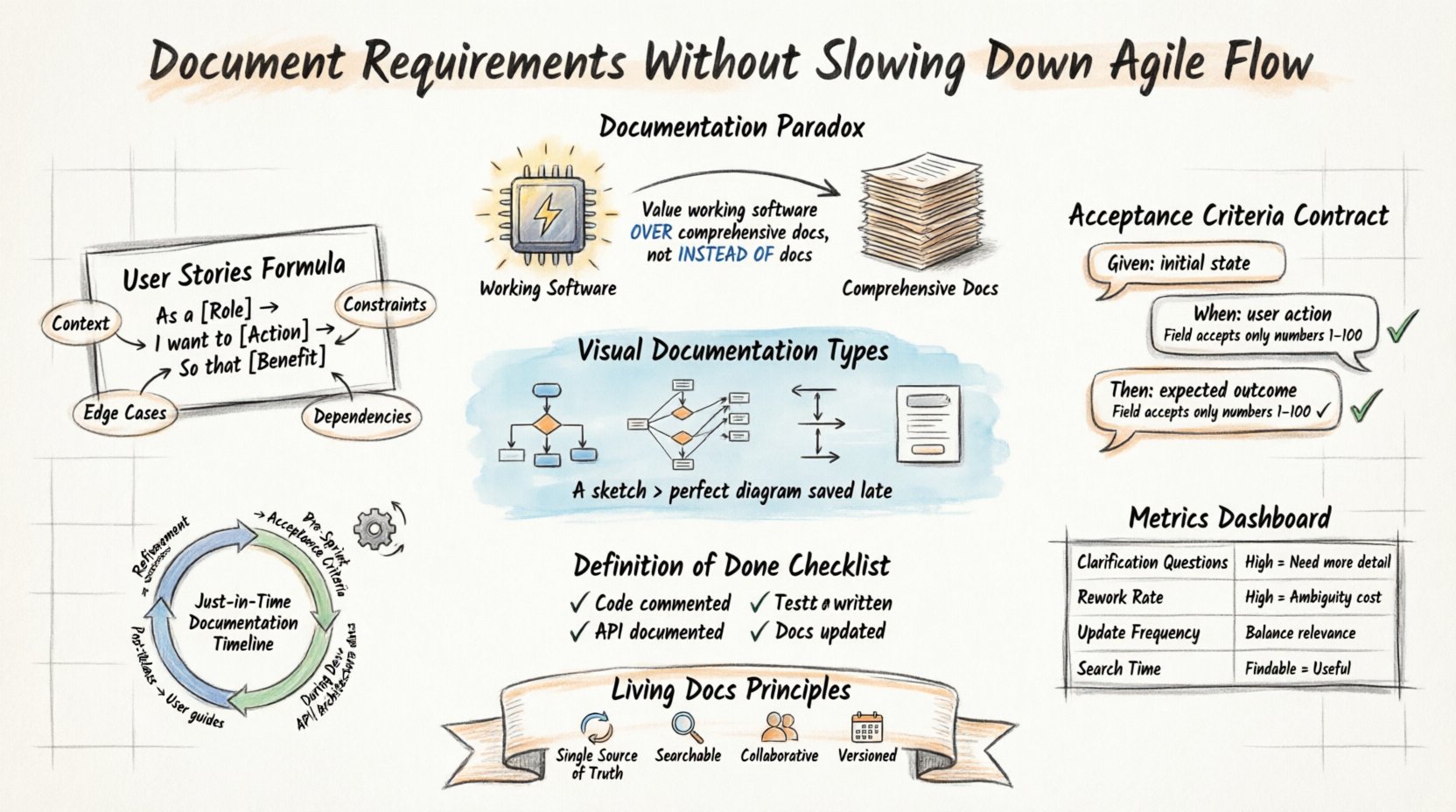
Understanding the Documentation Paradox in Scrum 🤔
Many practitioners believe that Agile means no documentation. This is a misunderstanding of the Agile Manifesto. The manifesto states that working software is valued more than comprehensive documentation, not that documentation is worthless. The distinction is subtle but critical.
- Working Software: Delivers immediate value to the customer.
- Comprehensive Documentation: Can become an end in itself, delaying delivery.
The paradox arises when teams interpret “less documentation” as “no documentation.” In reality, the right amount of documentation prevents rework. Ambiguity leads to bugs, misunderstandings, and feature creep. These issues slow down the flow more than a few well-placed notes ever would.
The Cost of Ambiguity
When requirements are vague, developers make assumptions. Sometimes these assumptions are correct, but often they are not. Fixing a misunderstanding during the testing phase is significantly more expensive than clarifying it during the planning phase. This concept is known as the Cost of Change curve. In Agile, we aim to catch issues early.
Documentation acts as the anchor for the team’s understanding. Without it, the team drifts. With too much, the team stagnates. Finding the balance is the core task of product ownership and team facilitation.
The Role of User Stories in Lean Documentation 📝
User stories are the primary artifact for capturing requirements in Scrum. They are designed to be concise. A well-written user story focuses on the user’s need rather than the technical implementation. This keeps the documentation lightweight.
A standard user story follows a specific format:
- As a: (Role)
- I want to: (Action)
- So that: (Benefit)
This format forces the writer to articulate value. It prevents the creation of technical specifications that developers already know or that are irrelevant to the user experience. However, the story card alone is rarely sufficient. It requires context to be effective.
Expanding the Card
While the card is short, the information surrounding it must be robust. This is where the team collaborates. The documentation exists not just on a card, but in the conversation. However, we must capture that conversation to ensure it persists beyond the meeting room.
Here are key elements to include alongside a user story:
- Context: Why is this feature needed now?
- Constraints: Are there technical or regulatory limits?
- Edge Cases: What happens if the user behaves unexpectedly?
- Dependencies: Does this rely on another team or system?
By listing these elements, the team reduces the need for constant clarification questions during development. This reduces interruptions and maintains flow.
Acceptance Criteria: The Contract of Quality ✅
Acceptance criteria define the boundaries of a user story. They are the conditions that must be met for the story to be considered complete. Unlike high-level requirements, acceptance criteria are specific and testable.
This section of documentation is vital. It shifts the focus from “what to build” to “how to verify it works.” This distinction is crucial for quality assurance and developer confidence.
Writing Clear Criteria
Criteria should be written in plain language. Avoid technical jargon where possible. This ensures that testers, product owners, and business stakeholders all share the same understanding.
- Bad Example: “The system shall validate the input field using regex.”
- Good Example: “The field must accept only numeric values between 1 and 100.”
The second example is clearer and focuses on behavior rather than implementation. It allows developers to choose the best technical solution without violating the requirement.
Teams often use the Given-When-Then format to structure these criteria. This format aligns with Behavior-Driven Development (BDD) practices and makes the criteria executable in many environments.
- Given: The initial context or state.
- When: The action taken by the user.
- Then: The expected outcome.
Visual Documentation for Complex Flows 📊
Text is powerful, but it has limits. Complex workflows, state changes, and data flows are often difficult to describe in writing. In these cases, visuals are superior. Diagrams reduce cognitive load and allow the team to grasp the whole picture quickly.
Visual documentation does not need to be elaborate. A sketch on a whiteboard, photographed and saved, often serves the purpose better than a polished diagram created hours later. The value lies in the shared understanding, not the aesthetic quality.
Types of Useful Visuals
- Flowcharts: Map out decision paths and user journeys.
- Entity Relationship Diagrams (ERD): Clarify data relationships.
- Sequence Diagrams: Show interactions between systems.
- Wireframes: Define layout and interaction points.
When using visuals, ensure they are accessible. Store them in a central location where the team can view them during stand-ups or planning. Do not let them become static files that no one opens.
Just-in-Time Documentation Strategies ⏱️
One of the most effective ways to prevent documentation bloat is to create documents just before they are needed. This is the principle of Just-in-Time (JIT) documentation.
Traditional waterfall models require all documentation upfront. Agile requires documentation to be iterative. As the product evolves, the documentation evolves with it. This ensures that the information is always relevant.
When to Write
Consider the following timing for documentation tasks:
- During Refinement: Create high-level requirements and user stories.
- Before Sprint Start: Finalize acceptance criteria and clarify edge cases.
- During Development: Update API documentation or architecture decisions.
- After Release: Update user guides or release notes.
By spreading the work across the cycle, no single phase becomes a bottleneck. The team avoids the “documentation cliff” where everything is written right before a major milestone.
Living Documents and Collaborative Spaces 📚
Documentation should be a living artifact. It must be easy to update. If a document is difficult to find or hard to edit, the team will not use it. Instead, they will rely on tribal knowledge, which is fragile and prone to loss when staff changes.
Use collaborative tools that allow real-time editing. This encourages transparency. When a requirement changes, the documentation should reflect that immediately. This reduces the risk of developers working from outdated information.
Best Practices for Living Docs
- Single Source of Truth: Avoid having the same info in multiple places.
- Version Control: Track changes to understand history.
- Accessibility: Ensure all team members have access.
- Searchability: Make it easy to find specific terms.
Do not hoard documentation. If a developer updates a technical detail, they should be empowered to update the docs immediately. This ownership fosters accountability and quality.
Handling Compliance and Governance 🏛️
In regulated industries, documentation is not optional. Healthcare, finance, and automotive sectors have strict legal requirements. This does not mean you must abandon Agile practices. It means you must adapt them.
You can maintain compliance without sacrificing flow. The key is to integrate compliance checks into the Definition of Done (DoD).
Integrating Compliance
- Automated Checks: Use scripts to verify regulatory requirements where possible.
- Checklists: Add compliance items to the sprint review checklist.
- Traceability: Maintain links between requirements and test cases.
By treating compliance as a feature rather than an external audit, the team owns the responsibility. This prevents last-minute panic during audits.
Measuring Documentation Efficiency 📏
How do you know if your documentation is too heavy or too light? You need metrics. However, be careful not to measure the wrong things. The number of pages written is not a good metric.
Focus on outcomes rather than outputs. Look at how documentation affects the team’s velocity and quality.
| Metric | Indicates Too Little | Indicates Too Much |
|---|---|---|
| Clarification Questions | High volume during development | Low volume |
| Rework Rate | High due to misunderstandings | Low |
| Update Frequency | Never updated | Frequently outdated |
| Search Time | High (hard to find) | High (too much info) |
Use this data to adjust your documentation strategy. If clarification questions are high, you need more detail. If rework is low but update frequency is high, you might be documenting unnecessary details.
The Definition of Done and Documentation 🛑
The Definition of Done is the checklist that determines when work is complete. It should include documentation tasks. If documentation is not part of the DoD, it will likely be skipped.
Examples of DoD items related to documentation:
- Code is commented appropriately.
- API endpoints are documented.
- User guides are updated for new features.
- Test cases are written and passed.
This ensures that documentation is treated with the same priority as code. It prevents the accumulation of technical debt in the form of missing information.
Communication Rituals for Knowledge Sharing 🗣️
Documentation is not just about files. It is about communication. Rituals within the team facilitate the flow of information. These rituals ensure that knowledge is shared without creating formal documents for everything.
Key Rituals
- Refinement Sessions: Discuss requirements before the sprint starts.
- Pair Programming: Share knowledge in real-time while coding.
- Demo Days: Show work to stakeholders for feedback.
- Retrospectives: Discuss how documentation processes are working.
These interactions reduce the need for static documents. If the team talks openly, they do not need to write down everything they say. However, key decisions must still be recorded.
Managing Technical Debt in Requirements 🏗️
Just as code generates technical debt, poor requirements generate documentation debt. This happens when requirements change frequently without updating the docs. Over time, the docs become a lie.
To manage this, treat documentation updates as part of the change management process. If a requirement changes, the documentation must change simultaneously. Do not defer this task.
Strategies to Reduce Debt
- Refactor Docs: Dedicate time in sprints to clean up old documentation.
- Archive Old Versions: Keep history but mark old versions as obsolete.
- Review Cadence: Schedule periodic reviews of key documents.
By acknowledging documentation debt, the team can plan to pay it down. This prevents the accumulation of confusion that slows down future development.
Final Considerations for Sustainable Flow 🌊
Building a culture of effective documentation takes time. It requires commitment from leadership and participation from every team member. The process is not about following a rigid rulebook, but about adapting to the needs of the product and the team.
Remember that the purpose of documentation is to enable the team. If it hinders the team, it is the wrong type of documentation. If it enables the team to move faster with confidence, it is successful.
Focus on clarity, accessibility, and relevance. Keep the volume low but the value high. By balancing these factors, you can maintain a sustainable Agile flow without sacrificing the quality of your requirements.
Teams that master this balance are better equipped to handle change. They can pivot quickly when market needs shift. They can deliver complex features without getting lost in the details. This is the true advantage of a disciplined yet flexible approach to documentation.
Start small. Pick one area, such as acceptance criteria, and improve it. Then move to the next. Continuous improvement applies to documentation just as it applies to software. Review your practices regularly and adjust them based on feedback. This ensures your documentation strategy remains aligned with your goals.