

Agile frameworks rely heavily on transparency, inspection, and adaptation. At the heart of this cycle lie the Scrum artifacts. These are not merely documents or lists; they are sources of truth that guide teams and stakeholders through the complexity of product development. When interpreted correctly, these artifacts provide the data necessary to make informed, timely decisions. This guide explores how to read the Product Backlog, Sprint Backlog, and Increment to drive value and clarity.
Many teams create artifacts but fail to derive actionable intelligence from them. A backlog becomes a graveyard of tasks rather than a prioritization tool. A sprint backlog becomes a static list rather than a commitment tracker. An increment becomes a feature dump rather than a value demonstration. To shift from passive creation to active interpretation, one must understand the intent behind each element and the signals they send regarding progress, risk, and quality.
📦 The Product Backlog: A Strategic Decision Tool
The Product Backlog is an ordered list of everything that is known to be needed in the product. It is the single source of requirements for any changes to be made to the product. However, its value lies not in its existence, but in its interpretation by the Product Owner and the team.
Understanding Prioritization Signals
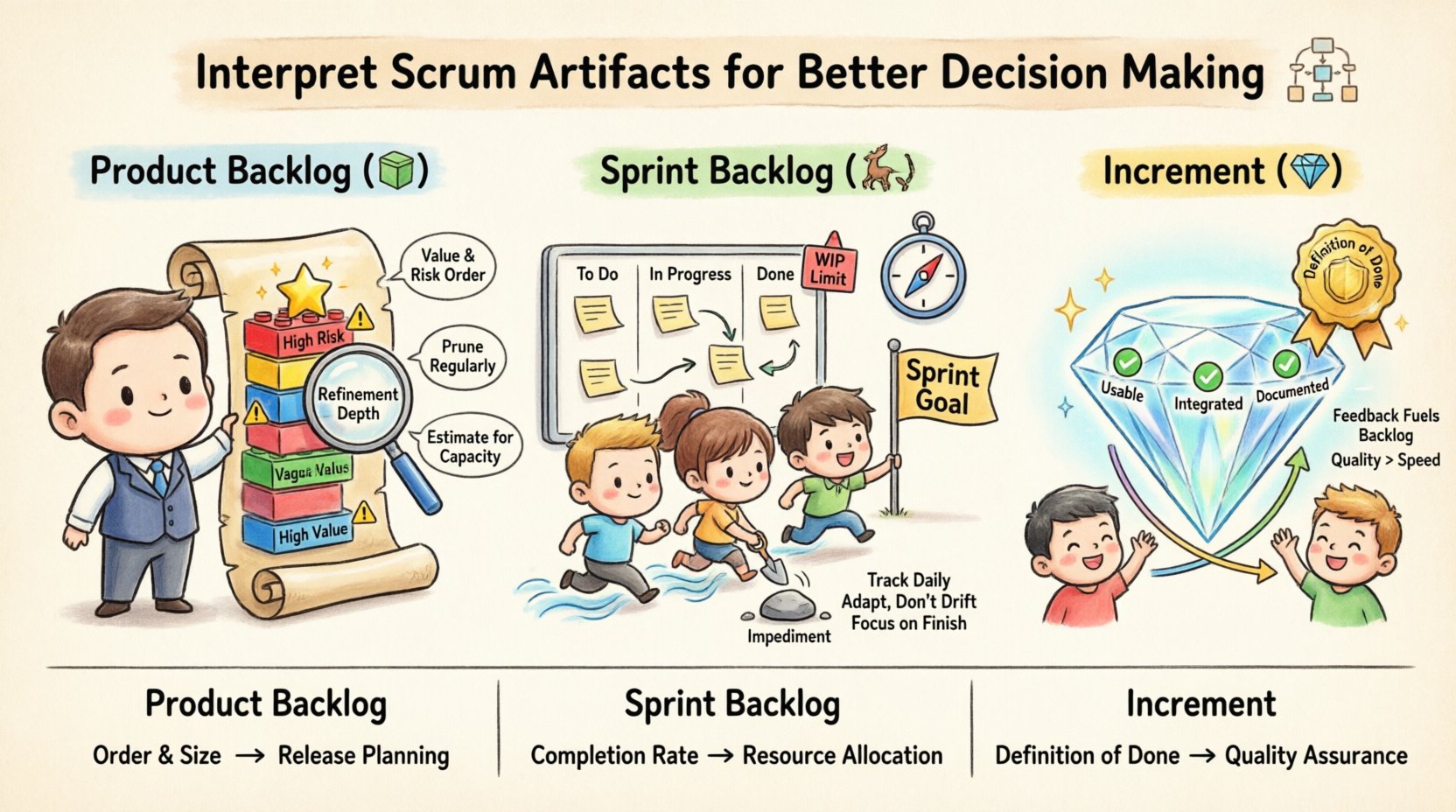
The order of items in the backlog is a direct reflection of value and risk. When reviewing the backlog, look for the following indicators:
- Top-Order Items: These represent the highest value or most urgent risk reduction. Decisions made here focus on immediate delivery and resource allocation.
- Refinement Depth: Items near the top should be well-defined. If they are vague, it signals a need for clarification before work begins. This impacts the team’s ability to commit.
- Granularity: The size of items indicates the level of detail available. Large epics at the top suggest a need for decomposition before planning can occur.
Decision-making regarding the backlog involves continuous pruning. Items that no longer align with current goals should be removed or re-prioritized. This ensures the team is always working on the most relevant work. Ignoring this maintenance leads to technical debt and strategic drift.
Estimation and Capacity Planning
Relative sizing, such as story points or ideal days, provides a historical baseline for capacity. Interpreting these numbers requires context. A velocity that fluctuates wildly often indicates hidden complexity or scope creep rather than team inefficiency.
When planning releases, use the backlog to map out potential trajectories. This allows stakeholders to see what is achievable within a given timeframe. It prevents over-promising and under-delivering. The backlog serves as a contract of intent, provided the estimates are honest and transparent.
🏃 The Sprint Backlog: Tactical Execution Tracking
The Sprint Backlog is the set of Product Backlog items selected for the Sprint, plus a plan for delivering the Increment and achieving the Sprint Goal. It is owned by the Developers. Interpreting this artifact requires a shift from strategic vision to tactical reality.
Monitoring Progress and Variance
During the Sprint, the Sprint Backlog changes. Items are added or removed based on new insights. This is not a failure; it is an adaptation. However, significant changes require analysis.
- Scope Creep: If items are added mid-sprint without removing others, the Sprint Goal is at risk. Decision-makers must assess whether the new work is critical enough to displace existing work.
- Work in Progress: Limiting WIP ensures focus. A backlog that shows too many partially completed tasks indicates a bottleneck. Decisions should focus on finishing current tasks before starting new ones.
- Task Completion: The movement of tasks from “To Do” to “Done” provides a real-time view of health. Stagnation in specific task types may indicate skill gaps or technical impediments.
The Sprint Goal as a Compass
The Sprint Goal is the objective that will be met during the Sprint. It provides flexibility to the Developers on how to build the Increment. When interpreting the Sprint Backlog, always ask: “Does this work contribute to the Sprint Goal?”
If the team deviates from the goal, they lose the focus that the Sprint provides. Decisions to pivot should happen at the Sprint Planning or Daily Scrum, not at the end. The Sprint Backlog should reflect the path to that goal. If the path is blocked, the artifact must show the impediment clearly to trigger support.
💎 The Increment: Evidence of Value
The Increment is the sum of all the Product Backlog items completed during a Sprint and the value of the increments of all previous Sprints. It is the tangible proof of progress. Unlike the backlog, which is potential, the Increment is actuality.
Definition of Done
The quality of the Increment is determined by the Definition of Done (DoD). This is a formal description of the state of the Increment when it meets the quality measures required for the product. Interpreting the Increment involves verifying this definition.
Key questions to ask when reviewing an Increment:
- Usability: Can the functionality be used by the intended audience without additional explanation?
- Integration: Does the new code work with the existing system without breaking previous features?
- Documentation: Is the knowledge transfer complete? Does the team understand the new code?
If the Increment is not potentially shippable, it is not a true Increment. This distinction forces difficult decisions about quality versus speed. Choosing to ship incomplete work degrades the product and erodes trust. The decision to hold back an Increment is often the most professional choice a team can make.
Feedback Loops
The Increment is the trigger for the Sprint Review. This is where stakeholders provide feedback. The decision-making process here relies on the quality of the demonstration. A working Increment allows for concrete feedback. A demo based on slides or prototypes invites speculation.
Feedback received on the Increment informs the next iteration of the Product Backlog. This closes the loop. Ignoring feedback creates a disconnect between development and market needs. The Increment is the medium through which the market speaks to the team.
🔍 Connecting Artifacts to Stakeholder Decisions
Stakeholders often look at these artifacts to make funding, hiring, or strategic decisions. To support them, the artifacts must be transparent. Ambiguity leads to anxiety and poor decisions.
Here is how different stakeholders interact with the artifacts:
- Executives: Look at the Product Backlog for roadmap alignment. They need to know if the work supports business goals.
- Product Managers: Use the Sprint Backlog to track progress against release dates. They manage the trade-offs between scope and time.
- Developers: Rely on the Increment to understand what “finished” looks like. They ensure quality and maintainability.
- Customers: Experience the Increment. Their reaction determines future priority.
When these groups align their interpretation of the artifacts, decision-making becomes smooth. Misalignment occurs when the Product Owner prioritizes features that Developers cannot build in time, or when Stakeholders expect features that are not in the Backlog.
🚧 Common Pitfalls in Artifact Interpretation
Even with the best intentions, teams often misinterpret artifacts. Recognizing these pitfalls is crucial for maintaining decision quality.
Pitfall 1: The Backlog as a Task List
When the Product Backlog is treated as a to-do list, value is lost. It should be ordered by value, not by dependency or convenience. Decisions made from a task-oriented backlog often result in building things that are easy to build rather than things that matter.
Pitfall 2: The Increment as Code
Code is not value. Value is realized when the code is used. If the Increment is not released or demonstrated, the value remains theoretical. Decisions based on “code complete” often overlook user experience and integration issues.
Pitfall 3: Hiding Impediments
Teams often hide impediments in the Sprint Backlog to avoid looking inefficient. This leads to delays and surprises later. Transparency requires admitting when work is blocked. Decisions about resources should be made early, not after the deadline has passed.
📉 Maintaining Transparency and Inspection
Scrum relies on the principle of transparency. Decisions are only as good as the information available to make them. If the artifacts are opaque, the decisions will be flawed.
Regular Inspection Cycles
Artifacts should be inspected at specific events:
- Sprint Planning: The Product Backlog is inspected for readiness.
- Daily Scrum: The Sprint Backlog is inspected for progress.
- Sprint Review: The Increment is inspected for value.
- Sprint Retrospective: The process of managing artifacts is inspected for improvement.
This cadence ensures that no decision is made on outdated information. It creates a rhythm of accountability. Teams that skip these inspections often find themselves chasing their tails, reacting to problems that could have been prevented.
🤝 A Framework for Artifact-Based Decisions
To systematize the interpretation of artifacts, consider the following framework. This helps standardize how decisions are derived from the data available.
| Artifact | Key Metric | Decision Context | Question to Ask |
|---|---|---|---|
| Product Backlog | Order & Size | Release Planning | Does the top of the backlog align with current business goals? |
| Sprint Backlog | Completion Rate | Resource Allocation | Are we on track to meet the Sprint Goal? |
| Increment | Definition of Done | Quality Assurance | Is this ready for user testing or production? |
Using this table as a checklist during meetings ensures that the right questions are asked at the right time. It prevents discussions from drifting into unrelated topics. It keeps the focus on the evidence provided by the artifacts.
🌱 Final Considerations
Interpreting Scrum artifacts is a skill that develops over time. It requires a mindset shift from managing tasks to managing value. The artifacts are not the work itself; they are the map of the work. A map is only useful if you know how to read it.
Teams that invest time in refining how they create and read these artifacts see a marked improvement in predictability and quality. The Product Owner gains better control over the vision. The Developers gain better clarity on the commitment. The Stakeholders gain trust in the process.
Remember that artifacts are living documents. They evolve as the product evolves. Rigid adherence to a format without understanding the purpose behind it leads to bureaucracy. Flexibility combined with transparency is the key to success. Use these tools to illuminate the path forward, not to obscure the challenges that lie ahead.
By focusing on the signals within the Product Backlog, Sprint Backlog, and Increment, you empower your organization to make decisions that are grounded in reality. This leads to sustainable development practices and products that truly meet user needs. The goal is not perfection, but continuous improvement based on accurate information.