

Agile teams strive for speed and adaptability, yet constant interruptions often undermine the very efficiency Scrum promises to deliver. When a developer or designer is pulled out of deep work to answer a question or handle an ad-hoc request, the cost of that context switch can be significant. This guide explores practical, non-software strategies to minimize disruptions while ensuring information flow remains intact. We focus on structural changes, communication norms, and the specific roles within the Scrum framework that protect focus time.
Creating an environment where team members can maintain focus without missing critical updates is not about isolation. It is about intentionality. By establishing clear boundaries and predictable rhythms, teams can reduce the cognitive load associated with constant switching. The goal is sustainable velocity, not frantic activity.
📉 The Real Cost of Interruptions
Understanding the impact of distractions is the first step toward mitigation. Research into cognitive psychology suggests that it takes considerable time to regain a state of deep focus after being interrupted. In a Scrum context, this directly affects the Sprint Goal.
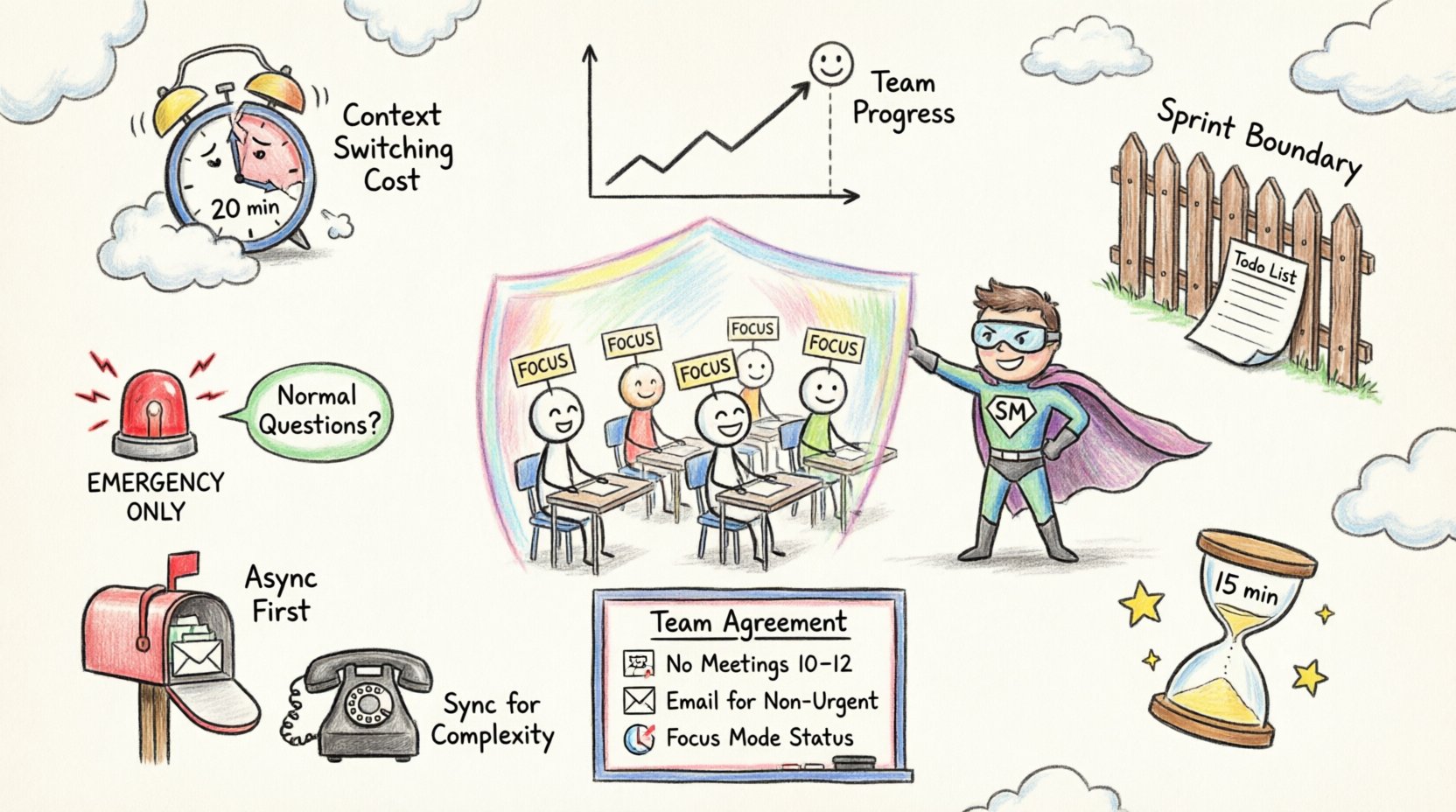
- Context Switching Overhead: Every time a team member stops working on a backlog item to address an interruption, they lose momentum. Studies indicate that regaining focus can take upwards of 20 minutes.
- Quality Degradation: Rushed work resulting from fragmented attention often leads to technical debt. This debt must be paid down later, slowing future iterations.
- Team Morale: Constant interruptions create a sense of reactivity rather than proactivity. Team members may feel their time is not valued, leading to disengagement.
- Sprint Goal Risk: If focus is fractured, the team may fail to complete committed work, jeopardizing the Sprint Goal and stakeholder trust.
Recognizing these costs helps justify the need for protected time. It shifts the conversation from “why are you ignoring me?” to “how do we ensure we deliver value?”
🛡️ Structuring the Sprint for Focus
The Scrum framework itself offers mechanisms to protect work. However, these mechanisms require active stewardship. The Sprint is the container for all work, and its integrity must be maintained.
1. Sprint Planning as a Boundary Setter
During Sprint Planning, the team commits to a specific set of items. This commitment creates a boundary. New requests that arrive mid-sprint should be evaluated against this boundary.
- Explicitly Define Scope: Ensure the Sprint Backlog is clearly visible and understood by all stakeholders.
- Change Management: Establish a protocol for adding new items. If a critical priority emerges, an existing item must be removed to maintain capacity.
- Stakeholder Expectations: Educate stakeholders that the Sprint Plan is not a suggestion list but a commitment. Changes require negotiation, not just immediate execution.
2. The Definition of Done (DoD)
A clear Definition of Done prevents the need for last-minute interruptions to clarify quality standards. When the criteria for completion are unambiguous, fewer questions arise during the execution phase.
- Collaborative Creation: Develop the DoD with the whole team, including developers and testers.
- Visual Indicators: Use the task board to show which items are in progress and which are ready for review.
- Refinement: Regularly review the DoD to ensure it reflects current technical standards and quality requirements.
💬 Communication Norms and Channels
How the team communicates determines how often interruptions occur. The medium used for a message often dictates the urgency perceived by the receiver. Moving from synchronous to asynchronous communication is a powerful lever for reducing interruptions.
1. Asynchronous First
Not every question requires an immediate answer. Documenting information allows team members to consume it on their own schedule.
- Documentation: Encourage writing down decisions, architectural patterns, and process changes. This creates a single source of truth.
- Updates: Use status updates in the task management tool rather than verbal check-ins. This reduces the need for “status update meetings”.
- Office Hours: Designate specific times for questions and collaboration. Outside these windows, team members focus on individual tasks.
2. Synchronous for Complexity
Some topics require real-time collaboration. Knowing when to switch to a live discussion is key.
- Brainstorming: Use meetings for creative sessions where ideas need to bounce off one another.
- Critical Blockers: If work is completely halted, a quick sync is appropriate. However, the goal is to resolve the blocker quickly and return to independent work.
- Retrospectives: Use the Retrospective to discuss communication friction. Is the team interrupting too much? Why?
📅 Optimizing Scrum Events
The standard Scrum events are designed to synchronize the team. However, if not managed well, they can become sources of interruption or inefficiency.
Daily Scrum: The 15-Minute Focus
The Daily Scrum is for the Developers. It is a planning meeting for the next 24 hours, not a status report for management.
- Stand-up Etiquette: Keep the meeting to the 15-minute timebox. If discussions get long, take them offline.
- Focus on the Plan: The discussion should center on what is being worked on, not just what was done.
- No Problem Solving: If a technical problem is identified, schedule a separate time to solve it. Do not turn the Daily Scrum into a working session.
Sprint Review: Controlled Feedback
The Sprint Review is often where stakeholders interrupt the flow with new ideas. It needs to be structured to welcome feedback without derailing the team.
- Increment Focus: The meeting is about inspecting the Increment. New ideas should be added to the Product Backlog, not the Sprint Backlog.
- Timeboxing: Set a clear time limit for the review. This prevents the meeting from dragging on and affecting end-of-day productivity.
- Product Owner Role: The Product Owner acts as a filter. They should manage stakeholder expectations regarding scope changes before they reach the development team.
🤝 Team Contracts and Boundaries
Explicit agreements about behavior help enforce boundaries without micromanagement. A “Team Charter” or “Working Agreement” is a living document that defines how the team operates.
Key Elements of a Working Agreement
| Area | Agreement Example | Benefit |
|---|---|---|
| Meeting Times | No meetings scheduled between 10:00 AM and 12:00 PM | Guarantees deep work time |
| Communication Channels | Use email for non-urgent updates; chat for urgent | Reduces notification fatigue |
| Availability | Mark status as “Focus Mode” during core hours | Signals unavailability clearly |
| Questions | Batch questions to 2:00 PM daily | Consolidates interruptions |
| Collaboration | Pair programming only when necessary | Preserves individual autonomy |
This table provides a template for teams to build their own agreements. The specific details matter less than the act of creating them together.
Implementing the Agreements
- Visual Cues: Use physical or digital signals. A red flag on a desk or a “Do Not Disturb” status in chat applications.
- Respect the Signal: If a team member is signaling focus, colleagues should respect it unless it is a true emergency.
- Regular Review: Check the Working Agreement during Retrospectives. Is it being followed? Does it need adjustment?
🛡️ The Scrum Master as a Shield
The Scrum Master has a unique responsibility to protect the team from external distractions. They do not manage the work, but they manage the environment in which the work happens.
1. Managing Stakeholders
External stakeholders often want immediate access to the team. The Scrum Master acts as the gatekeeper.
- Direct Communication: Encourage stakeholders to communicate directly with the Product Owner.
- Redirecting Requests: When stakeholders approach developers directly, guide them to the appropriate channel.
- Expectation Setting: Explain to stakeholders why interruptions harm the Sprint Goal.
2. Removing Impediments
Some interruptions are actually impediments in disguise. If a team member is constantly asked to fix something outside their scope, that is a process issue.
- Identify Patterns: Look for recurring types of interruptions. Are they technical? Administrative? External?
- Root Cause Analysis: Use the Retrospective to analyze why these interruptions happen.
- Systemic Fixes: Address the root cause. If it is a lack of clarity, improve documentation. If it is a resource issue, request support.
🧠 Psychological Safety and Culture
Reducing interruptions is not just about rules; it is about culture. Team members must feel safe to say “no” or “not now” without fear of retribution.
1. Encouraging Assertiveness
- Validate Priorities: When a team member says they are busy, validate that statement. Do not pressure them to drop what they are doing.
- Peer Support: Team members should support each other in maintaining focus. If one is interrupted, another might help deflect the request.
- Leadership Example: Leaders must model the behavior. If managers interrupt constantly, the team will follow suit.
2. Environment Design
- Physical Space: If possible, create quiet zones or private rooms for deep work.
- Digital Space: Configure tools to minimize notifications. Turn off non-essential alerts.
- Visual Management: Use Kanban boards to show work in progress. If the board is full, it visually signals that the team is at capacity.
🔄 Handling Emergencies
Not all interruptions are bad. Sometimes, a critical issue arises that requires immediate attention. The goal is to distinguish between true emergencies and perceived urgency.
1. Defining “Emergency”
- Service Outage: If production is down, this is an emergency.
- Security Breach: Immediate response is required.
- Stakeholder Crisis: A critical business need that cannot wait.
2. The Emergency Protocol
- Clear Definition: The team must agree on what constitutes an emergency.
- Escalation Path: Who decides that something is an emergency? Usually, this is the Scrum Master or Product Owner.
- Post-Incident Review: After an emergency is resolved, review what happened. Was it a true emergency, or could it have been handled differently?
📊 Measuring Progress
To ensure these strategies are working, the team should track relevant metrics. This data provides objective evidence of improvement.
Key Metrics to Track
- Sprint Burndown: Does the team finish committed work consistently?
- Velocity: Is the team maintaining a stable pace?
- Interruption Log: Track the frequency and type of interruptions during the Sprint.
- Team Happiness: Use Retrospective surveys to gauge how focused and engaged team members feel.
🚀 Moving Forward
Reducing interruptions while staying informed is a continuous improvement journey. It requires discipline, communication, and a commitment to the Sprint Goal. By implementing the strategies outlined above, teams can create a sustainable rhythm that supports high-quality work.
Start small. Pick one area, such as communication norms or meeting times, and implement changes there. Observe the impact. Adjust as needed. Over time, these small changes compound into a culture of focus and efficiency.
Remember, the objective is not to eliminate all contact. It is to ensure that contact serves the work, rather than hindering it. When the team is protected from unnecessary noise, they can deliver value with greater consistency and confidence.
Focus is a competitive advantage. Protect it wisely.