

The Sprint Review is frequently misunderstood. Many teams treat it as a final presentation, a demo day where the Development Team shows off completed work to stakeholders. While demonstrating the increment is a core component, the true value lies in the conversation that follows. This is where the product evolves. This is where the backlog is refined. This is where feedback transforms into action.
Providing and receiving actionable feedback is not a soft skill; it is a technical requirement for Agile success. Without precise, constructive input, the Product Backlog becomes a graveyard of vague ideas. This guide outlines the mechanics of delivering high-value feedback during Sprint Reviews, ensuring that every discussion leads to measurable progress.
What Defines Actionable Feedback? 🎯
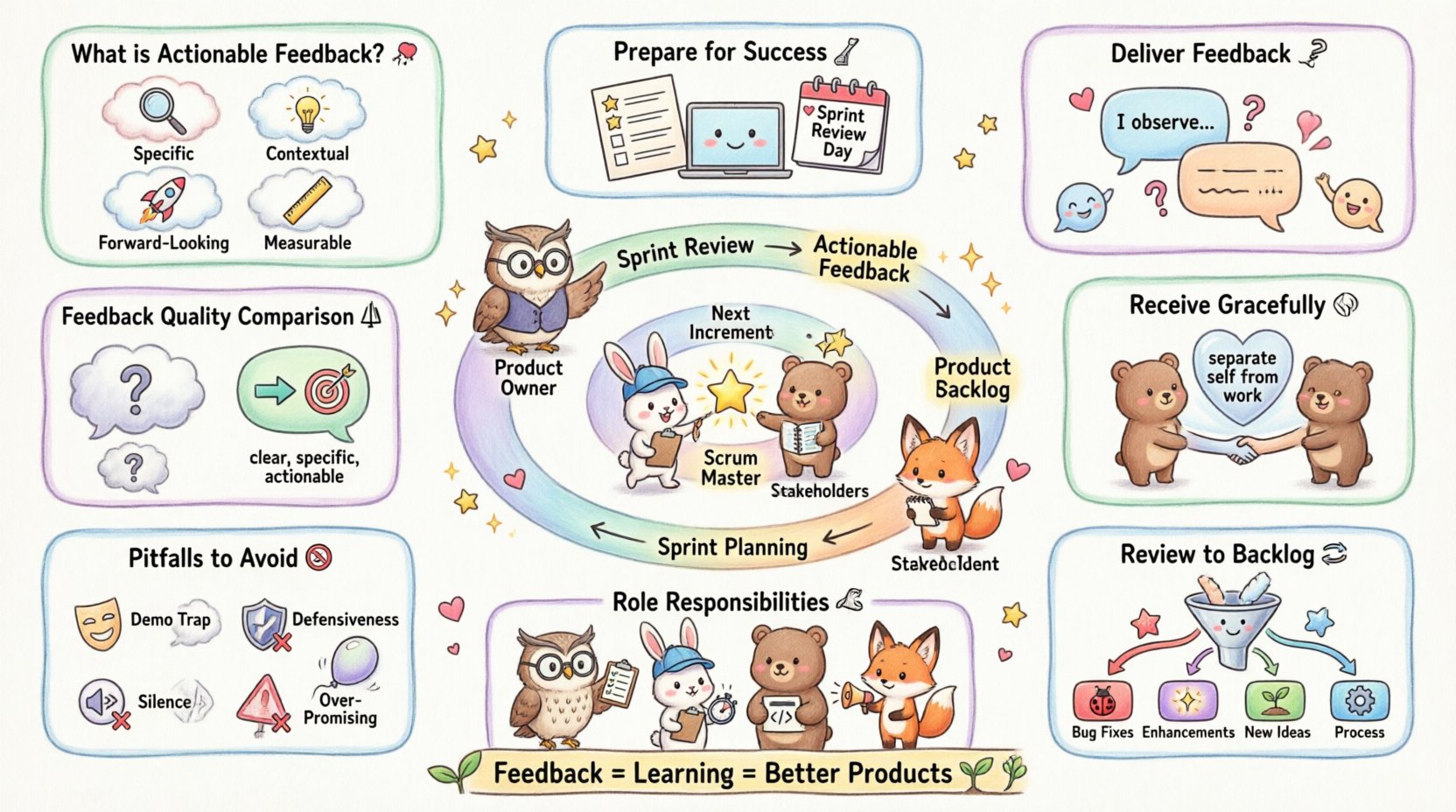
In the context of Scrum, feedback must be specific enough to influence the Product Backlog. General statements like “I like this” or “This looks nice” do not provide direction. They do not indicate what to keep, what to change, or what to remove.
Actionable feedback possesses specific characteristics. It must be grounded in observation rather than opinion. It must connect to business value or user needs. It must be clear enough for the Product Owner to prioritize.
- Specific: It refers to a specific feature, screen, or workflow.
- Contextual: It explains why the observation matters to the user or the business.
- Forward-Looking: It suggests a direction for the next iteration or a refinement in the backlog.
- Measurable: It implies a way to verify the change later (e.g., “This flow takes too many clicks”).
Consider the difference between these two statements:
- Vague: “The dashboard feels cluttered.”
- Actionable: “The key metrics are hard to find because the graph is buried under the navigation menu. Moving the chart to the top would help users see their status immediately.”
Preparing for the Feedback Loop 🛠️
Actionable feedback does not happen by accident. It requires preparation from both the Development Team and the stakeholders. The environment must be set up to encourage honest, focused dialogue.
1. Setting the Stage for Stakeholders
Before the meeting begins, invite stakeholders to understand the goal. Send a brief agenda that clarifies this is a collaborative session, not a lecture. Ask them to review the increment beforehand if possible, or to prepare specific questions.
When stakeholders arrive, they should be ready to engage. Provide them with the following context:
- The Goal of the Sprint: Remind them what the team aimed to achieve.
- The Scope: Clarify what was in scope and what was out of scope.
- The Definition of Done: Ensure everyone agrees on what constitutes a completed item.
2. Preparing the Increment
The Development Team must ensure the software is in a state that can be evaluated. This does not mean it must be perfect. It means it must be stable enough to demonstrate value without crashing.
- Real Data: Use realistic data sets where possible. Fake data can mask usability issues.
- Environment Parity: The demo environment should mimic the production environment as closely as feasible.
- Known Limitations: If a feature is incomplete, state this clearly. Transparency builds trust and prevents false expectations.
Delivering Feedback During the Review 🗣️
During the event, the flow of conversation shifts from the team presenting to the stakeholders discussing. This is the critical window for feedback. The Scrum Master facilitates this flow to ensure it remains productive.
1. Focus on the Product, Not the Process
The Sprint Review is not the place to discuss internal team dynamics. It is a forum for the product. If a stakeholder mentions a process issue, acknowledge it but move it to the Sprint Retrospective. Keep the review focused on the increment.
2. Use the “I Observe” Technique
Statements that begin with “I” are more palatable than accusations. This reduces defensiveness and opens the door for discussion.
- Instead of: “You didn’t design this correctly.”
- Try: “I observe that users might get confused at this step because the button label is similar to the previous one.”
3. Ask Open-Ended Questions
Facilitators and team members can prompt stakeholders to elaborate. This draws out deeper insights that simple yes/no answers miss.
- “How does this feature fit into your daily workflow?”
- “What is the biggest risk you see with this implementation?”
- “If we could change one thing about this screen, what would it be?”
Receiving Feedback with Grace 🤝
For the Development Team, receiving feedback can be challenging. It is easy to interpret criticism as a judgment on personal effort. Reframing this dynamic is essential for continuous improvement.
- Separate Self from Work: The code or the design is the object of feedback, not the person. This distinction protects psychological safety.
- Listen First: Do not interrupt to justify. Understand the stakeholder’s perspective fully before responding.
- Validate: Acknowledge the input. “Thank you for pointing that out. We will look into it.”
The Feedback Loop: From Review to Backlog 🔄
Feedback without action is noise. The value of the Sprint Review is realized in the subsequent Sprint Planning. The Product Owner must synthesize the feedback and update the backlog.
1. Categorizing Feedback
Not all feedback is equal. Some items require immediate attention, while others are nice-to-haves. The Product Owner should categorize feedback into:
- Bug Fixes: Issues that break functionality or violate the Definition of Done.
- Enhancements: Improvements to existing features based on user experience.
- New Ideas: Requests for entirely new functionality.
- Process Improvements: Changes to how the team works (move to Retrospective).
2. Prioritization Strategy
Once categorized, the Product Owner ranks these items against the current strategy. A single Sprint Review might generate twenty items, but only a few can fit into the next Sprint. The decision must be based on value, not just volume.
Common Pitfalls to Avoid 🚫
Even experienced teams fall into traps during Sprint Reviews. Awareness of these common mistakes helps maintain focus.
- The Demo Trap: Treating the event as a final show. If the product isn’t ready, don’t present it as ready.
- Defensiveness: Arguing with stakeholders about why a feature is difficult. Focus on the solution, not the constraint.
- Ignoring Silence: If stakeholders are quiet, do not assume they are happy. Ask specific questions to draw them out.
- Over-Promising: Committing to feedback items on the spot. Decisions on scope belong to the Product Owner, not the Development Team.
Comparison of Feedback Quality ⚖️
To illustrate the difference between effective and ineffective feedback, consider the following scenarios.
| Scenario | Ineffective Feedback | Actionable Feedback |
|---|---|---|
| Navigation | “The menu is bad.” | “The search bar is not visible on mobile. Users are missing the function.” |
| Performance | “It’s too slow.” | “The login page takes 5 seconds to load. This causes users to retry multiple times.” |
| Design | “This color is ugly.” | “The red button contrasts poorly with the background. Accessibility guidelines suggest a darker shade for better visibility.” |
| Functionality | “I don’t like how this works.” | “The current workflow requires three clicks to save. Users expect one click for this action.” |
Role Responsibilities in the Feedback Process 👥
Each role in the Scrum Team has a specific responsibility regarding feedback. Clear division of labor ensures nothing falls through the cracks.
| Role | Responsibility |
|---|---|
| Product Owner | Collects feedback, prioritizes backlog items, and ensures feedback aligns with the Product Goal. |
| Scrum Master | Facilitates the discussion, ensures time-boxing, and protects the team from unproductive arguments. |
| Development Team | Demonstrates the work, answers technical questions, and assesses the feasibility of new feedback. |
| Stakeholders | Provides user perspective, validates value, and offers market context. |
Measuring the Impact of Feedback 📈
How do you know if your feedback sessions are working? You can track several indicators over time.
- Backlog Health: Is the backlog updated regularly with stakeholder input? A stagnant backlog suggests poor feedback integration.
- Sprint Goal Achievement: Does feedback lead to changes that improve goal success in subsequent sprints?
- Stakeholder Engagement: Are stakeholders attending and participating actively? High engagement usually correlates with high-quality feedback.
- Defect Rate: Does feedback about bugs lead to a reduction in post-release issues?
Handling Difficult Conversations 💬
Not all feedback is easy to hear. Sometimes, stakeholders may demand changes that contradict the current strategy or technical constraints. Handling these moments requires diplomacy and clarity.
1. The “No” Scenario
If a request cannot be met, explain the trade-off. Do not simply say no. Say, “We can do that, but it would delay the timeline for X. Is that a priority?” This empowers the stakeholder to make the decision.
2. The Contradiction Scenario
Stakeholders may have conflicting views. The Product Owner must mediate this. The goal is to find the common objective that satisfies the core need, even if the implementation differs.
3. The Technical Debt Scenario
Stakeholders often do not understand technical debt. When feedback highlights a need for refactoring, explain the risk of not addressing it. “If we add this feature now without refactoring, the system will become slower by 20%. We recommend a small refactoring sprint first.”
Integrating Feedback into Sprint Planning 📅
The bridge between the Sprint Review and Sprint Planning is where the real work happens. The Product Owner should bring the refined list of feedback items to the Planning Session.
- Refine the Items: Ensure every feedback item is converted into a user story or task.
- Estimate: The Development Team must estimate the effort required to address the feedback.
- Commit: The team commits to the items that fit within the Sprint capacity.
This integration ensures that the feedback loop is closed. The review is not an endpoint; it is a data point that informs the next cycle of work.
Conclusion on Continuous Improvement 🌱
The Sprint Review is a powerful engine for product evolution. When used correctly, it aligns the team with stakeholder needs and ensures the product delivers real value. By focusing on specific, measurable, and forward-looking feedback, teams can avoid the trap of building the wrong thing.
Remember, the goal is not perfection in the first increment. The goal is learning. Every review provides new data. Every comment offers a chance to refine. By treating feedback as a strategic asset rather than a critique, teams can navigate complex projects with confidence and clarity.
Adopt these practices consistently. Over time, the quality of your product will rise, and the relationship with your stakeholders will strengthen. This is the essence of Agile delivery.