


In the dynamic environment of Agile development, clarity regarding who does what is the foundation of success. While the Development Team and Product Owner often receive the most attention, there is a critical group of individuals who hold significant influence over the product’s direction and success: the Stakeholders. Understanding the specific role of a stakeholder within the Scrum framework is essential for avoiding friction, ensuring alignment, and delivering value consistently. This guide explores the responsibilities, interactions, and best practices for stakeholders operating within a Scrum environment.
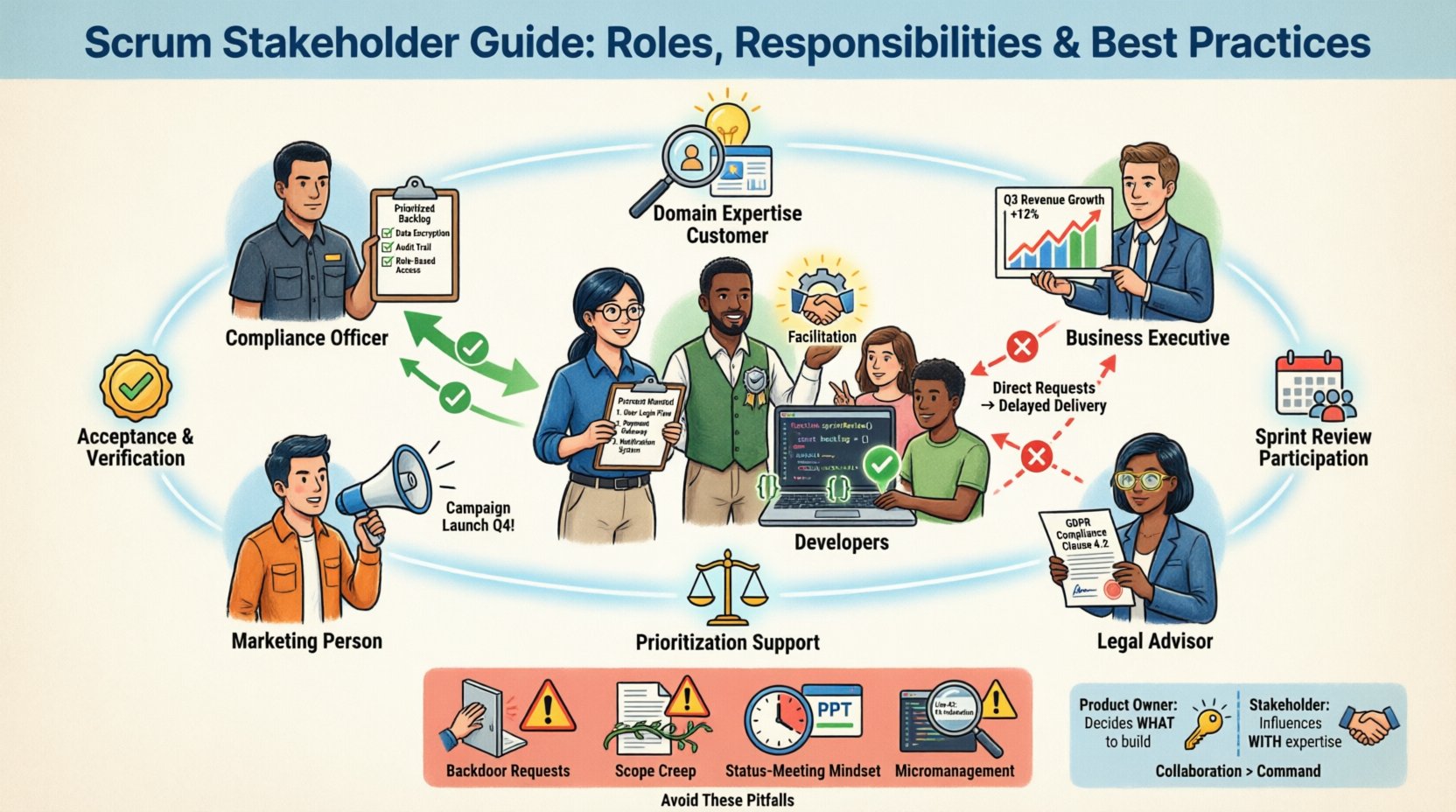
🤔 Who is a Scrum Stakeholder?
A stakeholder is anyone outside the Scrum Team who has an interest in the product or is affected by it. This definition is broad by design. It includes customers, users, management, legal advisors, compliance officers, and business leaders. Unlike the Scrum Team members, stakeholders are not part of the core group of three roles (Product Owner, Scrum Master, and Developers). They exist on the periphery, yet their input is the fuel that drives the product forward.
One common misconception is that stakeholders should be managing the day-to-day work of the Developers. This is incorrect. In Scrum, the team is self-managing. Stakeholders provide the what and the why through the Product Owner, rather than dictating the how. Confusing these boundaries often leads to micromanagement, which can erode team autonomy and slow down delivery.
🔄 The Core Scrum Roles: A Brief Context
To understand where the stakeholder fits, we must first look at the internal structure of the Scrum Team. The team consists of three specific roles, each with distinct accountabilities:
- Product Owner: Represents the voice of the customer and the business. They manage the Product Backlog and ensure the team is building the right thing.
- Scrum Master: Acts as a servant-leader for the Scrum Team. They ensure the process is followed and impediments are removed.
- Developers: The people doing the work. They create the increment of value at the end of each Sprint.
Stakeholders interact primarily with the Product Owner and, to a lesser extent, the Developers during specific events. They do not have direct authority over the Developers regarding task assignment or technical decisions.
📋 Key Responsibilities of a Stakeholder
Being a stakeholder is not a passive role. It requires active engagement at specific intervals to ensure the product remains relevant and valuable. Below are the primary responsibilities that define an effective stakeholder in a Scrum context.
1. Providing Domain Expertise
Stakeholders often possess deep knowledge about the market, the user base, or the regulatory environment. This information is critical for the Product Owner when refining the backlog. Without this input, the team might build technically sound features that fail to meet market needs.
- Share insights on current market trends.
- Explain the “why” behind specific business requirements.
- Clarify complex compliance or legal constraints early in the planning process.
2. Participating in the Sprint Review
The Sprint Review is the primary event where stakeholders engage with the team. It is not a status report; it is an inspection of the increment and an adaptation of the Product Backlog. Stakeholders are expected to attend this event regularly to provide feedback.
- Inspect the completed work (the increment).
- Provide constructive feedback on functionality and design.
- Discuss what is next based on the current state of the product.
- Ask questions about the feasibility of proposed features.
3. Supporting Prioritization Decisions
While the Product Owner owns the backlog, stakeholders help inform the priority. If multiple stakeholders have competing interests, it is the Product Owner’s job to negotiate, but stakeholders must provide the necessary context to make those decisions possible.
- Communicate the business value of requested features.
- Be willing to negotiate trade-offs when resources are limited.
- Accept that not every request can be implemented immediately.
4. Acceptance and Verification
Stakeholders play a vital role in the definition of “Done” for specific features. They are the ones who ultimately accept the work if it meets the business requirements. This does not mean they test the code, but they verify that the solution solves the business problem.
- Review the increment against acceptance criteria.
- Confirm that the solution meets user needs.
- Sign off on features ready for release.
🤝 Stakeholder Interactions: Who Do You Talk To?
Understanding who to communicate with is just as important as what to communicate. Improper communication channels can lead to confusion and scope creep. Here is how stakeholders should interact with the core Scrum Team.
Interacting with the Product Owner
This is the primary relationship. The Product Owner acts as the bridge between the stakeholder and the Development Team. Stakeholders should direct their requests, feedback, and requirements through the Product Owner.
- Request Features: Submit ideas to the Product Owner, not directly to developers.
- Clarify Requirements: The Product Owner will ask for details when needed.
- Feedback: Provide feedback on the backlog and the product vision.
Interacting with the Developers
Direct interaction is limited to the Sprint Review or during specific technical discussions where domain knowledge is needed. Developers focus on implementation, and stakeholders should respect their focus time.
- Discuss domain constraints during refinement sessions.
- Review the increment during the Sprint Review.
- Refrain from assigning tasks or estimating work directly.
Interacting with the Scrum Master
The Scrum Master facilitates the process. Stakeholders should engage with the Scrum Master if they observe process inefficiencies or if there are impediments preventing collaboration.
- Report process bottlenecks.
- Request training on Scrum events if needed.
- Discuss how to improve collaboration between business and team.
🚧 Common Pitfalls and Anti-Patterns
Even with the best intentions, stakeholders can inadvertently hinder the Scrum process. Recognizing these patterns is the first step toward avoiding them.
1. The “Backdoor” Request
This occurs when a stakeholder bypasses the Product Owner and asks a developer to make a change directly. This undermines the Product Owner’s authority and disrupts the team’s focus.
- Impact: Creates technical debt and untracked work.
- Solution: Enforce the rule that all changes go through the Product Owner.
2. Scope Creep During Sprints
Stakeholders may expect changes to be made mid-Sprint without consequence. In Scrum, the Sprint Goal is fixed. Changing requirements mid-cycle destabilizes the plan.
- Impact: Missed Sprint goals and team burnout.
- Solution: New requests are added to the backlog for the next Sprint.
3. Treating the Sprint Review as a Status Meeting
If stakeholders treat the Sprint Review as a place to report status rather than inspect the product, the value of the event is lost. It should be a collaborative discussion.
- Impact: Lack of transparency and missed feedback opportunities.
- Solution: Focus on the product increment and future direction.
4. Micromanagement of the Team
Stakeholders often want to know exactly how much time a task will take. Developers estimate effort, not time. Stakeholders should trust the team’s estimation process.
- Impact: Erodes trust and team autonomy.
- Solution: Focus on value delivery rather than hourly tracking.
📊 Comparison: Stakeholder vs. Product Owner
To further clarify the distinction, consider the following comparison table. This highlights the differences in authority, focus, and accountability.
| Aspect | Product Owner | Stakeholder |
|---|---|---|
| Primary Focus | Maximizing product value | Business interest / Domain expertise |
| Backlog Ownership | Owns and prioritizes | Provides input only |
| Availability | High (Daily) | Medium (Sprint Review / Refinement) |
| Decision Power | Decides what to build | Influences what to build |
| Accountability | Accountable for ROI | Accountable for business needs |
🛡️ Navigating Complex Stakeholder Environments
In large organizations, there may be dozens of stakeholders. Some may have conflicting interests. Managing this complexity requires a structured approach to engagement.
1. The Stakeholder Map
Create a visual map of all stakeholders. Identify who is influential, who is interested, and who has decision-making power. This helps the Product Owner prioritize which voices to amplify during backlog refinement.
- Identify key decision-makers.
- Map out communication channels.
- Ensure no critical stakeholder is left out of the review process.
2. Regular Cadence
Establish a regular cadence for stakeholder engagement that does not overwhelm the team. This might be a bi-weekly sync or a dedicated session prior to Sprint Reviews.
- Set expectations for attendance.
- Define the agenda for each meeting.
- Document outcomes and action items.
3. Managing Conflicts
When stakeholders disagree on priorities, the Product Owner is the arbiter. However, stakeholders should be encouraged to discuss their disagreements openly before bringing them to the backlog.
- Facilitate discussions between conflicting parties.
- Focus on business value rather than personal preference.
- Accept that compromise is part of the process.
📈 Measuring Stakeholder Value
How do you know if stakeholder engagement is working? It is not about the number of meetings held, but the quality of the collaboration. Consider the following indicators:
- Sprint Review Attendance: Are stakeholders showing up regularly?
- Feedback Quality: Is feedback constructive and actionable?
- Backlog Clarity: Do requirements become clearer after stakeholder input?
- Release Confidence: Do stakeholders feel confident in the product quality before release?
- Reduced Rework: Are there fewer changes requested after development starts?
🚀 Best Practices for Engagement
To foster a healthy relationship between the Scrum Team and stakeholders, adopt these best practices. These habits build trust and streamline the delivery process.
- Respect the Sprint Goal: Do not expect changes mid-Sprint unless absolutely critical.
- Be Available: Make time for Sprint Reviews and Refinement sessions.
- Speak the Language: Learn the basics of the development process to communicate effectively.
- Focus on Value: Always tie requests back to business value.
- Trust the Team: Allow the team to manage their own workload and technical decisions.
- Provide Timely Feedback: Do not wait until the end of the project to share concerns.
🔍 Deep Dive: The Sprint Review
The Sprint Review is the most critical touchpoint for stakeholders. It is often misunderstood as a demo. While a demo is part of it, the review is a working session.
Before the Review:
- Review the Sprint Goal and the items selected for the Sprint.
- Prepare specific questions about the functionality.
- Bring relevant business data or user feedback to the table.
During the Review:
- Inspect the increment collaboratively.
- Discuss the current state of the Product Backlog.
- Adapt the Product Backlog based on insights.
- Discuss the next steps and future opportunities.
After the Review:
- Share feedback with the Product Owner immediately.
- Update internal stakeholders if necessary.
- Prepare for the next Sprint planning cycle.
🔐 Specialized Stakeholder Roles
Not all stakeholders are the same. Some have specialized roles that require specific attention within the Scrum framework.
Compliance and Legal
These stakeholders ensure the product meets regulatory standards. They must be involved early to avoid costly rework later. Their input is often a hard constraint on the design.
- Review architecture decisions for compliance.
- Validate documentation requirements.
- Ensure data privacy standards are met.
Marketing and Sales
These stakeholders focus on the go-to-market strategy. They need to know when features will be ready to launch campaigns or sell the product.
- Coordinate release dates with marketing plans.
- Provide feedback on user experience for sales pitches.
- Ensure features align with market positioning.
Executive Leadership
Leaders focus on high-level strategy and ROI. They do not need to know the technical details but need visibility into progress and value delivery.
- Review high-level metrics and outcomes.
- Align team goals with organizational strategy.
- Remove organizational impediments.
💡 The Path to Collaboration
Success in Scrum is not just about the code written; it is about the collaboration between the team and the business. Stakeholders are the bridge to the market. By understanding their responsibilities and respecting the boundaries of the Scrum Team, organizations can achieve higher efficiency and better products.
Remember that Scrum is a framework, not a rigid set of rules. It requires adaptation to the specific context of your organization. However, the core principles of transparency, inspection, and adaptation remain constant. Stakeholders who embrace these principles will find themselves more integrated, more valued, and more effective in driving the product to success.
Start by clarifying expectations. Hold open conversations about how to work together. Be patient with the learning curve. And always keep the end goal in sight: delivering value to the customer. When stakeholders and the Scrum Team work in harmony, the result is a product that not only works but thrives in the marketplace.