

Understanding how to evaluate the effectiveness of a Product Owner (PO) is a critical challenge for Agile leaders. In many Scrum environments, teams and stakeholders mistakenly rely on velocity as the primary indicator of success. However, velocity is a measure of a development team’s throughput, not a measure of the Product Owner’s ability to drive value.
Using velocity to judge a Product Owner creates misaligned incentives. It encourages prioritizing quantity over quality and can lead to burnout or gaming the system. To truly understand the impact of a Product Owner, you must shift focus to metrics that reflect value delivery, backlog health, and stakeholder satisfaction.
🚫 Why Velocity Fails as a Product Owner Metric
Velocity is a team metric. It represents the average amount of work a Scrum Team completes during a sprint. It is a planning tool for the developers, not a performance review for the Product Owner. When you use velocity to measure the Product Owner, several issues arise:
- Prioritization Distortion: The PO may prioritize stories that are easy to complete rather than those that provide the most business value.
- Scope Manipulation: To maintain high velocity, the PO might break down work into smaller chunks artificially, obscuring the true complexity of features.
- Team Pressure: It places undue pressure on the development team to maintain a number, potentially compromising quality.
- Ignoring External Factors: Velocity fluctuates due to holidays, sick leave, or technical debt. It does not account for the PO’s strategic decisions.
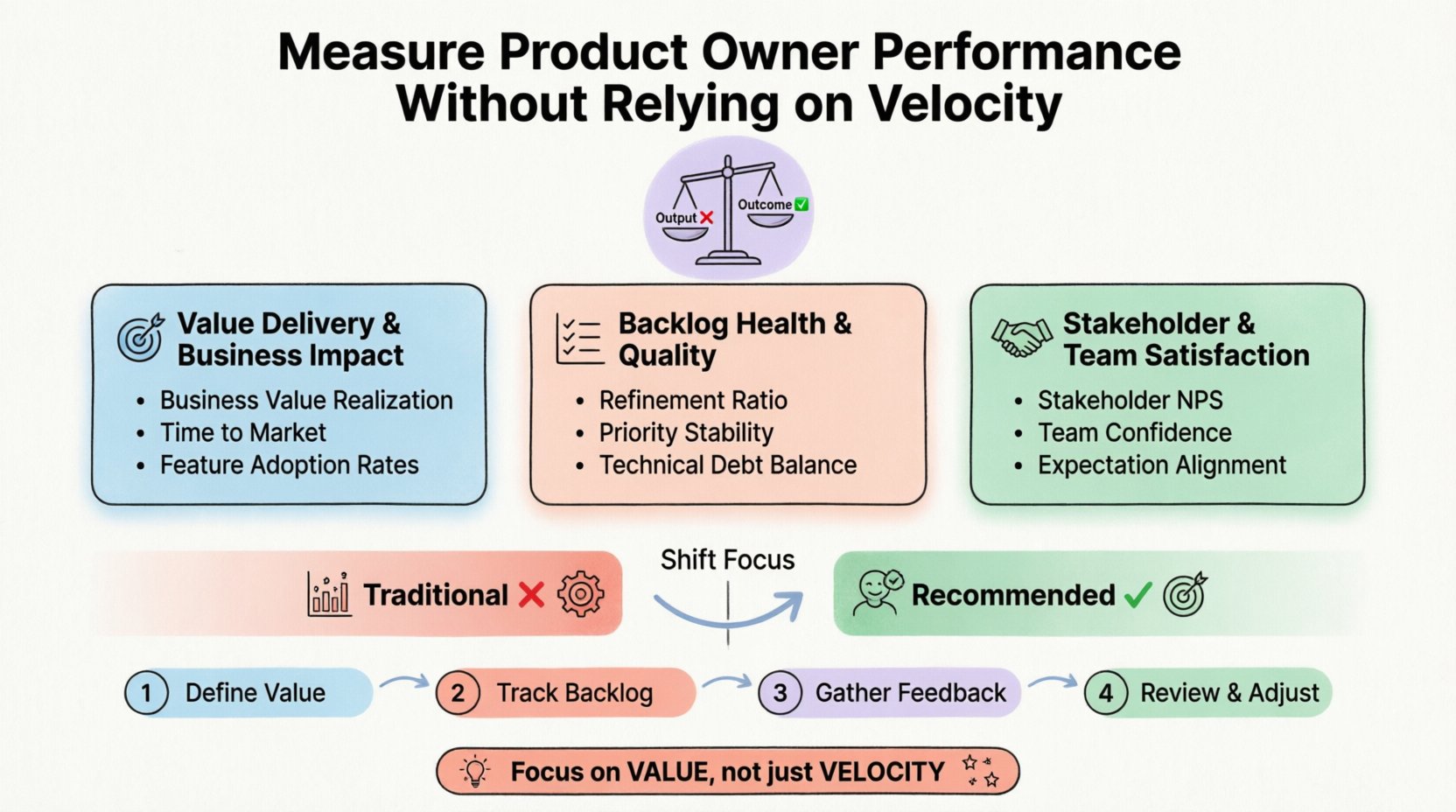
To evaluate a Product Owner effectively, you need a balanced scorecard that looks at the outcome, not just the output.
🎯 Core Metric 1: Value Delivery & Business Impact
The primary responsibility of a Product Owner is to maximize the value of the product resulting from the work of the Development Team. Measuring value requires looking at how the software impacts the business and the customers.
1.1 Business Value Realization
Instead of asking “How many points did we complete?”, ask “How much value did we deliver?”. This can be tracked through:
- Estimated vs. Actual Business Value: Assign value points (e.g., 1-10) to features during backlog refinement. Compare the total value of completed items against the value of planned items.
- Return on Investment (ROI): For major releases, calculate the cost of development against the revenue or cost savings generated.
- Feature Adoption Rates: Track how many users actually engage with a new feature after release. High velocity means nothing if no one uses the feature.
1.2 Time to Market
A skilled Product Owner understands the urgency of bringing value to the market. Measure the lead time from idea conception to production deployment for key features.
- Idea to Release: How long does it take from a stakeholder request to the feature being live?
- Release Frequency: Are releases happening regularly and predictably?
- Time to Value: How quickly after deployment do customers start deriving benefit?
🧹 Core Metric 2: Backlog Health & Quality
A healthy backlog is a sign of a healthy Product Owner. If the backlog is a graveyard of unrefined tickets, the Product Owner is failing to prepare the team for success. Focus on the quality of the work in progress.
2.1 Backlog Refinement Metrics
Refinement is the process of breaking down and clarifying items. A good PO ensures the team is not blocked by ambiguity.
- Refinement Ratio: Percentage of backlog items that are fully refined (acceptance criteria clear, estimates done) before a sprint planning session.
- Stability of Commitments: How often is the sprint goal changed mid-sprint due to unclear requirements? Low stability indicates good upfront preparation.
- Story Completion Rate: How often are items marked as Done without needing clarification during the sprint?
2.2 Priority Management
The PO acts as the filter for the team. The backlog should always be ordered by value and urgency.
- Priority Reversals: How often are the top items in the backlog changed before the sprint starts? Frequent changes suggest poor planning or external pressure.
- Technical Debt Management: Is the PO actively ensuring time is allocated for technical debt alongside feature work?
- Backlog Size: Is the backlog too small (starving the team) or too large (causing confusion)? It should be sized appropriately for the sprint cadence.
🤝 Core Metric 3: Stakeholder & Team Satisfaction
The Product Owner is the bridge between the business and the team. Their ability to communicate and manage expectations is crucial. This is best measured through feedback loops.
3.1 Stakeholder Satisfaction
Are the people funding the product satisfied with the results?
- Stakeholder NPS: Send a simple Net Promoter Score survey to key stakeholders after each release or quarter.
- Transparency: Do stakeholders feel informed about progress without needing to chase the PO for updates?
- Expectation Alignment: Does the delivered product match what the stakeholders asked for? High variance suggests a communication gap.
3.2 Team Enablement
The development team should feel supported by the Product Owner. A good PO removes obstacles related to requirements and decisions.
- Team Confidence: In retrospectives, do developers express confidence in the backlog items?
- Question Frequency: How often does the team ask the PO for clarification during a sprint? High frequency indicates poor definition of done.
- Sprint Goal Achievement: Did the team achieve the goal set at the start of the sprint? This reflects the clarity of the PO’s direction.
📊 Comparative Metrics Table
To help visualize the shift from traditional metrics to value-based metrics, review the comparison below.
| Metric Category | Traditional (Velocity Focus) | Recommended (Value Focus) |
|---|---|---|
| Primary Goal | Complete the most story points | Deliver the most business value |
| Backlog Focus | Maximize quantity of items | Ensure clarity and readiness of items |
| Success Indicator | High velocity trend line | High stakeholder satisfaction & adoption |
| Team Interaction | Pushing for speed | Removing ambiguity and blockers |
| Outcome | Output (Code shipped) | Outcome (Problem solved) |
🛠️ Implementation Strategy: How to Start Measuring
Shifting your measurement culture takes time. Here is a step-by-step approach to implementing these metrics without disrupting the team.
Step 1: Define Value with Stakeholders
Before measuring, you must agree on what value looks like. Sit down with key business stakeholders and define the success criteria for major initiatives. Is it revenue? Is it user retention? Is it cost reduction?
- Document these definitions clearly.
- Ensure the Product Owner knows which metric matters most for the current quarter.
Step 2: Track Backlog Health
Start observing the state of the backlog. Do not make this punitive. Use it as a diagnostic tool.
- Review the top 20 items in the backlog weekly.
- Check if they have clear acceptance criteria.
- Note how often the top items change before the sprint begins.
Step 3: Gather Qualitative Feedback
Quantitative data tells you what happened; qualitative data tells you why. Introduce simple feedback mechanisms.
- Ask the development team in retrospectives: “Did you feel supported by the Product Owner this sprint?”
- Ask stakeholders: “Did the last release meet your needs?”
Step 4: Review and Adjust
Don’t set it and forget it. Review these metrics quarterly with the Product Owner.
- Highlight wins where value was delivered.
- Identify areas where communication broke down.
- Adjust the definition of success if business goals shift.
⚠️ Common Pitfalls to Avoid
Even with the right metrics, implementation can go wrong. Watch out for these common mistakes.
3.1 Micromanagement
Using metrics to police the Product Owner creates a toxic environment. These measurements should be used for coaching and improvement, not punishment.
3.2 Ignoring Context
Not all features are created equal. A complex technical migration might have low immediate business value but high long-term value. Ensure the PO can explain the rationale behind the backlog order.
3.3 Vanity Metrics
Avoid metrics that look good but mean nothing. For example, “Number of Features Released” is a vanity metric if those features are unused. Focus on Active Users or Feature Utilization instead.
3.4 Over-Engineering the Measurement
You do not need a complex dashboard for every single metric. Sometimes a spreadsheet or a conversation is enough. Keep the measurement process lightweight.
🔍 Deep Dive: The Role of Customer Feedback
A Product Owner who ignores the customer is working in a vacuum. Integrating direct customer feedback into performance measurement is essential.
Direct User Input
- Support Ticket Volume: Are new features generating fewer support tickets than expected? Or more?
- Customer Interviews: How regularly does the PO conduct or review interviews with users?
- Feedback Loop Time: How long does it take from receiving a bug report to deploying a fix?
Usability and Experience
Value is not just functional. It is also experiential.
- Usability Scores: If you run usability tests, track the scores over time.
- Task Completion Rates: Can users complete their goals using the new software?
🔄 Continuous Improvement for the Product Owner
Performance measurement is not a one-time event. It is part of a continuous improvement cycle for the role itself.
- Quarterly Reviews: Schedule formal reviews where the Product Owner presents value metrics to leadership.
- Peer Reviews: Allow other Product Owners to review each other’s backlogs and strategies.
- Mentorship: Pair junior Product Owners with experienced ones to discuss how they handle prioritization and stakeholder management.
📝 Frequently Asked Questions
Q: Can I ever use velocity to measure a Product Owner?
A: Velocity can be a secondary indicator of team stability, which the PO influences, but it should never be the primary KPI. If velocity drops, investigate the backlog health or team capacity, not the PO’s performance directly.
Q: What if stakeholders don’t agree on what “value” is?
A: This is a leadership problem, not just a Product Owner problem. Facilitate a workshop to align stakeholders. The PO’s job is to facilitate this alignment, but the organization must support it.
Q: How do I measure technical debt if it doesn’t have direct business value?
A: Frame technical debt in terms of risk and speed. Explain that paying down debt reduces the time to market for future features. Measure the reduction in bug rates or the increase in deployment speed after debt reduction.
Q: Is stakeholder satisfaction subjective?
A: It can be. To make it objective, use structured surveys with Likert scales and track trends over time rather than single data points.
Q: What if the team is new and lacks data?
A: Start with qualitative measures. Focus on stakeholder communication and backlog readiness. As the team stabilizes, introduce quantitative metrics like lead time.
🚀 Final Thoughts on Performance Evaluation
Moving away from velocity as a Product Owner metric is a necessary evolution for Agile maturity. It shifts the focus from how much work was done to what value was created. By tracking value delivery, backlog health, and stakeholder satisfaction, you gain a clearer picture of the Product Owner’s true contribution.
This approach requires more effort than simply looking at a number. It requires conversation, alignment, and a willingness to look at qualitative data. However, the result is a Product Owner who is empowered to make better decisions, a team that is less stressed, and a business that sees real returns on its investment.
Start by auditing your current metrics. Identify which ones are output-focused and which are outcome-focused. Make the shift gradually. Engage the Product Owner in the conversation about how they are measured. When the measurement aligns with the goal of value creation, everyone wins.
Remember, the goal is not to find a perfect number. The goal is to build a system where the Product Owner knows exactly how to succeed. Value, quality, and satisfaction are the compass points for that success.