

Strategic planning often begins with a SWOT analysis. This framework helps organizations identify Strengths, Weaknesses, Opportunities, and Threats. However, a SWOT analysis is only as strong as the data supporting it. Without validation, these conclusions can become subjective guesses rather than actionable insights. This article explores how to validate SWOT conclusions using evidence-based research. We will look at data sources, bias mitigation, and practical steps to ensure strategic decisions are grounded in reality. 🧐
Why Validation Matters in Strategic Planning 🔍
Many teams treat SWOT analysis as a brainstorming session. They list items based on intuition or recent experiences. This approach carries significant risk. Unverified assumptions can lead to resource allocation errors. They can also cause missed market opportunities. Validating the findings ensures that the strategy is built on a solid foundation.
Reduces Risk: Verified data minimizes the chance of strategic failure.
Increases Confidence: Stakeholders trust plans backed by hard evidence.
Improves Accuracy: Distinguishes between perceived capabilities and actual performance.
Aligns Teams: Shared data creates a common understanding of the business landscape.
When you validate SWOT conclusions, you move from speculation to analysis. This shift requires a disciplined approach to information gathering. It involves cross-referencing internal metrics with external market data. It also requires questioning initial assumptions throughout the process. 📉
Common Biases in SWOT Frameworks 🧠
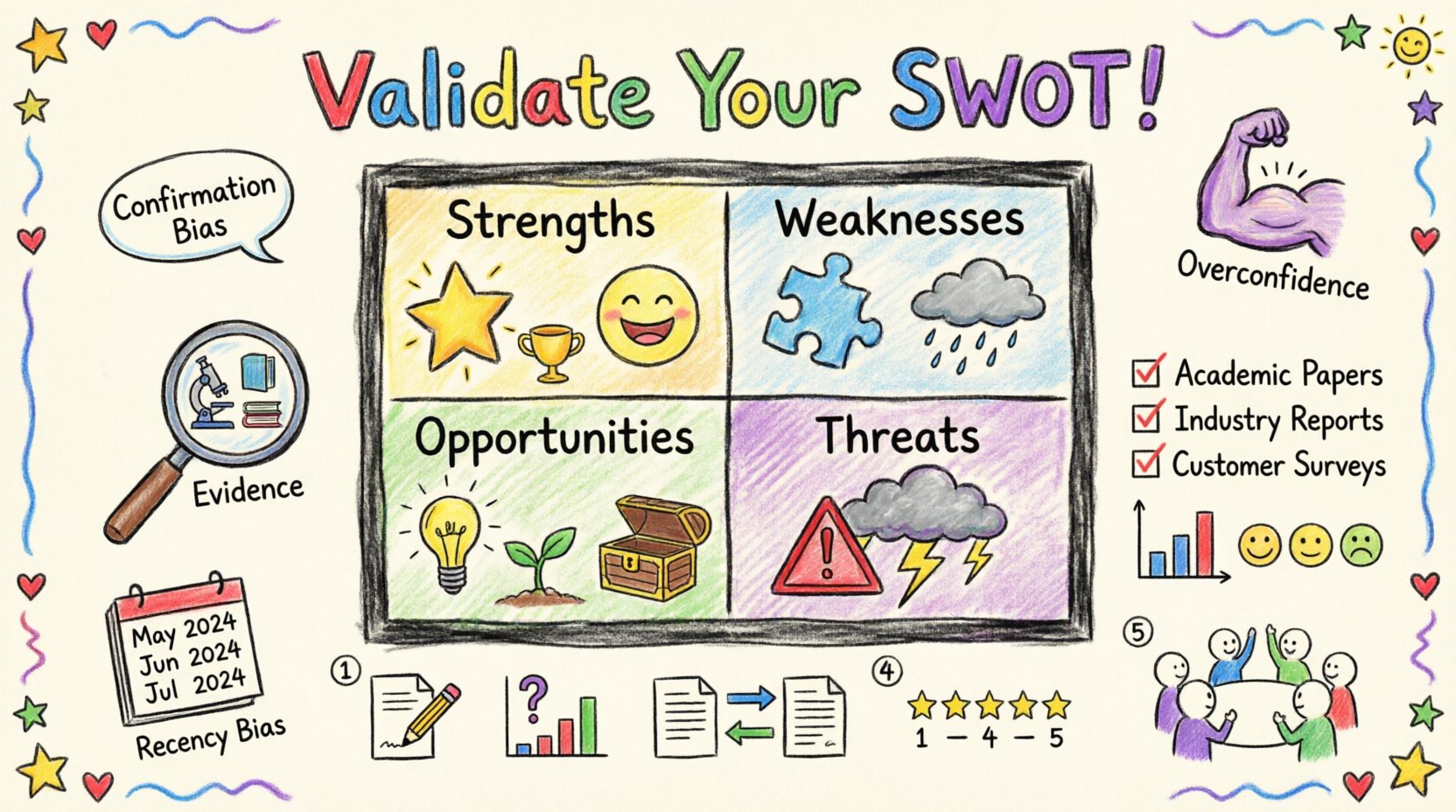
Human judgment is inherently flawed. Even experienced strategists fall prey to cognitive biases. Recognizing these biases is the first step in validation. Here are common pitfalls that affect SWOT analysis:
Confirmation Bias: Seeking information that supports existing beliefs while ignoring contradictory data.
Overconfidence Effect: Overestimating internal strengths and underestimating external threats.
Recency Bias: Giving too much weight to recent events rather than long-term trends.
Groupthink: Suppressing dissenting opinions to maintain group harmony, leading to weak analysis.
Survivorship Bias: Focusing on successful competitors without understanding why they succeeded.
Each of these biases can distort the four quadrants of the analysis. For example, confirmation bias might lead a team to classify a temporary trend as a permanent strength. Validation processes must specifically target these areas to ensure objectivity. 🔬
Sources of Evidence for Each Quadrant 📂
To validate a SWOT analysis, you need specific evidence for each category. Internal data is crucial for Strengths and Weaknesses. External data is essential for Opportunities and Threats. Using a mix of quantitative and qualitative data provides a comprehensive view. 📈
1. Validating Strengths
Strengths are internal attributes that give an organization an advantage. To verify these, look at:
Historical performance metrics over multiple years.
Customer satisfaction scores and retention rates.
Patents, proprietary technology, or unique processes.
Employee skill assessments and turnover rates.
Financial ratios compared to industry benchmarks.
A claim of “strong brand reputation” requires data such as net promoter scores or market share analysis. A claim of “efficient operations” needs process time metrics or cost-per-unit comparisons.
2. Validating Weaknesses
Weaknesses are internal factors that hinder performance. These are often harder to admit but critical to address. Evidence includes:
Declining revenue trends in specific sectors.
High customer churn rates in certain segments.
Outdated technology infrastructure.
High operational costs compared to competitors.
Skills gaps identified in performance reviews.
Identifying a weakness is only useful if you can quantify its impact. For instance, “poor customer service” should be supported by ticket response times or complaint volume.
3. Validating Opportunities
Opportunities are external factors the organization can exploit. These require market research. Look for:
Emerging market trends and consumer behavior shifts.
Regulatory changes that favor new products.
Gaps in competitor offerings.
Technological advancements that reduce costs.
Partnership potential with other entities.
Validation here means confirming the market size and growth potential. An opportunity is not real unless there is demand and a viable path to capture it.
4. Validating Threats
Threats are external factors that could cause trouble. These require monitoring the competitive landscape. Evidence includes:
Competitor product launches or pricing strategies.
Supply chain disruptions or raw material cost fluctuations.
Changes in consumer preferences.
Economic indicators like inflation or recession risks.
New legislation affecting operations.
A threat must be assessed for probability and impact. A potential competitor entering the market is only a threat if they have the capacity to gain market share quickly.
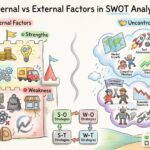
Table: Internal vs External Data Sources 📋
Data Type | SWOT Quadrant | Example Sources |
|---|---|---|
Internal | Strengths & Weaknesses | Financial reports, CRM data, HR records, Inventory logs |
Internal | Strengths & Weaknesses | Employee surveys, Process audit results, IT system logs |
External | Opportunities & Threats | Industry reports, Competitor analysis, Market research |
External | Opportunities & Threats | Regulatory filings, Economic forecasts, Social media sentiment |
This table highlights the distinction between where data originates and where it applies. Mixing these sources incorrectly can lead to flawed conclusions. Always ensure the data source matches the nature of the quadrant being analyzed.
A Step-by-Step Verification Process 🛠️
Once you have identified the potential items for the SWOT matrix, you need a process to verify them. This workflow ensures rigor and consistency. Follow these steps to validate your findings effectively.
Step 1: Document Initial Claims
Write down every point proposed for the SWOT analysis. Do not rely on verbal agreements. Documentation forces clarity and allows for later reference. Each claim should be written as a clear statement.
Step 2: Assign Data Requirements
For each claim, specify what evidence is needed. If a team member says “We have a unique feature,” ask for the patent number or technical specification. If they say “Market is growing,” ask for the growth rate percentage.
Step 3: Gather and Cross-Reference
Collect data from multiple sources. Do not rely on a single report. Cross-reference internal data with external industry reports. Discrepancies here are red flags that need investigation. 🚩
Step 4: Score Confidence Levels
Assign a confidence score to each point. Use a scale from Low to High based on data quality. Points with Low confidence should be flagged for further research or removed until verified.
Step 5: Review by Independent Stakeholders
Have individuals outside the planning group review the validated points. Their objectivity helps identify blind spots or lingering biases. This step acts as a final check before strategy formulation.
Integrating Validated Data into Strategy 🚀
Validation is not the end goal. It is a means to better strategy. Once the SWOT analysis is verified, the data should drive decision-making. Here is how to translate validated insights into action.
Resource Allocation: Direct investment toward validated Strengths and Opportunities.
Risk Mitigation: Create contingency plans for verified Threats.
Remediation: Address Weaknesses that are confirmed by data before expanding.
Goal Setting: Set specific, measurable goals based on the verified market size or capability gaps.
Strategies built on unverified data often fail when the market reality does not match the assumption. Validated strategies adapt faster to changes because they are rooted in observable facts. This agility is crucial in dynamic business environments. 🌍
Challenges in Gathering Reliable Data 📉
Even with a solid process, challenges arise. Data availability is not guaranteed. Some information may be proprietary or difficult to access. Acknowledging these limitations is part of the validation process.
Data Silos: Information is often trapped in different departments. Breaking these silos requires coordination and access permissions.
Data Quality: Old or inaccurate data can lead to false validation. Regular data cleansing is necessary.
Time Constraints: Gathering comprehensive evidence takes time. Balancing speed with accuracy is a constant tension.
Cost: Some external market research requires significant financial investment.
To overcome these, prioritize the most critical points. Focus validation efforts on the strategic pillars rather than every minor detail. Use proxy metrics where direct data is unavailable. For example, use search volume trends as a proxy for consumer interest if sales data is not public.
Best Practices for Objective Analysis ✅
To maintain integrity throughout the validation process, adhere to these best practices. They help keep the analysis focused and unbiased.
Establish Clear Criteria: Define what constitutes a valid strength or threat before starting.
Use Multiple Perspectives: Include voices from sales, operations, finance, and customer support.
Update Regularly: SWOT analysis is not a one-time event. Update it as new data becomes available.
Document the Process: Keep records of how conclusions were reached for future audits.
Focus on Trends: Look at long-term trends rather than single data points which may be anomalies.
These practices foster a culture of evidence-based decision-making. Over time, this culture reduces the reliance on gut feeling and increases organizational maturity. It shifts the focus from “what we think” to “what we know.” 🧠
The Role of Technology in Validation 🖥️
While specific software products are not the focus, the role of tools is relevant. Modern data tools facilitate the aggregation and analysis of large datasets. They allow for real-time monitoring of key performance indicators. This capability makes continuous validation possible.
Automated reporting helps identify deviations from expected performance. This signals potential Weaknesses or Threats earlier than manual review would. Dashboards can visualize the data needed to support the Strengths and Opportunities quadrants. Using technology to manage data does not replace human judgment but supports it with better information. 📊
Final Considerations for Strategic Leaders 👥
Leadership plays a critical role in enforcing validation standards. If leaders accept unverified claims, the culture will shift back to speculation. It is important to model the behavior of asking for data. When a proposal is made, ask “What evidence supports this?” consistently.
This inquiry should not be perceived as distrust. It should be framed as a commitment to success. Validating SWOT conclusions protects the organization from costly mistakes. It ensures that resources are spent on initiatives with the highest probability of success. 🎯
The landscape of business is complex and constantly changing. Static plans are rarely sufficient. A validated SWOT analysis provides a dynamic foundation. It allows the organization to pivot based on verified changes in the market or internal capabilities. This resilience is a key competitive advantage in any sector.
By rigorously applying evidence-based research to your strategic planning, you elevate the quality of your decisions. You move beyond intuition and into a space of calculated action. This is the path to sustainable growth and long-term stability. 🏆