


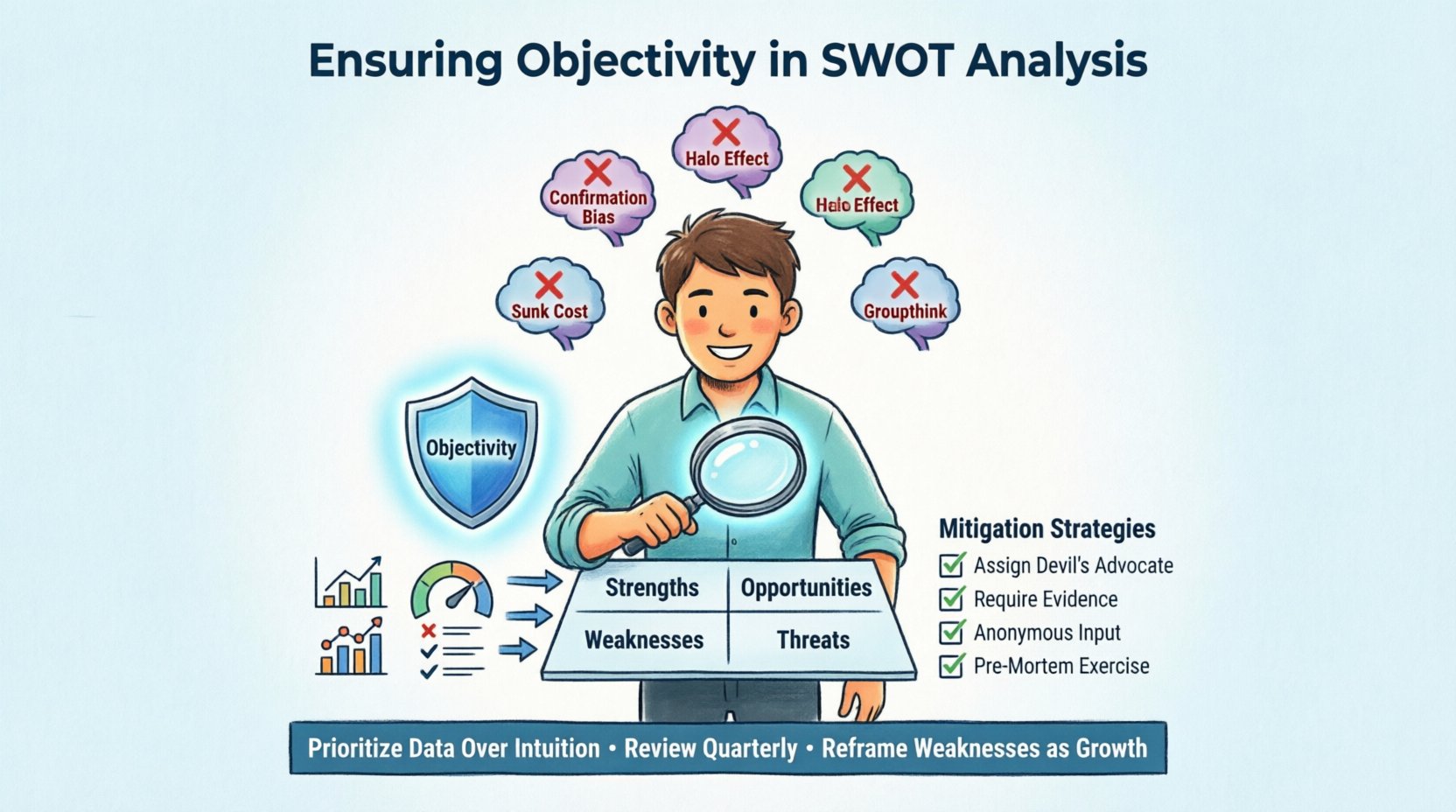
Strategic planning relies heavily on accurate self-assessment and environmental scanning. The SWOT analysis framework—Strengths, Weaknesses, Opportunities, and Threats—has remained a staple in business strategy and personal development for decades. However, the utility of this tool depends entirely on the quality of the input. When a SWOT exercise becomes a collection of subjective feelings or unchecked assumptions, it transforms from a strategic asset into a source of confusion.
Objectivity is the cornerstone of a meaningful SWOT analysis. Whether you are leading a corporate board meeting or conducting a personal career audit, the risk of cognitive bias is high. This article explores the mechanisms of bias in strategic planning and provides actionable methods to maintain clarity and accuracy throughout the process.
Why Objectivity Matters in Strategic Planning 📊
Strategy is the bridge between where you are and where you want to be. If the map you are using is distorted, the destination becomes unreachable. Subjectivity introduces distortion. When individuals or teams prioritize their desires over facts, the resulting plan is built on sand.
Consider the consequences of a subjective SWOT:
- Resource Misallocation: Investing in a “strength” that is actually perceived rather than proven wastes capital and time.
- Missed Opportunities: Ignoring a threat because it feels uncomfortable leads to vulnerability.
- Team Friction: When personal opinions are presented as facts, collaboration breaks down.
- False Confidence: Overestimating capabilities can lead to aggressive expansion plans that fail due to lack of capacity.
Achieving objectivity requires a shift in mindset. It demands that participants prioritize evidence over intuition. It requires a willingness to admit limitations without fear of judgment. This cultural shift is often more challenging than the analytical work itself.
Common Cognitive Biases in SWOT Analysis 🧠
Understanding bias is the first step toward mitigating it. The human brain is wired to protect its own ego and preserve existing beliefs. In a strategic context, these protective mechanisms can derail the process. Below are the most prevalent biases encountered during SWOT exercises.
1. Confirmation Bias
This occurs when participants seek out information that confirms their pre-existing beliefs while ignoring data that contradicts them. In a SWOT context, a team might highlight market trends that support their current product line while dismissing emerging technologies that threaten it.
2. The Halo Effect
When one positive attribute of a person, team, or product influences the perception of other unrelated attributes. For example, a company with a successful marketing campaign might assume their product development is equally flawless, overlooking technical debt.
3. Sunk Cost Fallacy
Continuing a course of action because of previously invested resources, even when current data suggests stopping is the better option. This often bleeds into the “Strengths” quadrant, where legacy systems are listed as assets despite being liabilities.
4. Groupthink
In team settings, the desire for harmony or conformity results in irrational decision-making. Dissenting voices are suppressed, leading to a SWOT that reflects the majority opinion rather than the full reality.
Mapping Biases to Mitigation Strategies
To combat these inherent human tendencies, specific protocols must be established. The following table outlines common biases and the practical steps required to neutralize them.
| Bias Type | Description | Mitigation Strategy |
|---|---|---|
| Confirmation Bias | Favoring data that supports existing views. | Assign a “Devil’s Advocate” to challenge every point. |
| Halo Effect | One success defines overall quality. | Require specific evidence for each claim made. |
| Sunk Cost Fallacy | Valuing past investment over future utility. | Focus on current utility and future ROI, not past spend. |
| Groupthink | Conforming to group pressure. | Use anonymous input methods before group discussion. |
| Optimism Bias | Underestimating risks and overestimating gains. | Conduct a “Pre-Mortem” to identify potential failures. |
| Recency Bias | Overweighting recent events over historical data. | Review data from the last 3 to 5 years, not just the last quarter. |
Facilitating an Objective Team Exercise 👥
Team dynamics complicate objectivity. Egos, office politics, and power hierarchies can influence what is written on the board. A facilitator plays a critical role in maintaining neutrality and ensuring every voice is heard based on merit, not rank.
Preparation Phase
Before the meeting begins, groundwork must be laid to set expectations.
- Define the Scope: Clearly state what the SWOT covers. Is it for a specific project, a department, or the whole organization? Ambiguity breeds assumption.
- Gather Data First: Do not start with opinions. Bring market reports, customer feedback, financial metrics, and employee surveys to the table.
- Establish Rules: Agree that statements must be backed by data. If a participant says “We are strong in customer service,” they must be prepared to show retention rates or satisfaction scores.
During the Exercise
The facilitator must actively manage the flow of conversation to prevent dominance by loud voices.
- Anonymous Brainstorming: Start with individual, anonymous contributions. This allows junior staff to identify weaknesses without fear of reprisal.
- Questioning Technique: Use the “Five Whys” method. If a strength is identified, ask why it is a strength. Keep asking until you reach a root cause or a tangible metric.
- Separate Fact from Opinion: Create two columns. One for data-backed assertions and one for hypotheses. Move items from hypotheses to fact only if evidence is provided.
Ensuring Objectivity in Personal SWOT Analysis
Personal development is often more prone to subjectivity than team settings because the subject and the evaluator are the same person. It is easy to overestimate one’s own skills or underestimate external threats due to optimism.
Techniques for Self-Reflection
To maintain objectivity when analyzing yourself, you must externalize the feedback loop.
- Seek External Validation: Ask peers, mentors, or managers for their honest assessment of your strengths and weaknesses. Compare their feedback with your own list.
- Review Performance Data: Look at past project outcomes. Did you meet deadlines? Were you the primary contributor to success, or did others carry the load?
- Identify Blind Spots: Acknowledge that you cannot see yourself fully. Use personality assessments or skill audits as a baseline for comparison.
Structuring the Personal SWOT
Personal SWOTs often become wish lists. To keep them grounded, adhere to the following structure:
- Strengths: Skills you have demonstrated repeatedly, not skills you wish you had.
- Weaknesses: Areas where you have consistently received negative feedback or struggled.
- Opportunities: Market trends or internal openings that align with your proven skills.
- Threats: Industry changes or competitive pressures that could impact your role or employability.
Validating Findings with Data 🔍
A SWOT analysis without data is merely a discussion. Validation ensures that the insights hold weight. This process turns a brainstorming session into a strategic document.
Data Sources for Validation
Depending on the context, various data sources can be utilized to verify the entries in your SWOT matrix.
- Financial Reports: Use margins and growth rates to verify Strengths or Weaknesses in revenue generation.
- Customer Surveys: Use Net Promoter Scores (NPS) or churn rates to validate service strengths or weaknesses.
- Competitor Analysis: Compare your offerings against market leaders to identify genuine threats or opportunities.
- Employee Engagement: Internal survey results can reveal operational weaknesses that leadership may be unaware of.
The Evidence Standard
Implement a rule where every item in the SWOT requires an “Evidence Tag.” This does not mean every item needs a complex spreadsheet, but it does require a source.
- Weak Entry: “We have a good brand reputation.”
- Strong Entry: “Brand reputation is strong (Source: 85% positive sentiment in social media audit, Q3 2023).”
Maintaining Objectivity Over Time
Objectivity is not a one-time state; it is a discipline. A SWOT analysis created today will become obsolete quickly if the environment changes. Regular reviews are essential to ensure the document remains accurate.
Review Cycles
Schedule periodic reviews of the SWOT matrix.
- Quarterly Check-ins: Review the Threats and Opportunities quadrants. Markets shift rapidly, and old data can lead to missed pivots.
- Annual Deep Dive: Re-evaluate Strengths and Weaknesses. Have internal capabilities changed due to training, hiring, or technology upgrades?
Updating the Strategy
If a threat becomes a reality, the SWOT must reflect the new reality. If a weakness is resolved, it should be removed from the list. Keeping outdated items in the matrix creates clutter and distracts from current priorities.
Handling Emotional Resistance
Even with data, emotional resistance can occur. Admitting a weakness can feel like failure. Highlighting a threat can induce anxiety. Facilitators and individuals must manage these emotions to preserve objectivity.
Reframing Weaknesses
Reframe weaknesses not as personal failures, but as areas for improvement. A weakness in the SWOT is a target for resource allocation, not a character flaw. This psychological shift allows for honest assessment without defensiveness.
Managing Anxiety About Threats
Threats are often easier to identify than opportunities. However, dwelling on threats can lead to paralysis. Balance the SWOT by ensuring that for every threat identified, there is a corresponding strategic response or contingency plan.
Final Thoughts on Strategic Clarity 🛡️
The goal of a SWOT analysis is not to create a perfect document, but to create a clear understanding of the current landscape. Objectivity serves as the filter that removes noise from signal. By implementing structured processes, demanding evidence, and managing cognitive biases, you ensure that the insights derived are actionable.
Whether you are steering a large organization or planning your own career path, the integrity of your strategic planning depends on the honesty of your assessment. Prioritize truth over comfort. Prioritize data over intuition. And prioritize the long-term viability of the plan over the immediate satisfaction of the team.
When the SWOT is objective, the path forward becomes clear. Decisions become easier. Resources are deployed effectively. Risks are managed proactively. This is the true value of the framework.