

Strategic planning often begins with a SWOT analysis. It is a familiar framework that many organizations return to time and again. However, the process frequently stalls when teams fail to rigorously examine the external factors. Specifically, the Opportunities and Threats quadrants are where assumptions hide most dangerously. These external elements are outside your control, yet they dictate your survival and growth. Relying on intuition here is a gamble with high stakes. This article explores how to validate external factors and remove bias from your strategic outlook.
The Trap of Unchecked External Beliefs 🕸️
Every strategy is built on a foundation of beliefs. When we analyze the market, we inevitably make predictions. The problem arises when these predictions are treated as facts rather than hypotheses. Confirmation bias leads teams to look for evidence that supports their desired outcome while ignoring data that contradicts it.
In the context of SWOT, internal strengths and weaknesses are often easier to assess because they exist within the organization. Opportunities and threats require a lens pointed outward. This distance creates room for error. Common pitfalls include:
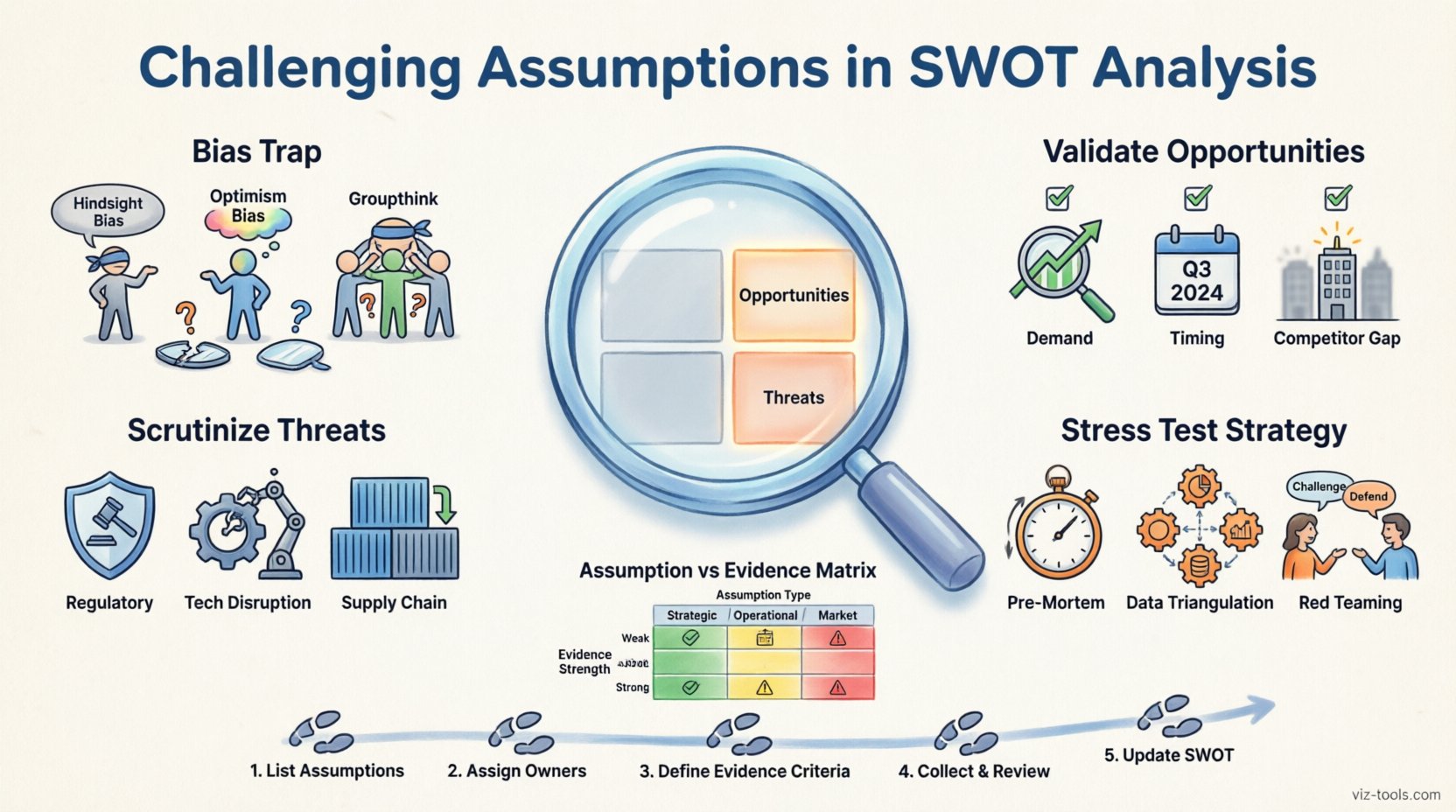
- Hindsight Bias: Interpreting past market movements as inevitable trends.
- Availability Heuristic: Overvaluing recent events over long-term data.
- Optimism Bias: Underestimating risks while overestimating potential gains.
- Groupthink: Suppressing dissenting views during the planning session.
When assumptions go unchallenged, resources are allocated to initiatives that lack market viability. This leads to wasted capital, missed deadlines, and strategic drift. The goal is not to eliminate risk entirely, but to understand the probability of success based on evidence.
Dissecting Opportunities: Beyond Surface Trends 🚀
Opportunities are external chances to improve performance. They might include a new technology, a change in regulations, or a shift in consumer behavior. The danger lies in assuming that because a trend exists, your organization can capture value from it. Validating an opportunity requires more than just observing the horizon.
1. The Demand Fallacy
Teams often assume that market demand equals customer purchase. Just because a segment is growing does not mean they will buy your specific solution. You must verify:
- Are customers actively seeking a solution for this problem?
- Is the budget available for this category?
- Who else is serving this need, and why have they failed or succeeded?
2. The Timing Assumption
Entering a market too early can be as damaging as entering too late. There is a specific window where the ecosystem is ready. If you assume the timing is right without testing it, you risk becoming the pioneer that dies.
- Early Adopters: Are they ready to pay for your offering?
- Infrastructure: Is the necessary support infrastructure in place?
- Education: Does the market understand the value proposition?
3. The Competitor Gap
Opportunities are often framed as “competitors are weak here.” This is a dangerous assumption. Competitors may be weak for a reason, such as low margins or high churn. Entering a “gap” without understanding why others avoided it is risky.
Scrutinizing Threats: The Invisible Risks 🛡️
Threats are external elements that could cause trouble. These are often easier to list but harder to quantify. A threat is not real until it impacts your operations. However, treating threats as distant possibilities can lead to complacency.
1. Regulatory Blind Spots
Legal frameworks change frequently. Assuming current regulations will remain stable is a common error. This is particularly true in finance, healthcare, and technology sectors.
- What pending legislation could affect your supply chain?
- How might data privacy laws impact your customer acquisition?
- Are there trade barriers emerging in your target export markets?
2. Technological Disruption
Technology moves faster than product development cycles. A threat today might be the standard tomorrow. Relying on current technology stacks creates vulnerability.
- Is your core technology becoming obsolete?
- Are new entrants using AI or automation to lower costs significantly?
- Could a substitute product solve the problem better than your current method?
3. Supply Chain Fragility
Globalization has increased efficiency but reduced redundancy. Assuming that suppliers will always deliver on time ignores geopolitical and environmental risks.
- What happens if a single source of supply fails?
- Are there alternative vendors in different geographic regions?
- How does currency fluctuation affect your cost structure?
Methods to Stress Test Your Strategy 🧪
Once you have identified potential opportunities and threats, you need a method to challenge them. Relying on a single meeting is insufficient. You need structured processes that force the team to confront uncomfortable truths.
1. The Pre-Mortem Exercise
Instead of looking forward, look backward. Imagine it is one year later and the strategy has failed. Ask the team to write down why it failed. This technique bypasses optimism bias by forcing participants to justify failure rather than success.
- Imagine the project has failed completely.
- What specific external threat caused this?
- Which opportunity assumption was false?
- What evidence did we ignore?
2. Data Triangulation
Never rely on a single data source. Triangulation involves gathering information from three independent sources to verify a claim.
- Primary Data: Direct interviews with customers.
- Secondary Data: Industry reports and market research.
- Tertiary Data: Competitor public filings and news articles.
3. Red Teaming
Assign a specific group to challenge the strategy. Their role is to act as an adversary. They should not build the plan; they should try to break it. This creates a culture where questioning is expected and valued.
Assumption vs. Evidence Matrix 📊
To make this actionable, you can map your assumptions against the evidence you have. Use a table like the one below to visualize the risk level of each strategic pillar.
| Assumption Statement | Current Evidence | Verification Method | Risk Level |
|---|---|---|---|
| Market demand for Product X is growing 20% annually. | One industry report from 2023. | Conduct 50 customer interviews. | High |
| Competitors are slow to adapt to AI integration. | Observation of competitor websites. | Monitor patent filings and hiring trends. | Medium |
| Regulatory changes will not impact pricing. | General knowledge of current laws. | Hire external legal consultant. | High |
| Supply chain partners can scale production by 50%. | Verbal confirmation from supplier. | Review capacity reports and site visits. | Medium |
This visual aid highlights where you are flying blind. Areas marked as High Risk require immediate attention before committing resources.
Implementation Framework for Validation 📝
Integrating assumption testing into your workflow requires a systematic approach. Follow these steps to ensure your SWOT analysis is robust.
- Inventory Assumptions: List every belief underpinning your Opportunities and Threats. Do not skip the small ones.
- Categorize by Impact: Determine which assumptions, if proven false, would destroy the strategy. Focus on high-impact items first.
- Assign Owners: Every assumption needs a person responsible for verifying it. Accountability drives action.
- Set Deadlines: Validation cannot be open-ended. Set a date by which evidence must be gathered.
- Review and Pivot: If an assumption is disproven, the strategy must change. Do not force the data to fit the plan.
The Cost of Inaccuracy 💸
Why spend this effort? The cost of a flawed strategy is often higher than the cost of the research itself. When assumptions are wrong, the consequences ripple through the organization.
- Financial Loss: Capital spent on products with no market.
- Brand Damage: Launching features that do not work well for customers.
- Talent Attrition: Teams lose confidence in leadership when plans fail repeatedly.
- Opportunity Cost: Resources spent on the wrong things means missing the right ones.
By challenging assumptions early, you reduce the cost of failure. It is better to find out a threat is real before you launch than after you have invested millions.
Building a Culture of Inquiry 🤔
Tools and frameworks are useless if the culture does not support them. Leaders must encourage questions. If a team member points out a flaw in the opportunity analysis, they should be thanked, not silenced.
Key behaviors to foster include:
- Psychological Safety: Ensuring no one is punished for sharing bad news.
- Data-Driven Decisions: Basing arguments on facts rather than opinions.
- Humility: Acknowledging that leaders do not have all the answers.
- Agility: Being willing to change direction when new information arrives.
Final Thoughts on Strategic Rigor 🎯
Strategic planning is not about predicting the future perfectly. It is about understanding the variables that influence the future. The difference between a successful plan and a failed one often comes down to how well the team challenged their own beliefs.
Opportunities and threats are dynamic. They shift with every news cycle, every economic report, and every competitor move. A static SWOT analysis is a snapshot that becomes outdated immediately. By treating assumptions as hypotheses that require constant testing, you keep your strategy alive and responsive.
Take the time to dig deeper. Look for the evidence that contradicts your hopes. Validate the risks that scare you. This rigor is the only path to sustainable growth in a complex environment.