

The SWOT analysis is a staple in academic and professional planning. It stands for Strengths, Weaknesses, Opportunities, and Threats. Students often encounter this tool during business strategy classes, career counseling sessions, or personal development projects. While the concept appears simple on paper, executing a robust SWOT framework requires nuance. Many students fall into traps that dilute the value of the analysis. This guide details the frequent errors in SWOT frameworks and how to correct them for accurate strategic planning.
Understanding the difference between a superficial list and a strategic tool is crucial. When used correctly, this framework illuminates your position. When used incorrectly, it generates noise. Below, we explore the specific pitfalls that undermine student success in this methodology.
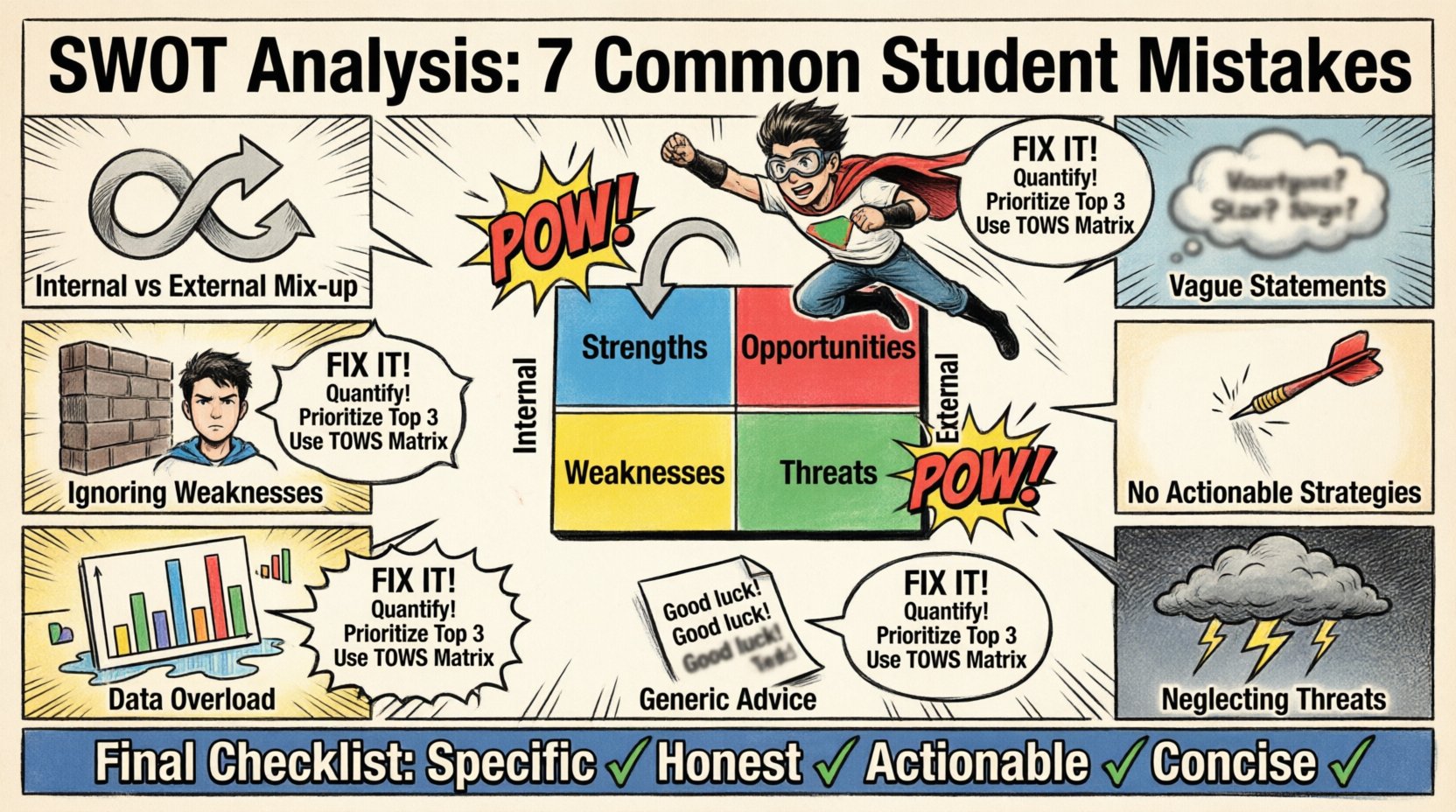
1. Confusing Internal and External Factors 🔄
The most fundamental error involves misclassifying factors. The SWOT matrix divides variables into two distinct categories:
- Internal: Strengths and Weaknesses. These are within your control.
- External: Opportunities and Threats. These exist in the environment outside your control.
Students often mix these up. For example, listing “a new competitor” under Strengths is a classification error. A competitor is an external market force, making it a Threat or Opportunity. Conversely, listing “lack of funding” under Opportunities is incorrect. Funding is an internal resource issue, making it a Weakness.
Why this matters: Strategic planning relies on knowing what you can change. If you attribute an external factor to internal control, you waste time trying to fix the unfixable. If you attribute an internal factor to external control, you ignore your own agency.
Common Confusion Points
- Market Trends: These are external (Opportunities/Threats), not internal strengths.
- Skills: These are internal (Strengths/Weaknesses), not external opportunities.
- Economic Climate: External. You cannot change the economy; you can only adapt to it.
- Team Dynamics: Internal. You manage your team.
2. Using Vague Statements Instead of Specifics 📝
A common issue in student projects is writing generic phrases. Statements like “good grades” or “hard working” lack analytical depth. They do not provide a basis for decision-making. An effective SWOT entry requires specificity and evidence.
Consider the difference between these two entries:
- Vague: “I am good at writing.”
- Specific: “I have a 95% average on all English composition essays due to strong research skills.”
The specific entry allows you to leverage the skill. The vague entry is just a compliment. In a business context, vague statements prevent stakeholders from understanding the actual capability.
Guidelines for Precision
- Quantify where possible: Use percentages, dates, or numbers.
- Contextualize: Mention the environment where the strength exists.
- Focus on outcomes: What was the result of the action?
- Avoid buzzwords: Terms like “synergy” or “paradigm shift” add no value.
3. Ignoring Weaknesses Due to Ego 🧱
Students tend to focus heavily on Strengths and Opportunities. There is a natural desire to present a positive image. This leads to omitting or downplaying Weaknesses. This is a critical failure. A SWOT analysis is useless if it only tells you what is going well.
Identifying weaknesses allows for mitigation. If you do not acknowledge a gap in your skills or resources, you cannot plan to close it. In an academic setting, ignoring weaknesses can lead to failure in group projects or exams.
Why Weaknesses Matter
- Resource Allocation: Knowing where you lack resources helps you ask for help.
- Risk Management: Weaknesses often lead to future threats.
- Self-Awareness: Honest assessment drives personal growth.
Do not hide weaknesses. Address them directly. If you lack technical skills, state that. Then, plan how to acquire them.
4. Failing to Create Actionable Strategies 🎯
A SWOT analysis is not just a list; it is a planning tool. Many students stop at the listing phase. They write down the four quadrants and submit the document. The real value lies in the cross-matching of factors.
For instance, how can a Strength be used to seize an Opportunity? How can a Weakness be fixed to avoid a Threat? Without these connections, the framework is merely a snapshot, not a roadmap.
TOWS Matrix Application
To move beyond a basic list, apply the TOWS matrix logic:
- SO Strategies: Use strengths to maximize opportunities.
- WO Strategies: Overcome weaknesses by taking advantage of opportunities.
- ST Strategies: Use strengths to minimize threats.
- WT Strategies: Minimize weaknesses and avoid threats.
Without this step, the analysis lacks direction. You know where you are, but you do not know where to go.
5. Data Overload and Lack of Prioritization 📊
Students often try to fill every box with as many points as possible. A list of 50 strengths is as unhelpful as a list of 2. The goal is clarity, not volume.
When everything is important, nothing is important. Prioritization is essential. You must identify the top three factors in each category that truly impact your situation. Focus your energy on the critical few, not the trivial many.
Selection Criteria
- Impact: How much does this factor affect the outcome?
- Urgency: Does this need to be addressed immediately?
- Feasibility: Can we actually do something about this?
6. Neglecting External Threats 🌪️
Optimism bias is common in student projects. It is easy to focus on what could go right. It is harder to focus on what could go wrong. Students often minimize Threats or assume they are manageable without a plan.
Threats include market saturation, economic downturns, or regulatory changes. In an academic context, threats might include a shift in curriculum standards or a change in grading policies. Ignoring these variables leaves you vulnerable.
Assessing Threats
- Probability: How likely is this to happen?
- Severity: How much damage would it cause?
- Warning Signs: What indicators suggest the threat is approaching?
Comparison: Effective vs. Ineffective Entries
The table below illustrates the contrast between poor execution and high-quality analysis.
| Category | ❌ Ineffective Entry | ✅ Effective Entry |
|---|---|---|
| Strength | “Good communication.” | “Led a team of 10 in the final project, resolving conflicts effectively.” |
| Weakness | “Sometimes lazy.” | “Struggle with time management during exam weeks due to lack of planning tools.” |
| Opportunity | “More jobs available.” | “New internship program launched by the university in Q3.” |
| Threat | “Competition is high.” | “Graduating class size increased by 20%, reducing scholarship availability.” |
7. Copying Generic Advice 📄
Some students look up templates online and fill them with generic content. “Networking is important” or “Technology is growing” applies to everyone. This lacks context. A SWOT analysis must be specific to the individual, the course, or the project at hand.
Generic advice fails to drive specific action. If your situation is unique, your analysis must be unique. Avoid copying lists from the internet. Use them only as a structural guide, not a content source.
Fixing the Framework: A Step-by-Step Approach 🛠️
To ensure accuracy, follow this structured process:
- Gather Data: Collect facts, grades, feedback, and market research before writing.
- Brainstorm Freely: Write down everything without judging quality initially.
- Categorize: Sort items into S, W, O, T based on Internal/External.
- Filter: Remove duplicates and low-impact items.
- Connect: Draft strategies linking the quadrants.
- Review: Have a peer or mentor review the logic and clarity.
Application in Academic Settings 🎓
Students can apply this framework to various academic scenarios:
- Career Planning: Assessing readiness for the job market.
- Research Projects: Evaluating the feasibility of a thesis topic.
- Group Work: Understanding team dynamics and resource allocation.
- Study Habits: Analyzing personal productivity and learning barriers.
For example, when choosing a major, a student might identify a Strength in analytical thinking. The Opportunity might be a high demand for data analysts. The Weakness could be a lack of coding experience. The Threat might be automation of entry-level roles. This analysis guides the decision to learn coding before graduation.
Real-World Implications 💼
The skills developed through this analysis translate directly to the professional world. Employers value candidates who can assess their own standing and the market environment. A well-documented SWOT analysis demonstrates strategic thinking.
During interviews, you can reference your self-analysis. You can explain how you identified a weakness and took steps to improve it. This shows maturity and a growth mindset. It moves the conversation from “what you did” to “how you think”.
Final Checklist for Success ✅
Before submitting or presenting your framework, verify the following:
- Are all factors clearly labeled? Ensure internal and external are distinct.
- Are statements specific? Remove vague adjectives.
- Is there an action plan? Do you know what to do with this info?
- Is it honest? Did you include the bad news?
- Is it concise? Have you removed unnecessary clutter?
Adhering to these standards transforms a simple exercise into a powerful planning instrument. It shifts the focus from completion to utility. By avoiding these common mistakes, you ensure that your analysis yields tangible results.
Strategic planning requires discipline. It requires you to look at the data objectively, without the filter of desire or fear. When you master this objectivity, the SWOT framework becomes a reliable compass for your academic and professional journey.