

Strategic planning often begins with data collection. Organizations gather information, assess capabilities, and identify external factors. However, a significant disconnect frequently occurs between analysis and action. A SWOT analysis is a powerful diagnostic tool, but it becomes ineffective when its insights remain isolated in a report.
The true value of a SWOT analysis lies in its integration with organizational goals. When internal strengths and weaknesses are weighed against external opportunities and threats, the result should be a clear roadmap. This roadmap directs resources toward objectives that matter most. Without this alignment, teams may pursue initiatives that do not support the broader mission.
This article explores the methodology for connecting strategic assessment with business objectives. It focuses on practical steps, structural frameworks, and the discipline required to ensure every insight translates into action.
🔍 Why Alignment Matters
Many organizations conduct SWOT analyses annually. The document is created, presented to leadership, and then filed away. This process wastes time and capital. The gap between insight and strategy creates friction in execution. Employees may feel their work lacks direction. Leadership may struggle to justify resource allocation.
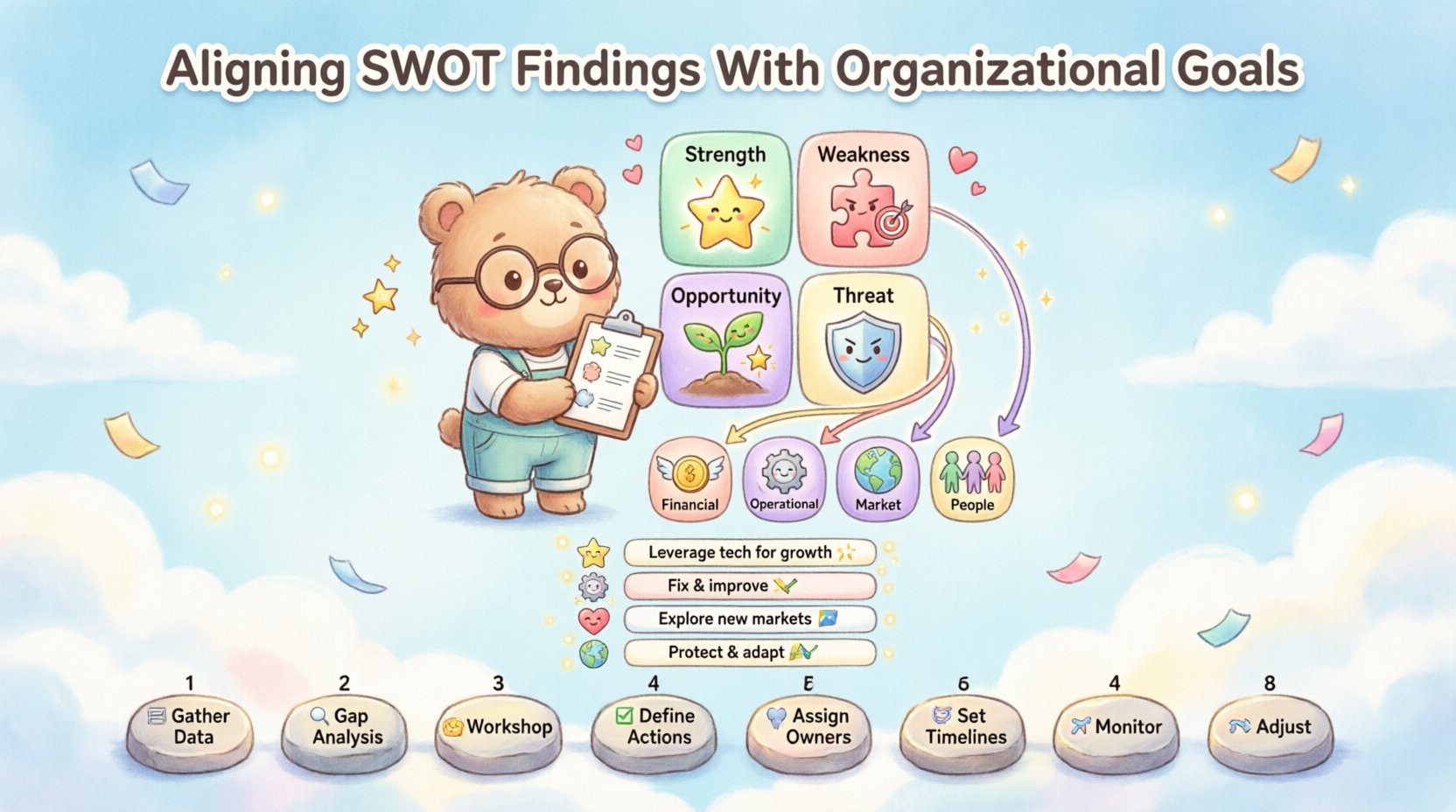
Aligning findings with goals solves this disconnect. It ensures that:
Strengths are leveraged to accelerate progress toward targets.
Weaknesses are addressed to remove barriers to success.
Opportunities are seized to expand market presence or efficiency.
Threats are mitigated to protect existing revenue streams.
When a SWOT analysis is treated as a living document linked to strategic goals, it becomes a dynamic tool for decision-making. It moves from a static review to an active management system.
📊 The Foundation: Defining Organizational Goals
Before mapping SWOT factors, the destination must be clear. Organizational goals should be specific, measurable, and time-bound. Vague aspirations like “improve performance” do not provide a benchmark for analysis.
Effective goals typically fall into these categories:
Financial Objectives: Revenue growth, profit margins, cost reduction.
Operational Objectives: Efficiency gains, process optimization, quality standards.
Market Objectives: Share of market, customer acquisition, brand recognition.
People Objectives: Talent retention, skill development, culture building.
Clarity here is essential. A SWOT finding regarding a “new technology” is only relevant if the organizational goal involves “digital transformation” or “efficiency improvement.” Without this context, the finding is noise.
🧩 The Integration Framework
Integration requires a systematic approach. You cannot simply list goals and list SWOT factors side by side. You must cross-reference them to find connections. The following framework outlines the process for this cross-referencing.
1. Strengths as Enablers
Internal strengths are assets that provide a competitive edge. When aligned with goals, they become accelerators. For example, if a company has a highly skilled engineering team (Strength) and aims to launch a new product line (Goal), the team is the engine for that launch.
Actionable steps include:
Assign key strengths to high-priority strategic goals.
Use strengths to outperform competitors in targeted areas.
Reinvest profits generated by strengths into innovation.
2. Weaknesses as Obstacles
Internal weaknesses are limitations. They hinder progress toward goals. Identifying a weakness without addressing it creates a risk to the entire strategy. If the goal is “global expansion” but the weakness is “inadequate logistics infrastructure,” the plan is compromised.
Strategies to handle weaknesses:
Allocate resources to fix critical weaknesses before scaling.
Partner with external entities to compensate for internal gaps.
Adjust goals to be realistic given current limitations.
3. Opportunities as Pathways
External opportunities are favorable conditions in the market. They represent growth potential. Aligning these with goals means selecting which opportunities to pursue based on strategic fit. Not every opportunity is worth chasing.
Selection criteria include:
Does this opportunity support the core mission?
Do we have the capacity to capitalize on it?
What is the return on investment?
4. Threats as Risks
External threats are challenges that could harm the organization. They require defensive strategies. Aligning with goals means ensuring risk management is part of the objective planning. Ignoring threats can derail even the best plans.
Risk mitigation tactics:
Diversify revenue streams to reduce dependency.
Develop contingency plans for high-probability threats.
Monitor regulatory changes that could impact operations.
🗺️ Mapping Findings to Objectives
To visualize this alignment, organizations often use a matrix. This table structure helps stakeholders see the relationship between analysis and action. Below is a representation of how this mapping works in practice.
SWOT Factor | Strategic Goal | Alignment Action | Priority |
|---|---|---|---|
Strength: Proprietary Technology | Increase Market Share by 15% | Leverage tech for superior product features | High |
Weakness: High Customer Churn | Improve Customer Retention Rate | Implement feedback loop and support training | High |
Opportunity: Emerging Market Demand | Enter New Geographic Region | Allocate budget for regional expansion team | Medium |
Threat: Competitor Price War | Maintain Profit Margins | Focus on value-added services rather than price | High |
This table serves as a living document. It is reviewed during strategic planning sessions to ensure alignment remains intact as goals evolve.
🚀 Operationalizing the Strategy
Once the alignment is mapped, the focus shifts to execution. This involves translating high-level strategic connections into day-to-day operations. It requires clear communication and defined responsibilities.
Resource Allocation
Budget and personnel must follow the aligned strategy. If a goal is prioritized based on a SWOT finding, funding should reflect that priority. For instance, if a strength is identified as a key differentiator, marketing spend should highlight that strength. If a weakness is a bottleneck, capital expenditure should target fixing it.
Key considerations for allocation:
Efficiency: Ensure funds are not wasted on low-priority initiatives.
Balance: Do not over-invest in strengths to the point of neglecting weaknesses.
Flexibility: Maintain a reserve for unforeseen opportunities or threats.
Performance Metrics
Success must be measurable. The goals derived from the SWOT analysis need Key Performance Indicators (KPIs). These metrics track whether the alignment is working. If a goal is “reduce operational costs,” the metric is the cost percentage. If a goal is “leverage brand reputation,” the metric might be net promoter score.
Effective tracking involves:
Regular reporting cycles (monthly or quarterly).
Clear ownership of each metric.
Thresholds for intervention (e.g., if churn exceeds X%, trigger a review).
Communication Flow
Employees need to understand how their daily tasks contribute to the strategic goals. If a SWOT finding identifies a weakness in communication, the solution is not just training, but a change in how information flows.
Best practices for communication:
Explain the “Why” behind the goals.
Show how strengths are being utilized.
Be transparent about threats and how the team is protecting the organization.
Recognize contributions that align with strategic priorities.
⚠️ Common Pitfalls in Alignment
Even with a solid framework, organizations often stumble. Understanding these common errors helps prevent them.
Analysis Paralysis: Spending too much time on the SWOT and not enough on action. The analysis is a means to an end, not the end itself.
Static Goals: Setting goals that do not change even when the SWOT landscape shifts. Markets evolve, and strategies must adapt.
Ignoring Weaknesses: Focusing only on strengths and opportunities while neglecting internal deficiencies. Weaknesses can be fatal if left unaddressed.
Lack of Ownership: Assigning strategic goals to the organization as a whole without specific departmental accountability.
Disconnect Between Levels: Executive strategy does not match team-level objectives. The alignment must cascade through all levels of the hierarchy.
🔄 Continuous Review and Adaptation
A SWOT analysis is not a one-time event. The internal and external environments change constantly. Therefore, the alignment between findings and goals requires continuous monitoring.
This involves scheduled reviews. Quarterly business reviews are a common cadence. During these reviews, ask:
Have our organizational goals changed?
Have our strengths or weaknesses shifted?
Are there new opportunities or threats we missed?
Is the current strategy still effective?
If the answer to any of these is “yes,” the alignment matrix must be updated. This agility ensures the organization remains responsive to change.
📈 Measuring the Impact
How do you know if the alignment was successful? The answer lies in the performance against the original goals. However, the success is also visible in the decision-making process itself.
Indicators of successful alignment include:
Speed of Execution: Decisions are made faster because the criteria are clear.
Resource Efficiency: Less waste on projects that do not support the core mission.
Employee Engagement: Staff understand how their work fits into the bigger picture.
Strategic Consistency: The organization moves in a consistent direction over time.
When a SWOT analysis is properly integrated, the organization operates with a clearer vision. It reduces confusion and increases the likelihood of achieving long-term objectives.
🛠️ Practical Implementation Steps
To begin this process, follow these actionable steps. They provide a roadmap for implementation without relying on external tools.
Gather Data: Compile the most recent SWOT analysis and current strategic goals.
Conduct a Gap Analysis: Compare the two lists. Identify where goals are unsupported by the SWOT.
Host a Workshop: Bring leadership and key stakeholders together to discuss the gaps.
Define Actions: Create specific tasks to address each gap.
Assign Owners: Ensure every task has a responsible person.
Set Timelines: Establish deadlines for each action item.
Monitor Progress: Review status regularly.
Adjust as Needed: Update the plan based on results.
This structured approach ensures that the SWOT analysis remains relevant and useful. It transforms abstract data into concrete business value.
🌟 Final Thoughts on Strategic Cohesion
The journey from analysis to action is where value is created. A SWOT analysis provides the landscape. Organizational goals define the destination. Alignment is the bridge that connects them.
Organizations that master this connection gain a significant advantage. They navigate uncertainty with confidence. They allocate resources with precision. They build resilience against external threats.
Commit to treating your strategic documents as living tools. Keep them connected to your daily operations. Ensure every insight informs your next move. This discipline turns good data into great results.