

Academic research is a complex endeavor that requires strategic planning, critical evaluation, and clear methodology. One tool often borrowed from business strategy but highly applicable to scholarly work is the SWOT analysis. This framework helps researchers identify Strengths, Weaknesses, Opportunities, and Threats. Understanding when to integrate this tool into your workflow can significantly enhance the robustness of your study. This guide explores the specific moments to apply SWOT analysis in an academic setting, ensuring your research remains grounded and strategic.
Understanding SWOT in a Scholarly Context 🧠
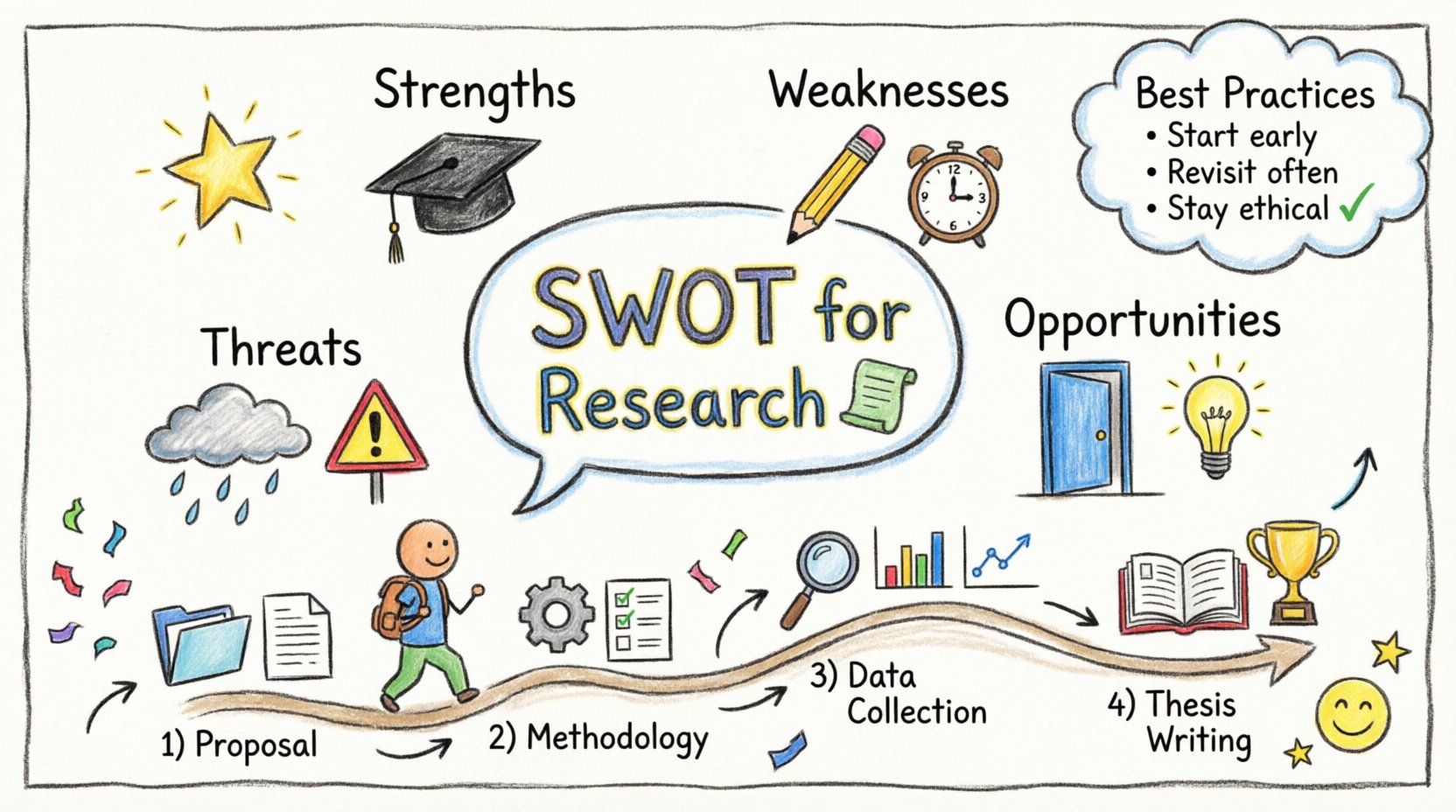
While originally designed for corporate environments, the SWOT model translates effectively to academia. It moves beyond simple pros and cons lists to a structured examination of internal and external factors. In research, internal factors include your skills, resources, and access to data. External factors encompass funding landscapes, ethical constraints, and market trends in the field.
Applying this analysis early can prevent common pitfalls. It forces the researcher to confront limitations before they become blockers. By mapping these elements, you create a clearer path through the research lifecycle. It is not merely a planning exercise but a continuous reflective tool.
Key Components Defined
- Strengths: Internal attributes that support the research goal. This includes your expertise, established networks, or access to unique data sets.
- Weaknesses: Internal limitations that may hinder progress. Examples include gaps in technical skills, limited budget, or time constraints.
- Opportunities: External conditions that could be exploited for advantage. This might involve emerging theories, new funding sources, or collaborative possibilities.
- Threats: External obstacles that could cause trouble. These include competing studies, changes in ethical guidelines, or equipment failure.
Strategic Moments for Integration ⏱️
Knowing when to use SWOT is as important as knowing how. Applying it at the wrong stage can lead to confusion or wasted effort. Below are the critical junctures where this analysis adds the most value.
1. Proposal Development Phase
Before submitting a research proposal, you must demonstrate feasibility. A SWOT analysis here validates your approach. It helps reviewers see that you have considered potential risks.
- Why apply it: To identify gaps in your preliminary plan.
- Focus: Do you have the necessary literature? Is the methodology sound?
- Outcome: A refined proposal that anticipates reviewer questions.
2. Methodology Design
Once the topic is set, the method must be chosen. This is where internal and external constraints become tangible.
- Why apply it: To ensure the chosen method aligns with available resources.
- Focus: Qualitative vs. quantitative capacity. Access to participants.
- Outcome: A methodology that is realistic and ethically sound.
3. Data Collection & Analysis
During the active phase, challenges often arise. Revisiting the SWOT matrix can help pivot strategies without losing momentum.
- Why apply it: To address unexpected data loss or participant withdrawal.
- Focus: Adjusting sampling techniques or analysis software workflows.
- Outcome: Resilience in data gathering processes.
4. Thesis or Dissertation Writing
When drafting the final document, you need to contextualize your findings within the broader field.
- Why apply it: To frame limitations and contributions clearly.
- Focus: How your work fits into existing literature.
- Outcome: A stronger discussion section that acknowledges boundaries.
Comparison of Research Stages vs. SWOT Utility 📋
| Research Stage | Primary SWOT Focus | Strategic Benefit |
|---|---|---|
| Topic Selection | Opportunities & Strengths | Ensures novelty and feasibility |
| Proposal Writing | Weaknesses & Threats | Identifies risks to mitigate |
| Methodology Design | Internal Strengths & Weaknesses | Aligns skills with tasks |
| Data Analysis | External Threats | Protects data integrity |
| Final Writing | All Four Quadrants | Provides comprehensive context |
Practical Steps for Manual Execution 📝
Conducting a SWOT analysis does not require specialized software. It relies on critical thinking and structured organization. You can use a physical whiteboard, a notebook, or a simple spreadsheet. The goal is clarity, not complexity.
Step 1: Brainstorming Sessions
- Gather your team or work alone in a quiet space.
- Write down every factor that comes to mind regarding the research.
- Do not judge items immediately; capture everything first.
Step 2: Categorization
- Sort each item into one of the four quadrants.
- Move items that feel misplaced to test the framework.
- Ensure internal factors go to Strengths/Weaknesses and external to Opportunities/Threats.
Step 3: Prioritization
- Rank the factors by impact and urgency.
- Identify which threats pose the greatest risk.
- Select the strengths that offer the most leverage.
Step 4: Strategic Planning
- Develop actions to maximize strengths.
- Create contingency plans for the identified threats.
- Set timelines for addressing weaknesses.
Integrating Results into Your Thesis 📚
The output of a SWOT analysis should not remain a private document. It informs the narrative of your research. You can reference the strategic decisions made during the proposal phase in your methodology section.
Discussing Limitations
When you list weaknesses, you are essentially defining the limitations of your study. This transparency builds credibility. It shows you understand where the data might fall short.
- Explicitly state resource constraints.
- Explain how you mitigated these issues.
- Discuss how these limitations affect generalizability.
Framing Contributions
Strengths highlight your unique contribution. This is where you argue why your research matters. It connects your capabilities to the research gap you identified.
- Link specific skills to specific findings.
- Highlight unique data sources or access.
- Emphasize the novelty of the approach.
Common Pitfalls to Avoid ⚠️
Even with a strong framework, errors can occur. Being aware of these mistakes ensures the analysis remains valid.
- Confusing Internal and External: A lack of funding is often internal (budget constraints), but a change in grant availability is external. Distinguish carefully.
- Being Too Vague: Avoid generic statements like “good data.” Specify the type of data and why it is good.
- Ignoring Interactions: A weakness might turn into a threat if not managed. Analyze how factors interact with each other.
- Static Application: Do not treat the analysis as a one-time event. Research evolves, and so should your matrix.
Ethical Dimensions in Academic SWOT ⚖️
Research ethics are paramount. A SWOT analysis can help identify ethical risks before they become issues. Consider how your weaknesses might compromise participant safety.
Participant Protection
- Assess if your team has the training to handle sensitive topics.
- Identify if external pressures might force rushed consent processes.
- Plan for data privacy breaches as a potential threat.
Integrity of Findings
- Ensure that opportunities for publication do not lead to data fabrication.
- Check if time pressures (threats) might tempt cutting corners.
- Maintain transparency about the analysis process in your records.
Case Study: Environmental Science Research 🌱
Consider a study on local water quality. The researcher uses SWOT to plan the project.
- Strength: Access to a local laboratory and established community trust.
- Weakness: Limited budget for advanced spectrometry equipment.
- Opportunity: Partnership with a regional environmental agency for funding.
- Threat: Seasonal weather patterns affecting sample collection.
By addressing the weakness (budget) through the opportunity (partnership), the researcher secures necessary equipment. By planning for the threat (weather), they schedule multiple collection windows. This proactive approach saves months of potential delay.
Final Thoughts on Strategic Clarity 💡
Integrating SWOT analysis into academic research transforms a linear process into a dynamic strategy. It provides a lens to view your project holistically. By knowing when to apply this framework, you ensure that your research is not only academically rigorous but also practically achievable.
Start early, revisit often, and let the structure guide your decisions. The goal is to produce knowledge that stands up to scrutiny while navigating the inevitable challenges of scholarly work. With clear planning, your research can achieve the depth and impact it deserves.
Summary of Best Practices ✅
- Apply SWOT during proposal and methodology stages.
- Keep the analysis manual and accessible.
- Distinguish clearly between internal and external factors.
- Use the insights to frame limitations and strengths in writing.
- Revisit the matrix as the project evolves.
- Maintain ethical vigilance throughout the process.