

Strategic planning is a cornerstone of organizational success and academic rigor. When tasked with a strategic planning assignment, the need for a structured framework becomes paramount. One of the most enduring and practical tools available for this purpose is the SWOT Matrix. This framework allows analysts to evaluate internal and external factors influencing a specific project or business unit. By utilizing a SWOT matrix, students and professionals can systematically identify Strengths, Weaknesses, Opportunities, and Threats. This article provides a comprehensive guide on applying this matrix to strategic planning assignments, ensuring clarity and depth in your analysis.
🔍 Understanding the SWOT Framework
The SWOT analysis is not merely a list of points; it is a diagnostic tool. It forces a distinction between what you control and what you do not. In the context of strategic planning assignments, this distinction is vital. It helps in separating the internal environment from the external environment. This separation ensures that the strategy developed is grounded in reality rather than wishful thinking.
- Internal Factors: These are elements within the organization or project scope. They are things you can influence directly.
- External Factors: These are elements outside the organization or project scope. They are environmental conditions you must adapt to.
When working on a strategic planning assignment, the goal is to bridge the gap between your current position and your desired future state. The SWOT matrix provides the data needed to make that connection. It transforms vague ideas into actionable insights.
🧩 The Four Quadrants Explained
To use the matrix effectively, you must understand the nuance of each quadrant. Each section requires a different type of thinking and data collection.
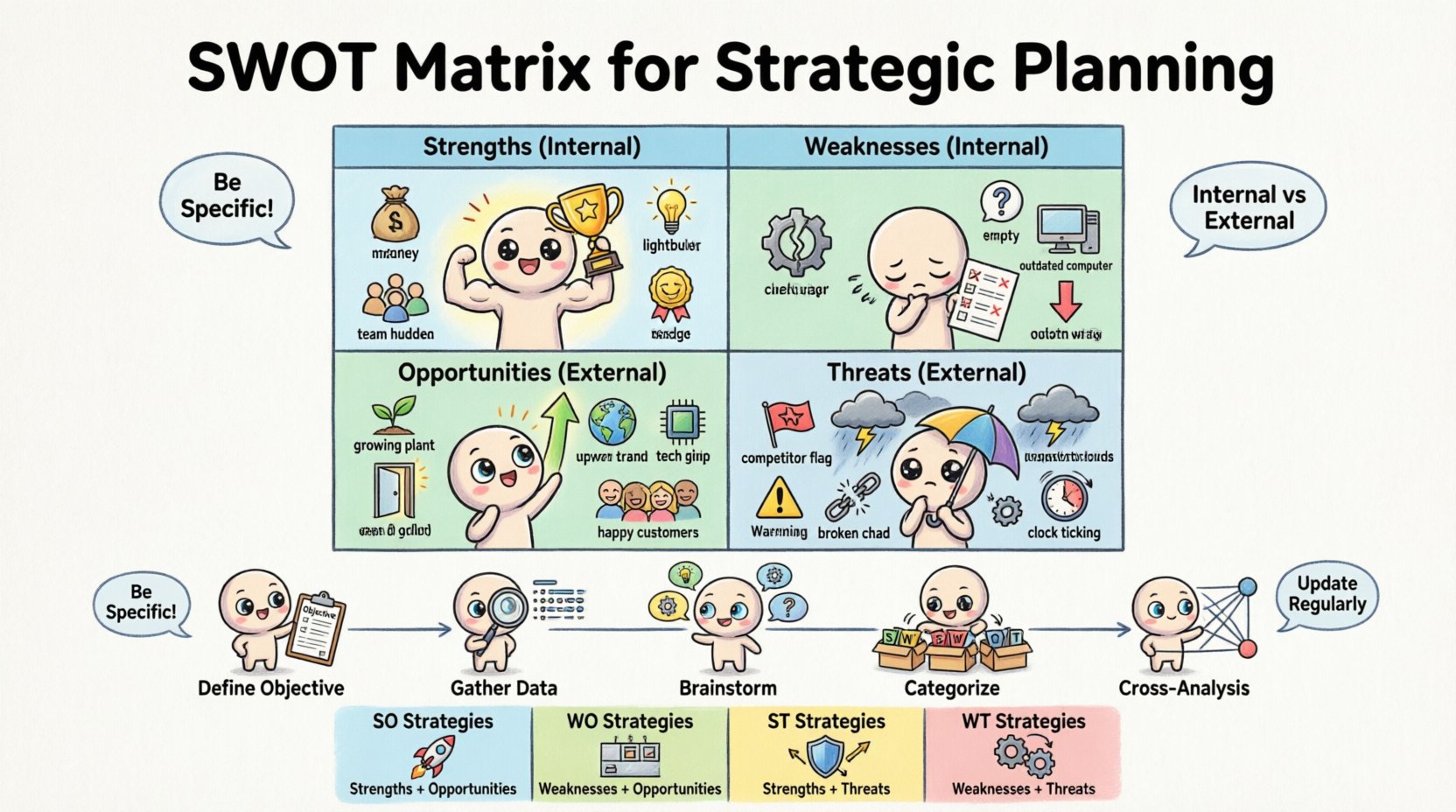
1. Strengths (Internal)
Strengths are positive attributes internal to the entity you are analyzing. These are resources or capabilities that give you an advantage over others. In an assignment, you might identify these through:
- Financial resources available for the project.
- Specialized skills of the team or organization.
- Proprietary technology or intellectual property.
- A strong brand reputation or customer loyalty.
- Efficient operational processes.
2. Weaknesses (Internal)
Weaknesses are internal factors that place the entity at a disadvantage relative to others. These are areas that need improvement or resources that are lacking. Honest assessment is key here.
- Limited budget or funding constraints.
- Lack of skilled personnel or training gaps.
- Outdated technology infrastructure.
- Weak supply chain management.
- Negative brand perception or low market share.
3. Opportunities (External)
Opportunities are external chances to improve performance or achieve growth. These are trends or changes in the environment that can be leveraged. They are not within your control, but you can choose to act on them.
- Emerging markets or customer segments.
- Changes in government regulations that favor your sector.
- Technological advancements that reduce costs.
- Competitor failures or market exits.
- Shifts in consumer behavior or preferences.
4. Threats (External)
Threats are external elements that could cause trouble for the business or project. These are risks that must be mitigated or managed. Ignoring threats can lead to the failure of the strategic plan.
- New competitors entering the market.
- Economic downturns or recessions.
- Changes in trade laws or tariffs.
- Supply chain disruptions.
- Technological obsolescence.
📝 Step-by-Step Execution Guide
Executing a SWOT analysis for a strategic planning assignment requires a methodical approach. Rushing this process often leads to generic or inaccurate results. Follow these steps to ensure a robust analysis.
Step 1: Define the Objective
Before drawing the matrix, clarify what you are analyzing. Is it a specific product launch? A departmental restructuring? A new market entry? The scope of the assignment dictates the depth of the research. A broad objective yields broad results, while a narrow objective yields specific insights.
Step 2: Gather Data
Do not rely on assumptions. Collect data from reliable sources. This might include financial reports, market research, customer feedback, and internal audits. For academic assignments, library databases and industry reports are excellent resources. For professional contexts, internal metrics and stakeholder interviews are crucial.
Step 3: Brainstorming Sessions
Hold a session with relevant stakeholders. Different perspectives yield a more complete picture. Encourage open dialogue. Write down every point that comes to mind before filtering them. This stage is about quantity, but the subsequent stage is about quality.
Step 4: Categorize and Prioritize
Place the brainstormed points into the four quadrants. Once categorized, prioritize them. Not all strengths are equal. Some are critical to success, while others are merely nice to have. Rank them based on their impact on the strategic goal.
Step 5: Cross-Analysis
This is where the matrix becomes a strategic tool. Look for connections between the quadrants. For example, how can a specific Strength be used to capture an Opportunity? How can a Weakness make the organization vulnerable to a Threat? This cross-referencing creates the strategy.
🎓 Applying to Academic or Business Projects
When submitting a strategic planning assignment, the presentation of the SWOT analysis is as important as the analysis itself. The matrix should be clear, concise, and supported by evidence. Below is a comparison of how the matrix is applied in different contexts.
| Context | Focus Area | Data Sources |
|---|---|---|
| Academic Assignments | Theoretical application and case study analysis. | Textbooks, journals, public company reports. |
| Business Projects | Operational feasibility and financial impact. | Internal databases, client interviews, market data. |
| Personal Development | Career path and skill acquisition. | Self-reflection, mentor feedback, industry trends. |
In academic settings, the focus is often on demonstrating understanding of the framework. You must show that you can distinguish between internal and external factors correctly. In business settings, the focus shifts to actionable outcomes. The matrix is a means to an end, not the end itself.
⚠️ Common Pitfalls to Avoid
Even experienced analysts can make mistakes when using the SWOT matrix. Being aware of these common errors can improve the quality of your strategic planning assignments.
- Confusing Internal and External: A common error is listing market trends under Strengths. Market trends are external. Only list how your organization reacts to them as an internal factor.
- Being Too Vague: “Good management” is not a strength. “A management team with 20 years of industry experience” is a strength. Specificity adds credibility.
- Ignoring Weaknesses: Some analysts hide weaknesses to make the project look better. This is counterproductive. Identifying weaknesses is the first step to fixing them.
- Static Analysis: A SWOT analysis is a snapshot in time. Strategies change, and so do the factors. For a long-term assignment, consider how these factors might evolve.
- Listing Without Strategy: A matrix without a plan is just a list. Every item identified should lead to a strategic action or decision.
🚀 From Analysis to Action
The true value of the SWOT matrix lies in the strategy it generates. Once the quadrants are filled, you must move to the TOWS matrix approach. This involves combining the factors to create specific strategies.
SO Strategies (Maxi-Maxi)
Use Strengths to maximize Opportunities. This is the ideal scenario. For example, if you have a strong R&D team (Strength) and a new technology trend (Opportunity), invest heavily in that technology.
WO Strategies (Mini-Maxi)
Overcome Weaknesses by taking advantage of Opportunities. If you lack in-house expertise (Weakness) but a new market is opening up (Opportunity), consider hiring consultants or forming partnerships to fill the gap.
ST Strategies (Maxi-Mini)
Use Strengths to minimize Threats. If you have a strong cash reserve (Strength) and an economic recession is coming (Threat), you can afford to invest in counter-cyclical products or acquire competitors at a discount.
WT Strategies (Mini-Mini)
Minimize Weaknesses and avoid Threats. This is the defensive strategy. If you have poor cash flow (Weakness) and high interest rates (Threat), the priority is cost-cutting and debt reduction to survive.
📊 Structuring Your Assignment Report
When writing the final report for your strategic planning assignment, the structure matters. It guides the reader through your logic. Consider the following outline.
- Executive Summary: Brief overview of the situation and the primary findings of the analysis.
- Introduction: Background on the organization or project and the purpose of the assignment.
- Methodology: How the data was collected and the framework used (SWOT).
- SWOT Analysis: The detailed matrix with supporting data and rationale.
- Strategic Options: The TOWS strategies derived from the matrix.
- Recommendations: Specific actions to take based on the analysis.
- Implementation Plan: Timeline and resource allocation for the recommendations.
- Conclusion: Summary of the strategic path forward.
This structure ensures that the SWOT matrix is not an isolated exercise but the foundation of a coherent plan. It shows the reader that you have thought through the implications of your findings.
🌟 Enhancing the Analysis with Visuals
While the SWOT matrix is often presented as a simple grid, enhancing it with visuals can improve the reading experience. In a digital or printed report, consider the following enhancements.
- Weighted Scoring: Assign importance scores to each item. This helps prioritize which factors matter most.
- Cause and Effect Diagrams: Link specific threats to their root causes. This adds depth to the analysis.
- Heat Maps: Use color coding to indicate the severity of threats or the value of strengths. Red for high risk, green for high opportunity.
- Comparison Charts: Compare your organization against competitors in each quadrant. This contextualizes your internal factors.
Visual aids should clarify the data, not complicate it. Keep them simple and relevant to the core message of the assignment.
🔄 Continuous Improvement and Review
Strategic planning is not a one-time event. The environment changes, and so do the factors in your matrix. For a long-term assignment or a real-world scenario, propose a review cycle. Suggest that the SWOT analysis be revisited annually or quarterly.
This demonstrates foresight. It shows that you understand the dynamic nature of strategy. A static plan is a fragile plan. A plan that adapts to new information is resilient. When writing your recommendations, explicitly state the need for ongoing monitoring of the identified factors.
🤝 Integrating Stakeholder Feedback
One often overlooked aspect of a strategic planning assignment is stakeholder engagement. The SWOT analysis should not be conducted in a vacuum. Include feedback from key groups such as employees, customers, investors, or suppliers.
- Employee Feedback: They know the internal weaknesses best.
- Customer Feedback: They can validate strengths and identify external threats like competitor offerings.
- Investor Feedback: They can assess financial strengths and risks.
Integrating this feedback adds a layer of validation to your analysis. It proves that your conclusions are grounded in the perspectives of those affected by the strategy.
💡 Final Thoughts on Strategic Application
Using the SWOT matrix for strategic planning assignments is about more than filling out a grid. It is about developing a disciplined way of thinking. It requires you to look inward and outward, to be honest about limitations, and to be optimistic about possibilities. When done correctly, it provides a solid foundation for decision-making.
Remember that the matrix is a tool, not a crystal ball. It organizes information to help you see patterns. The strategy itself comes from your judgment and the synthesis of the data. By following the steps outlined in this guide, avoiding common pitfalls, and focusing on actionable outcomes, you can produce high-quality strategic plans. Whether for a university project or a corporate initiative, the principles remain the same. Structure your thinking, validate your data, and connect your analysis to clear actions.
Adopting this framework will enhance the quality of your work and ensure that your strategic recommendations are robust and defensible. The SWOT matrix remains a staple for a reason: it works. It forces clarity in a complex world. Use it wisely, and it will serve you well in your planning endeavors.