

Academic work often feels like navigating a vast ocean without a map. Whether you are drafting a bachelor’s dissertation, organizing a group research study, or planning a capstone project, the path from concept to completion is fraught with variables. Many students and researchers stumble not because of a lack of intelligence, but due to a lack of strategic foresight. This is where the SWOT analysis transitions from a business buzzword to a critical academic tool. By applying this framework to your scholarly endeavors, you gain a structured method to evaluate your position before you begin.
This guide moves beyond the textbook definition. It focuses on how to practically deploy a SWOT analysis within the constraints of university timelines, limited resources, and high expectations. We will explore internal capabilities and external conditions specific to the academic environment, ensuring your project foundation is robust.
🔍 Why SWOT Matters in Scholarly Work
Traditional academic instruction focuses heavily on content creation. You are taught how to cite sources, how to write an abstract, and how to present data. However, the management of the project itself is often left to intuition. This is risky. A SWOT analysis provides a snapshot of your current reality. It forces you to confront hard truths about your resources and the environment you are operating in.
When applied to academic projects, the framework helps you:
- Identify Risks Early: Spot potential blockers before they become crises.
- Optimize Time: Focus effort on areas where you have a competitive advantage.
- Secure Resources: Justify funding or lab access based on clear strengths.
- Manage Stress: Reduce anxiety by having a plan for potential threats.
This is not about predicting the future with certainty. It is about preparing for multiple futures. The academic landscape is unpredictable. Deadlines shift, equipment fails, and data collection encounters hurdles. A SWOT analysis equips you to pivot quickly.
🏗️ Internal Factors: Strengths and Weaknesses
Internal factors are elements within your direct control. These are the assets and liabilities you bring to the table. In the context of an academic project, these are often personal or team-based attributes.
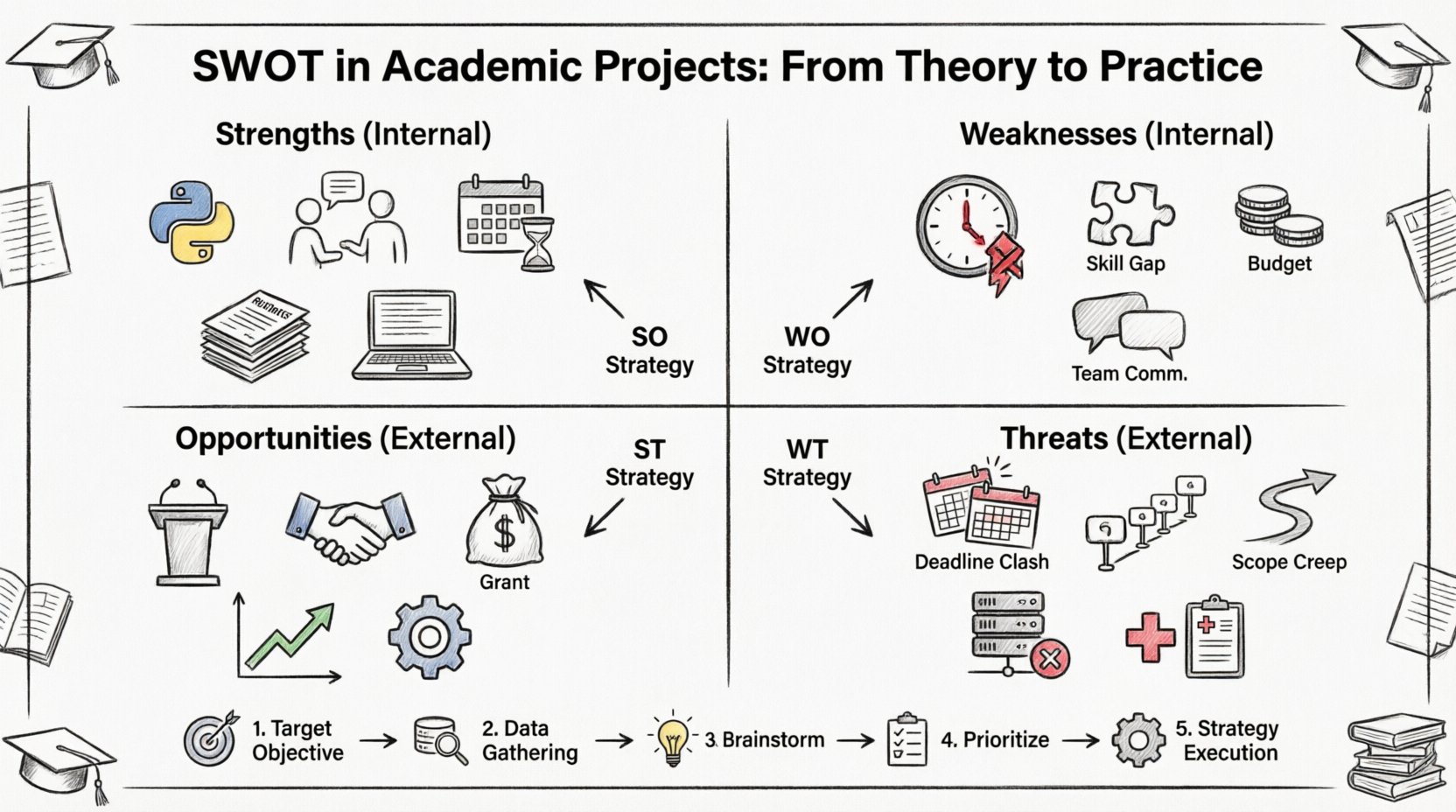
💪 Strengths (Internal)
Strengths are the positive attributes you possess that help you achieve your project goals. Be specific. Vague statements like “I am smart” do not help. Instead, identify tangible skills and resources.
- Technical Proficiency: Do you have advanced knowledge of statistical software, coding languages, or laboratory techniques relevant to your topic?
- Access to Data: Do you have a network that allows for easy survey distribution or access to proprietary archives?
- Advisor Support: Is your supervisor known for being accessible and supportive? Do you have a clear line of communication?
- Time Availability: Do you have fewer extracurricular commitments compared to your peers, allowing for deeper focus?
- Previous Experience: Have you completed similar research papers or internships that give you a head start?
⚠️ Weaknesses (Internal)
Weaknesses are internal limitations that could hinder progress. Acknowledging these is not a sign of failure; it is a sign of strategic maturity. You cannot fix what you do not admit.
- Time Management: Do you struggle with procrastination or overcommitting to other tasks?
- Skill Gaps: Is there a specific methodology you need to use but do not yet understand?
- Financial Constraints: Are you self-funding the project without a grant, limiting your ability to purchase materials?
- Group Dynamics: If working in a team, are there communication issues or conflicting work styles?
- Focus Areas: Do you tend to get stuck in “research rabbit holes” rather than writing?
🌍 External Factors: Opportunities and Threats
External factors are outside your direct control. You cannot command the weather, but you can check the forecast. In academia, these factors often relate to the institution, the field of study, and the broader economic or social climate.
🚀 Opportunities (External)
Opportunities are favorable conditions in the environment that you can exploit to your advantage.
- Conferences: Are there upcoming academic conferences where you can present preliminary findings for feedback?
- Collaborations: Can you partner with a department or professor who has complementary expertise?
- Funding Grants: Are there small research grants specifically for student projects available this semester?
- Emerging Trends: Is your topic gaining traction in the industry, making it more relevant for publication?
- Tool Updates: Are new open-source tools being released that make data analysis faster or cheaper?
⛈️ Threats (External)
Threats are external challenges that could cause trouble for your project. These are often the most critical to monitor.
- Deadline Conflicts: Do other major exams or project submissions occur at the same time?
- Resource Scarcity: Is the lab equipment fully booked, or is the specific dataset restricted?
- Scope Creep: Is the field expanding so quickly that your original hypothesis becomes obsolete?
- Technical Failures: Are you relying on software that might undergo maintenance or shutdowns?
- Health or Personal Issues: External circumstances that might impact your ability to work consistently.
📊 Structuring Your Analysis
To make this analysis actionable, it helps to visualize the relationship between internal and external factors. Below is a structured approach to organizing your findings.
| Factor | Category | Academic Context Example |
|---|---|---|
| Strengths | Internal | Strong proficiency in Python for data analysis. |
| Weaknesses | Internal | Limited experience with qualitative coding software. |
| Opportunities | External | New open dataset released by government agency. |
| Threats | External | Upcoming campus strike affecting library access. |
Using a table like this forces clarity. It prevents you from mixing up internal feelings with external realities. For instance, thinking “I am tired” is a weakness (internal), whereas “The library closes early” is a threat (external). Distinguishing these allows for different mitigation strategies.
🛠️ The Practical Workflow
Writing a SWOT analysis is not a one-time event. It is a process. Here is a step-by-step workflow to integrate this into your project lifecycle.
1. Define the Objective
Before listing factors, state the specific goal. Is this for a research proposal? A thesis defense? A group presentation? The context changes the weight of the factors. A weakness in writing matters more for a thesis than for a poster presentation.
2. Gather Data
Do not guess. Collect evidence. Look at your past grades, talk to your supervisor, review the syllabus, and check project timelines. If you are in a group, hold a meeting where everyone contributes. Diverse perspectives reveal blind spots.
3. Brainstorming Session
Dedicate 30 to 60 minutes to list items for each quadrant. Do not judge ideas yet. Quantity comes first. Use sticky notes or a digital document. Focus on honesty. If you are not disciplined, write that down.
4. Prioritize and Validate
You will likely end up with a long list. Narrow it down to the top 3 to 5 factors in each category. Ask yourself: “Is this factor critical to success?” If it does not impact the outcome, move it to a secondary list. Validate your weaknesses with reality. If you think you lack time, check your calendar.
5. Develop Strategies
Once the factors are identified, you must create actions. This is where the analysis becomes a plan.
- Maximize Strengths: How can I use my Python skills to speed up this analysis?
- Minimize Weaknesses: I will take a workshop on qualitative software to fix my gap.
- Exploit Opportunities: I will apply for the grant immediately to cover costs.
- Defend Against Threats: I will download my readings now before the library strike.
🧩 Advanced Application: The TOWS Matrix
Once you have your SWOT, the next level of strategic thinking involves cross-referencing these factors. This is often called the TOWS Matrix. It connects your internal and external factors to generate specific strategies.
- SO Strategies (Maxi-Maxi): Use strengths to take advantage of opportunities. Example: Use your coding skills to analyze the new government dataset faster than competitors.
- WO Strategies (Mini-Maxi): Overcome weaknesses by taking advantage of opportunities. Example: Take a workshop (opportunity) to learn the software you lack (weakness).
- ST Strategies (Maxi-Mini): Use strengths to avoid threats. Example: Use your strong writing skills to quickly produce a backup summary if the lab is inaccessible.
- WT Strategies (Mini-Mini): Minimize weaknesses to avoid threats. Example: Start working earlier to avoid the stress of the deadline conflict.
This step transforms a static list into a dynamic action plan. It ensures you are not just listing problems, but solving them.
⚠️ Common Pitfalls in Academic SWOT
Even with a solid framework, students often make mistakes that reduce the utility of the analysis. Be aware of these common errors.
- Being Too Vague: “Good research skills” is not a strength. “Ability to synthesize 50+ peer-reviewed articles in two weeks” is.
- Ignoring the Timeline: A factor that is a threat today might not be a threat next month. Consider the duration of your project.
- Overlooking Group Dynamics: In team projects, individual SWOTs can differ wildly. You must synthesize these into a team SWOT to avoid conflict.
- Confusing Symptoms with Causes: “Failing to write” is a symptom. “Fear of failure” might be the cause. Address the root cause.
- Static Analysis: A SWOT done in September is different from one done in November. The academic year is dynamic. Revisit the analysis monthly.
🔄 Integration into Project Management
How do you keep this analysis alive throughout the semester? It should not sit in a folder. It must inform your daily decisions.
Weekly Reviews: Every week, check your SWOT. Did a new threat emerge? Did you utilize a strength? If you noted a weakness in time management, does your weekly schedule reflect a strategy to fix it?
Milestone Checkpoints: At the end of every major phase (e.g., proposal approval, data collection completion), run a mini-SWOT. This allows you to adjust your strategy based on real-world feedback rather than assumptions.
Communication: Share relevant parts of your SWOT with your supervisor. It shows you are proactive. If you list a threat regarding equipment access, your supervisor might be able to intervene. If you list a strength in a specific method, they might suggest publishing a paper.
📝 Final Considerations for Success
Applying SWOT to academic projects requires discipline. It demands that you look at your work with a critical eye, balancing optimism with realism. The goal is not to create a perfect plan that never changes, but to create a resilient plan that can adapt.
By understanding your internal capabilities and the external landscape, you reduce the uncertainty that often plagues research. You move from reacting to events to directing them. Whether you are analyzing data, writing chapters, or managing a team, this framework provides the clarity needed to navigate complex academic environments.
Start with a single project. Apply the steps outlined here. Refine the process. Over time, this strategic thinking will become second nature, serving you well beyond graduation and into your professional career. The difference between a struggling project and a successful one often lies in the preparation before the first word is written.