

In the modern business landscape, stability is an illusion. Markets shift, technologies evolve, and consumer behaviors transform at an unprecedented pace. For organizations aiming for longevity, understanding the external forces at play is not optional—it is critical. This guide focuses on a specific yet vital component of strategic planning: evaluating threats within a competitive environment analysis, specifically within the framework of SWOT analysis. By identifying potential risks and disruptions, leaders can fortify their positions before challenges materialize.
🧐 Understanding the Competitive Environment
The competitive environment encompasses all external factors that influence an organization’s ability to achieve its goals. Unlike internal strengths and weaknesses, these factors lie outside the control of the management team. However, they are not uncontrollable; they can be monitored, analyzed, and prepared for. A robust evaluation requires looking beyond the immediate rivalries and considering the broader ecosystem.
When analyzing threats, it is essential to distinguish between those that are immediate and those that are long-term. Some threats manifest as a price war today, while others may emerge as a technological paradigm shift in five years. Both require attention, but the strategies for addressing them differ significantly.
📉 Direct vs. Indirect Threats
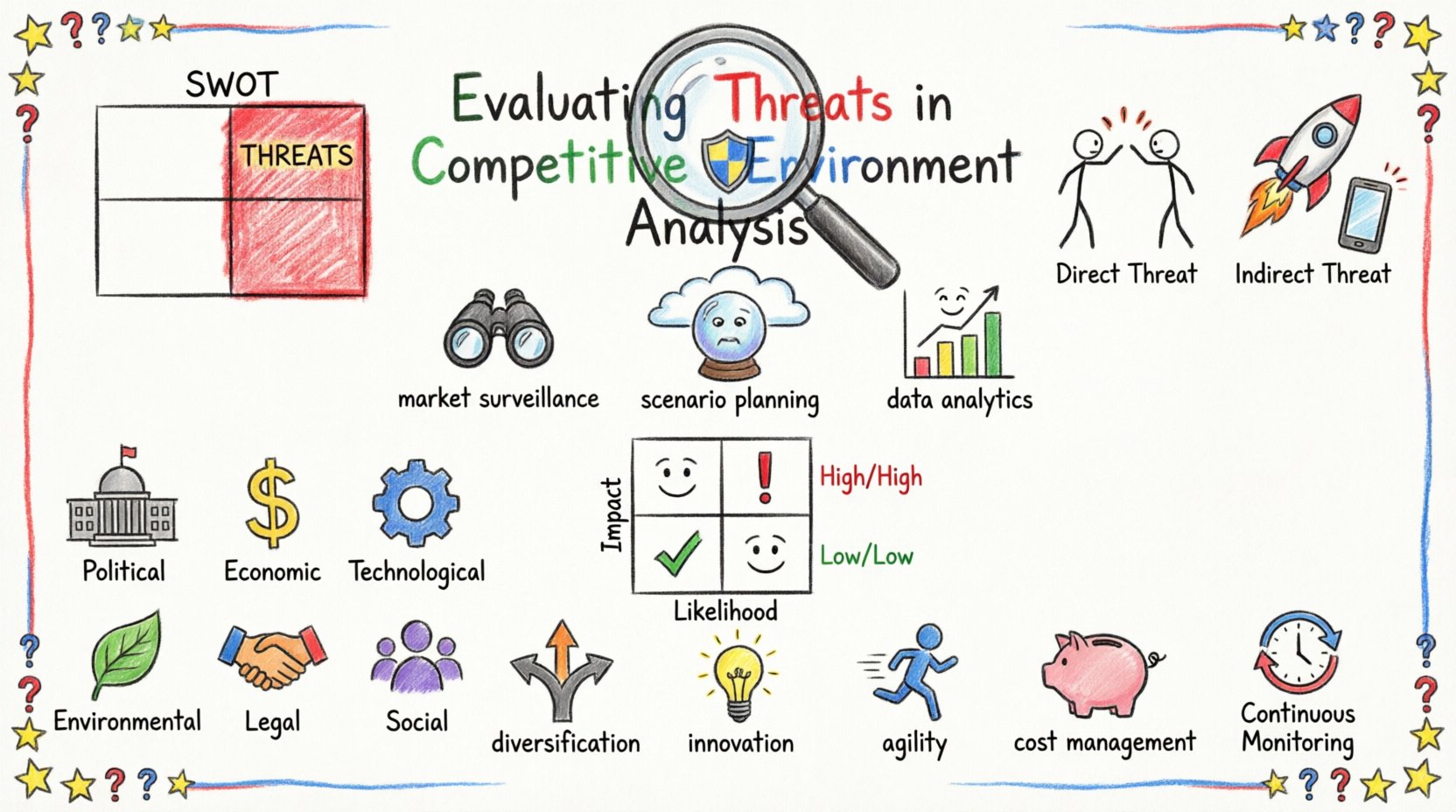
Threats generally fall into two categories. Understanding the distinction helps in allocating resources effectively.
- Direct Threats: These come from competitors offering similar products or services to the same target audience. They include pricing strategies, new product launches, and aggressive marketing campaigns.
- Indirect Threats: These are often overlooked but can be equally devastating. They include substitute products, changes in consumer habits, or new technologies that render current offerings obsolete.
For example, a traditional taxi service faces a direct threat from another taxi company. However, it faces a more significant indirect threat from a ride-sharing platform that changes the fundamental mode of urban transport.
🔍 Methodologies for Threat Evaluation
Evaluating threats is not a guessing game. It requires a structured approach to data collection and interpretation. Various frameworks exist to assist in this process, though the core principle remains the same: gather intelligence, analyze patterns, and assess impact.
1. Market Surveillance
Continuous monitoring of the market is the first step. This involves tracking competitor activities, industry news, and regulatory announcements. Organizations should maintain a watchlist of key competitors and industry events. Information gathered here helps in identifying early warning signals.
- Track competitor pricing changes over time.
- Monitor job postings to anticipate expansion or new project launches.
- Review patent filings for emerging technologies.
- Observe customer reviews to identify gaps in the market.
2. Scenario Planning
Scenario planning involves creating detailed narratives about how the future might unfold. By simulating different threat scenarios, organizations can test their resilience. This process helps in moving from reactive to proactive strategies.
Consider a scenario where a new entrant disrupts the supply chain. How would this impact production costs? What are the backup options? Scenario planning forces leadership to confront uncomfortable possibilities before they become reality.
3. Data Analytics
Modern analysis relies heavily on data. Quantitative metrics provide objective evidence of market shifts. Key performance indicators (KPIs) related to market share, customer churn, and sales velocity can signal emerging threats.
- Market Share Trends: A steady decline in share often indicates a growing competitive threat.
- Customer Churn Rates: Increasing churn may suggest that competitors are winning with better value propositions.
- Lead Generation Costs: Rising costs can indicate increased competition for audience attention.
🌍 External Factors Influencing Threats
While competitors are a primary source of threats, the broader external environment plays a significant role. These factors are often categorized using frameworks like PESTLE, which examines Political, Economic, Social, Technological, Legal, and Environmental aspects.
🏛️ Regulatory and Legal Changes
Government regulations can suddenly alter the competitive landscape. New compliance requirements might increase operational costs, giving an advantage to larger competitors who can absorb the burden. Conversely, deregulation might open the door for new entrants.
- Changes in tax laws affecting profitability.
- Stricter environmental standards requiring new equipment.
- Data privacy laws impacting marketing strategies.
💰 Economic Conditions
Economic fluctuations influence both demand and the financial stability of competitors. During recessions, budget-conscious consumers may switch to lower-cost alternatives. Inflation can increase production costs, squeezing margins across the industry.
🔬 Technological Disruption
Technology is perhaps the most volatile threat factor. Innovations can render business models obsolete overnight. Organizations must assess whether their current technology stack is scalable or if it poses a risk of obsolescence.
📊 Prioritizing Threats: Impact vs. Probability
Not all threats are created equal. An organization cannot address every potential risk simultaneously. A matrix approach helps in prioritizing which threats require immediate attention and which can be monitored.
The following table outlines a common method for categorizing threats based on their likelihood and potential impact.
| Threat Category | Probability (Likelihood) | Impact (Severity) | Action Required |
|---|---|---|---|
| High Priority | High | High | Immediate Mitigation Strategy |
| Medium Priority | High | Low | Process Optimization |
| Medium Priority | Low | High | Contingency Planning |
| Low Priority | Low | Low | Monitor and Review |
This structured view ensures that resources are not wasted on minor risks while critical vulnerabilities are addressed promptly.
🤝 Analyzing Competitor Moves
Competitors are the most direct source of threat. Understanding their capabilities and intentions is crucial. This goes beyond simple observation of their marketing materials.
📦 Product Capabilities
Assess the quality, features, and pricing of competitor offerings. If a competitor releases a feature that becomes an industry standard, failing to adapt could lead to a loss of relevance. Benchmarking against the competition helps in understanding where the market stands.
- Compare feature sets directly.
- Analyze customer satisfaction scores.
- Review warranty and support policies.
📢 Marketing and Brand Positioning
How a competitor positions themselves influences consumer perception. Aggressive branding can erode brand loyalty. Analyzing their messaging reveals their strategic focus and target audience.
📈 Distribution Channels
Access to customers is a competitive advantage. If a competitor secures exclusive distribution rights or dominates key online channels, it creates a barrier to entry. Evaluating channel strategies helps in identifying where market share is being lost.
🛡️ Mitigation Strategies for Identified Threats
Once threats are identified and prioritized, the next step is developing a response. The goal is not necessarily to eliminate the threat, but to reduce its impact to an acceptable level.
1. Diversification
Relying on a single product line or market increases vulnerability. Diversifying revenue streams spreads risk. If one sector faces a downturn, others may sustain the organization.
- Expand into new geographic regions.
- Develop complementary product lines.
- Build partnerships to share risk.
2. Innovation
Stagnation invites threats. Continuous innovation keeps the organization ahead of the curve. Investing in research and development ensures that the company remains relevant even as technology evolves.
3. Agility
Organizational structure should support quick decision-making. Bureaucracy slows down responses to threats. Agile methodologies allow teams to pivot quickly when market conditions change.
4. Cost Management
Efficiency creates a buffer against economic threats. Maintaining lean operations ensures that the organization can survive price wars or economic downturns without compromising quality.
👁️ Continuous Monitoring and Review
Threat evaluation is not a one-time event. The environment is dynamic, and what is a low-risk factor today could become a critical threat tomorrow. Regular reviews of the competitive analysis are essential.
- Quarterly Reviews: Assess changes in market share and competitor activities.
- Annual Strategy Shifts: Re-evaluate the overall threat landscape in the context of long-term goals.
- Real-Time Alerts: Set up systems to notify management of significant market shifts.
Documentation is key. Maintaining a log of threat assessments allows for historical analysis. If a threat was underestimated, understanding why helps in refining future predictions.
🧱 Common Pitfalls in Threat Evaluation
Even experienced strategists can make mistakes when evaluating threats. Awareness of common errors helps in avoiding them.
- Confirmation Bias: Only looking for information that supports existing beliefs. Leaders must remain open to data that contradicts their assumptions.
- Short-Term Focus: Focusing only on immediate revenue threats while ignoring long-term structural changes.
- Ignoring Weak Signals: Dismissing small changes in the market that could indicate a larger trend.
- Overconfidence: Assuming the organization is immune to industry-wide disruptions.
🔗 Integrating Threats into Strategic Planning
The ultimate value of evaluating threats lies in how it informs strategic planning. Threat assessment should feed directly into the decision-making process for resource allocation, hiring, and investment.
When drafting a strategic plan, include specific sections dedicated to risk management. Define what triggers a response for each major threat. This creates a clear roadmap for action when uncertainty arises.
🌟 Conclusion
Evaluating threats in a competitive environment analysis is a disciplined process that requires vigilance, data, and strategic foresight. By distinguishing between direct and indirect risks, utilizing structured methodologies, and prioritizing actions based on impact, organizations can navigate uncertainty with confidence. The goal is not to predict the future with certainty, but to build resilience against whatever comes. Regular review and adaptation ensure that the strategy remains robust in the face of change.
Remember, the most dangerous threat is often the one that is ignored. By embedding threat evaluation into the core of organizational culture, businesses can sustain growth and maintain a competitive edge for the long term. 🚀