
Transforming Workflows with AI-Assisted BPMN 2.0: From Narrative to Execution
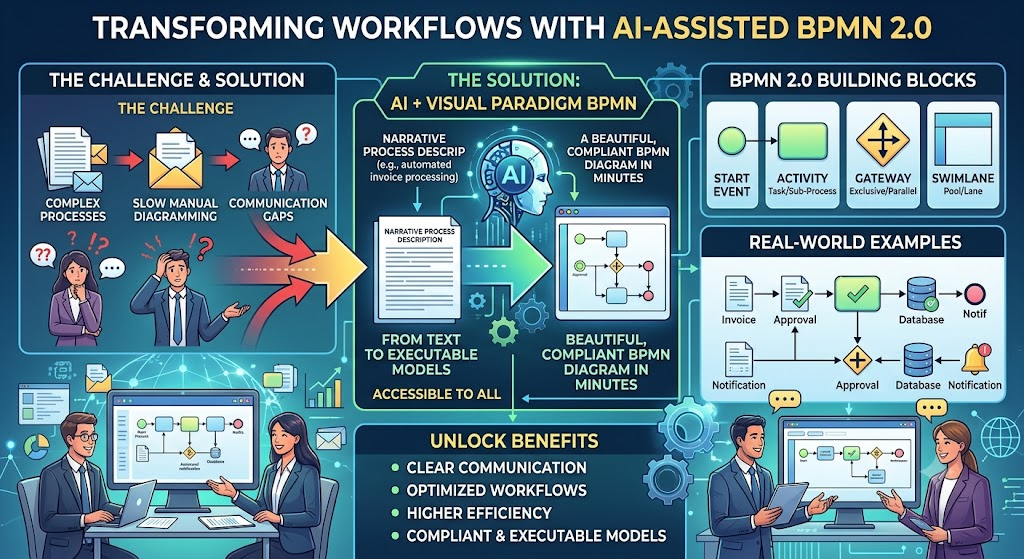
In today’s fast-paced business environment, clear communication and efficient workflows are the backbone of organizational success. Yet, many teams struggle to translate complex processes into understandable, actionable models. This is where Business Process Model and Notation (BPMN) comes in—the global standard that has revolutionized how businesses visualize, analyze, and optimize their workflows.
For years, creating professional BPMN diagrams required specialized expertise and significant time investment. But the landscape has changed. With the introduction of AI-assisted features in modern tools like Visual Paradigm, the gap between textual descriptions and executable process models has never been narrower. What once took hours of manual diagramming can now be accomplished in minutes, making professional-grade business process modeling accessible to everyone—from business analysts to project managers.
The Challenge: Bridging the Gap Between Text and Diagrams
Business processes are often described in narrative form—emails, documents, or verbal explanations. These descriptions are rich in context but lack structure. When teams try to convert them into BPMN diagrams manually, several challenges arise:
- Complex Processes: Multi-step workflows with conditional logic are hard to map without a structured approach.
- Slow Manual Diagramming: Dragging and dropping shapes, connecting them, and ensuring compliance with BPMN 2.0 standards is time-consuming.
- Communication Gaps: Stakeholders may interpret textual descriptions differently, leading to misaligned expectations.
This is where AI-powered modeling tools step in—not to replace human insight, but to accelerate the translation of ideas into standardized, executable models.
The Solution: AI + Visual Paradigm BPMN
Visual Paradigm’s AI-assisted BPMN engine allows users to input a narrative process description—such as “Automated invoice processing”—and instantly generate a compliant, visually polished BPMN 2.0 diagram. The AI understands key BPMN elements:
- Events: Start, intermediate, and end events that mark the lifecycle of a process.
- Activities: Tasks and sub-processes that represent work units.
- Gateways: Decision points (exclusive, parallel, inclusive) that control flow.
- Swimlanes: Organizational or system boundaries that assign responsibility.
Here’s how it works:
Input: Narrative Process Description
  → AI parses intent, identifies actors, decisions, and data flows
  → Generates BPMN 2.0-compliant diagram structure
  → Applies layout, color-coding, and annotations
  → Outputs executable model ready for simulation or deployment
BPMN 2.0 Building Blocks: A Quick Refresher
Before diving into AI-generated examples, let’s briefly review the core constructs you’ll encounter:
1. Start Event
Represents the trigger of a process (e.g., “Invoice Received”). Usually drawn as a green circle.
2. Activity
A unit of work—either a single task or a sub-process. In BPMN, tasks are rounded rectangles; sub-processes can be collapsed or expanded.
3. Gateway
Controls branching logic:
- Exclusive Gateway (XOR): Only one path is taken (e.g., “Approved? Yes → Send to Finance; No → Notify User”).
- Parallel Gateway (AND): All paths execute simultaneously (e.g., “Send email AND log entry”).
4. Swimlane
Organizes activities by role or system (e.g., “Finance Department”, “ERP System”). Helps clarify ownership and handoffs.
Real-World Example: Automated Invoice Processing
Let’s walk through a real-world scenario where AI transforms a textual description into an executable BPMN model.
Narrative Input:
When an invoice is received, the system validates it. If valid, it routes to approval. If approved, it updates the database and sends a notification. If invalid, it flags the invoice for manual review.
AI-Generated BPMN Flow (Simplified Representation):
flowchart TD
    A[Start: Invoice Received] --> B{Valid?}
    B -- Yes --> C[Route to Approval]
    B -- No --> D[Flag for Manual Review]
    C --> E{Approved?}
    E -- Yes --> F[Update Database]
    E -- No --> G[Notify Requestor]
    F --> H[Send Notification]
    H --> I[End: Process Complete]
This diagram can be rendered in Visual Paradigm with full BPMN 2.0 compliance—including proper event markers, gateway symbols, and swimlanes for “System”, “Approver”, and “Database”.
Unlocking Benefits: Why AI-Assisted BPMN Matters
- Clear Communication: Visual models reduce ambiguity and align stakeholders.
- Optimized Workflows: Simulations and analytics reveal bottlenecks before implementation.
- Higher Efficiency: Reduce modeling time from hours to minutes.
- Compliant & Executable Models: Generate models ready for automation platforms or workflow engines.
Recommended Tooling: Visual Paradigm BPMN + AI
For teams seeking to adopt AI-assisted BPMN modeling, Visual Paradigm stands out as the industry-leading platform. Its AI engine supports:
- Natural language to BPMN conversion
- Auto-layout and style enforcement
- Simulation and performance analysis
- Integration with enterprise systems (ERP, CRM, RPA)
- Collaborative editing and version control
Whether you’re a business analyst refining a process, a developer preparing for automation, or a manager seeking visibility into operations, Visual Paradigm’s AI-assisted BPMN capabilities empower you to model faster, communicate clearer, and execute smarter.
Conclusion: Your Journey to Smarter Process Modeling Starts Here
The future of business process modeling is not just about drawing diagrams—it’s about transforming ideas into action. With AI-assisted tools like Visual Paradigm, the barrier to entry has never been lower. You no longer need to be a BPMN expert to create professional, executable models. You simply need to describe your process—and let the AI handle the rest.
Start small: take a simple workflow you’ve described in an email or document, feed it into Visual Paradigm’s AI engine, and watch it become a living, breathing process model. Then scale up—tackle multi-organization workflows, integrate with backend systems, and unlock the full potential of intelligent automation.
The revolution is here. The question is: will you lead it—or be left behind?
Recommended Tooling: Visual Paradigm BPMN + AI — your partner in turning narrative into execution.