
Mastering BPMN: A Step-by-Step Guide to Modeling an Order Fulfillment Process
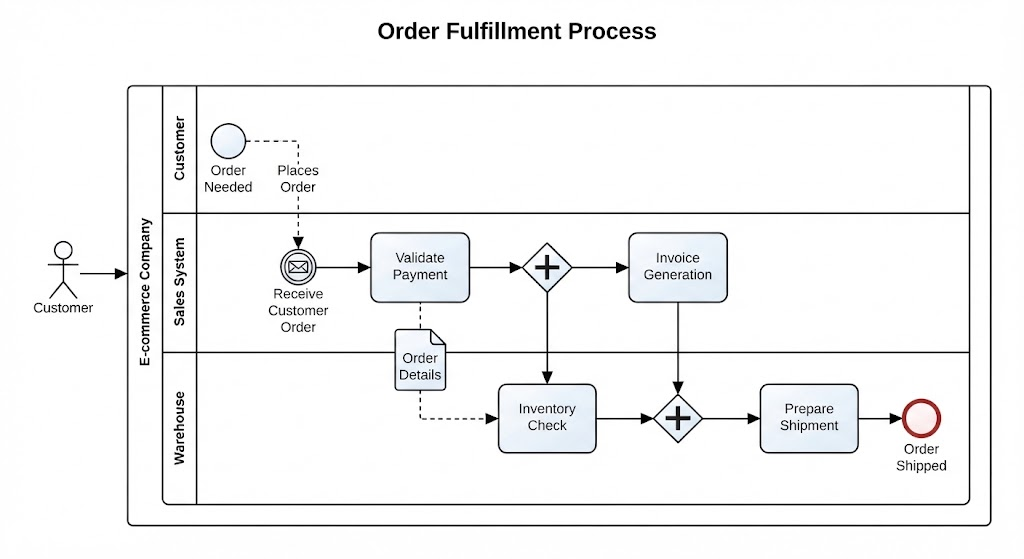
BPMN (Business Process Model and Notation) is the industry standard for visualizing business processes. It allows organizations to document, analyze, and improve their workflows using a standardized graphical language. In this tutorial, we will deconstruct a real-world Order Fulfillment Process, breaking down how different actors interact, how data flows, and how parallel activities are managed.
1. Understanding the Process Structure
The process begins with a high-level view of the organization. In BPMN, we organize complex processes into Pools and Lanes.
- The Pool: The outer boundary represents the E-commerce Company. This defines the scope of the process.
- The Lanes: Inside the pool, we have specific lanes representing different roles or systems:
- Customer: The external entity initiating the request.
- Sales System: The digital backend handling the transaction.
- Warehouse: The physical logistics team handling the product.
2. The Trigger: Initiating the Order
The process lifecycle starts when a need arises. This is represented by the Start Event (the circle) in the Customer lane, labeled Order Needed.
From this state, the customer performs an action: Places Order. This action is not just a manual task; in modern systems, it is a digital trigger. The diagram shows a dashed line (Message Flow) indicating that the customer sends a message to the Receive Customer Order event in the Sales System lane. This event is a Message Start Event, meaning the process waits for this external signal to begin.
3. Data Management: The “Order Details”
Once the order is received, the process needs to carry information. In BPMN, Data Objects represent information used or created by tasks. You will see a document icon labeled Order Details attached to the Validate Payment task.
This is a critical concept: the task “Validate Payment” does not exist in a vacuum. It relies on the Order Details data to make a decision. This data object acts as the bridge between the sales system and the warehouse, ensuring that the inventory check knows exactly which items are being shipped.
4. Logic and Parallelism: The Parallel Gateway
Efficiency in business processes often comes from doing things at the same time. After the sales system validates the payment, the process hits a Parallel Gateway (represented by the diamond with a plus sign +). This is a fork in the road where the single flow splits into two simultaneous paths:
- Path A (Top): Invoice Generation. The system immediately generates the financial record for the customer.
- Path B (Bottom): Inventory Check. The warehouse system is notified to verify stock availability.
This parallel execution saves time. The company doesn’t wait for the invoice to be printed before checking if the item is in stock; both happen immediately.
5. Synchronization and Completion
Once the parallel tasks are complete, the process must synchronize. We see a second Parallel Gateway (the diamond with a plus sign) in the Warehouse lane. This acts as a “Join” mechanism. The flow cannot proceed to the next step until both the Invoice Generation and Inventory Check are finished.
Once synchronized, the process moves to Prepare Shipment. Finally, the process ends at the End Event (the red circle), labeled Order Shipped.
Conclusion
BPMN is an indispensable tool for modern organizations seeking to clarify, optimize, and communicate their business processes. By providing a standardized visual language, it ensures that stakeholders across technical and non-technical domains share a common understanding of how work gets done.
With the foundational knowledge of BPMN’s basic constructs—Swimlanes, Flow Elements, Connecting Objects, Data, and Artifacts—you can begin to map out your organization’s workflows with precision. When combined with powerful tooling like Visual Paradigm BPMN and enhanced by AI-driven generation capabilities, the process of creating and maintaining these models becomes faster, more accurate, and more collaborative. Whether you are documenting existing processes for compliance or designing new workflows for innovation, mastering BPMN will empower you to drive efficiency and clarity in your business operations. Start small, iterate often, and leverage the right tools to turn complex processes into clear, actionable insights.