


Embedded systems operate in environments where time is not merely a metric, but a functional requirement. When multiple processes compete for shared resources without precise synchronization, the system can halt indefinitely. This phenomenon is known as a deadlock. In high-stakes industries like automotive control, medical devices, and industrial automation, a single freeze can have severe consequences. To navigate these complexities, engineers rely on formal modeling techniques. Among these, the UML Timing Diagram stands out as a critical tool for visualizing temporal relationships between components.
This guide explores a practical scenario where UML Timing Diagrams were instrumental in diagnosing and resolving a persistent deadlock. We will examine the mechanics of the diagram, the nature of the concurrency issue, and the systematic approach taken to restore system reliability. By understanding the temporal behavior of signals and state changes, developers can prevent bottlenecks before code is ever deployed to hardware.
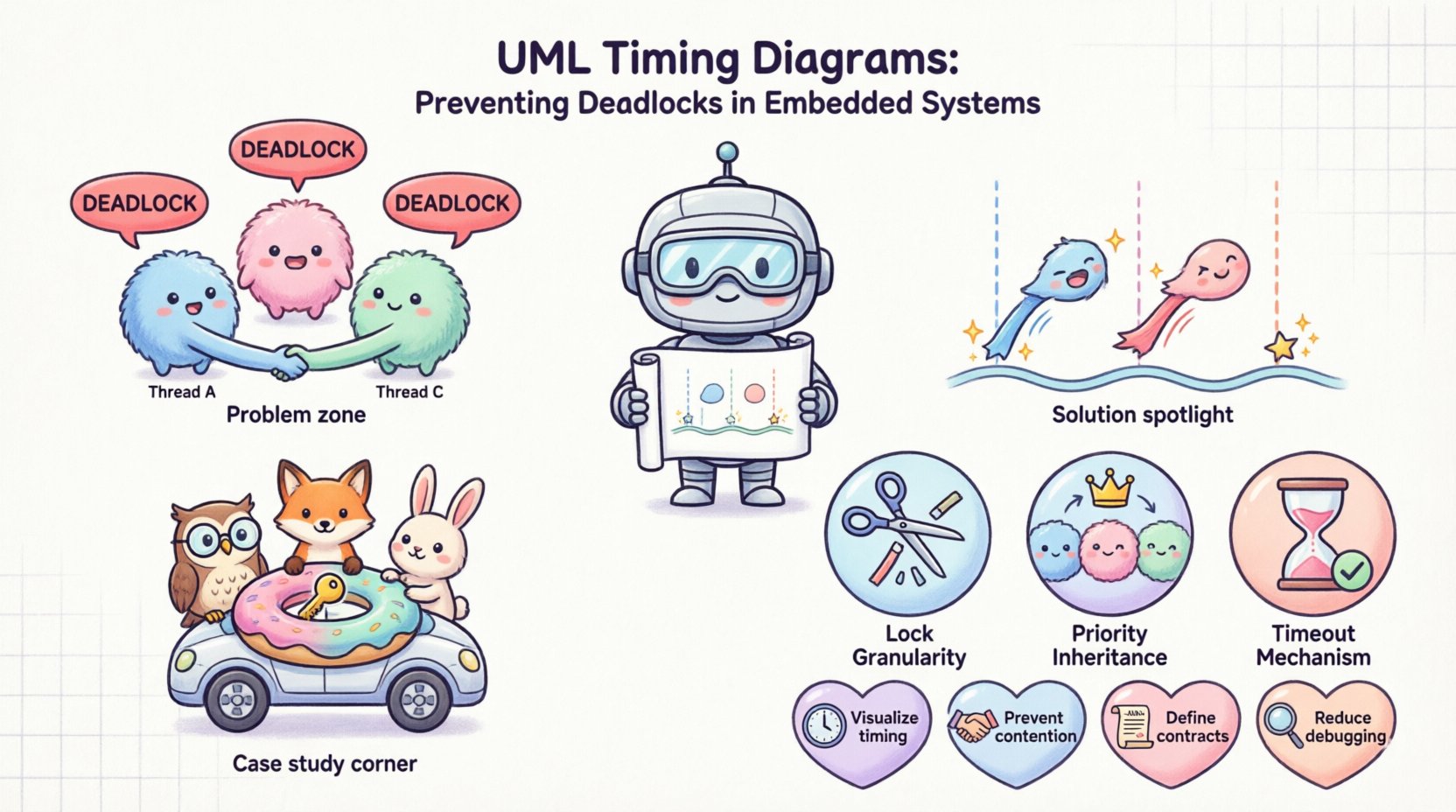
The Hidden Cost of Concurrency in Embedded Design ⚠️
Modern embedded software is rarely linear. It is an ecosystem of interrupts, background tasks, and real-time threads interacting simultaneously. While concurrency improves performance and responsiveness, it introduces a specific class of errors that static code analysis often misses. These errors occur when processes enter a waiting state that cannot be resolved because the resource they need is held by another process waiting on the first.
The challenges typically stem from:
- Resource Contention: Multiple threads attempting to access a shared memory buffer or peripheral bus simultaneously.
- Priority Inversion: A high-priority task is blocked by a low-priority task holding a necessary resource.
- Timing Mismatches: One component expects a signal to arrive within a specific window, but the sender operates on a different clock cycle.
- Deadlocks: A circular wait condition where no progress can be made.
Standard flowcharts or activity diagrams illustrate the logic flow but fail to represent the duration of actions. A sequence diagram shows the order of messages but often abstracts away the actual time duration. To catch timing-related deadlocks, one must look at the timeline itself.
Why Traditional Flowcharts Miss the Mark 📉
Many development teams rely on standard Unified Modeling Language (UML) diagrams like Class Diagrams or Activity Diagrams. While useful for structure and logic, they lack temporal granularity.
| Diagram Type | Primary Focus | Limitation for Deadlock Analysis |
|---|---|---|
| Activity Diagram | Control Flow | Does not show execution duration or overlaps. |
| Sequence Diagram | Message Order | Vertical axis is logical, not necessarily temporal. |
| State Machine | System States | Focuses on state transitions, not timing constraints. |
| UML Timing Diagram | Time & Signals | Explicitly maps signals to specific time intervals. |
When a deadlock occurs, it is often because Task A holds Resource X and waits for Resource Y, while Task B holds Resource Y and waits for Resource X. If the timing of these handshakes is misaligned, the system hangs. A Timing Diagram visualizes these intervals, making the circular dependency visible as overlapping active periods that never release.
Decoding UML Timing Diagrams for Real-Time Analysis 🕒
A UML Timing Diagram is a specialized interaction diagram. It focuses on the evolution of variables over time. In the context of embedded systems, these variables represent the state of signals, registers, or task statuses.
Key elements include:
- Lifelines: Represent the participants in the interaction, such as a CPU core, a sensor driver, or a memory controller.
- Time Axis: The horizontal axis represents the passage of time, often measured in clock cycles or milliseconds.
- State Changes: Vertical bars or regions indicating when a signal is active (high) or inactive (low).
- Events: Specific points in time where a transition occurs, such as a rising edge on an interrupt pin.
By mapping the lifecycle of a request from initiation to completion, engineers can identify gaps where a process is stuck waiting for a signal that never arrives due to a timing constraint violation.
Case Study: The Autonomous Sensor Fusion Controller 🚗🤖
To illustrate this process, consider a project involving an autonomous vehicle sensor fusion module. This system processes data from LiDAR, Radar, and Cameras to create a unified environmental model. The architecture relies on three distinct processing threads running on a multi-core microcontroller.
System Architecture Overview
- Thread A (Sensor Driver): Collects raw data from peripherals. It operates on a fixed interrupt timer.
- Thread B (Pre-Processor): Cleans and formats data before fusion. It runs as a high-priority task.
- Thread C (Fusion Engine): Calculates the final position and velocity. It runs as a medium-priority task.
All three threads share a common circular buffer for data storage. Access to this buffer is protected by a mutex lock. The system exhibited intermittent hangs during high-load scenarios, specifically when multiple sensors transmitted data simultaneously.
Modeling the Deadlock Scenario 🛠️
The first step in the resolution process was to model the expected behavior using a UML Timing Diagram. This was not done to draw pretty pictures, but to create a contract of behavior that could be compared against actual runtime logs.
We defined the following signal states for the buffer access:
- LOCK_ACQUIRED: A thread has exclusive access to the buffer.
- WAITING: A thread is blocked, waiting for the lock.
- RELEASED: The lock has been freed by the previous holder.
- TIMEOUT: A wait period exceeded the maximum allowable limit.
The initial model assumed that Thread B would always acquire the lock before Thread C, given the priority settings. However, the interrupt from Thread A could occur at any time, potentially preempting Thread B while it held the lock.
Visualizing the Interaction
The diagram was constructed with three lifelines corresponding to the threads. The time axis was scaled to represent a 10-millisecond window, which is typical for this control loop.
- 0ms – 1ms: Thread B acquires the lock.
- 1ms – 3ms: Thread B processes data.
- 3ms: An interrupt fires, triggering Thread A.
- 3ms – 5ms: Thread A attempts to acquire the lock (blocked).
- 5ms: Thread B releases the lock.
- 5ms – 6ms: Thread C attempts to acquire the lock (preempted by Thread A’s interrupt context).
This sequence highlighted a critical vulnerability. The priority inversion caused Thread A to hold the CPU, preventing Thread C from running, while Thread A waited for Thread B to finish its specific task which was delayed by the interrupt.
Identifying the Bottleneck with Signal States 🔍
Upon closer inspection of the timing diagram, a specific pattern emerged. The circular buffer access was not atomic. The lock acquisition and the data write were separated by a function call that involved a network handshake for telemetry data.
The diagram revealed that the lock was held for a duration longer than the interrupt latency threshold. This meant that if the interrupt occurred during the critical section, the waiting thread would not wake up until the network handshake completed.
Timing Violation Table
| Condition | Expected Duration | Actual Duration (Observed) | Impact |
|---|---|---|---|
| Lock Hold Time | < 2ms | 4.5ms | High Latency |
| Interrupt Response | < 1ms | 6ms | Missed Deadline |
| Buffer Release | Immediate | Delayed by Network | Deadlock Risk | d>
The UML Timing Diagram made it clear that the “Network Handshake” was the culprit. It was happening inside a critical section, which is a forbidden pattern in real-time programming. The diagram showed the active state of the Lock lifeline overlapping with the active state of the Network thread, creating a deadlock scenario where the network thread waited for the buffer, and the buffer thread waited for the network thread.
Implementing Solutions Based on Timing Data 🛠️✅
With the timing violations identified, the engineering team could propose targeted fixes. The goal was to minimize the time resources were held and ensure that interrupts could preempt critical sections safely.
Strategy 1: Lock Granularity Reduction
- Separate the data copy operation from the network transmission.
- Acquire the lock only to copy data into a local buffer.
- Release the lock immediately.
- Perform the network transmission outside the critical section.
Strategy 2: Priority Inheritance Protocol
- When a high-priority thread waits for a resource held by a lower-priority thread, the lower-priority thread temporarily inherits the higher priority.
- This prevents the high-priority thread from being blocked indefinitely by a medium-priority interrupt.
Strategy 3: Timeout Mechanisms
- Implement a timeout on the lock acquisition.
- If the lock is not acquired within the time window shown in the UML diagram (e.g., 5ms), the task should abort and signal an error rather than waiting forever.
After applying these changes, the UML Timing Diagram was updated to reflect the new expected behavior. The new model showed a significantly reduced overlap between the Lock lifeline and the Network lifeline.
Verification and Validation Strategies 📊
Modeling is only the first step. The revised design must be validated against the physical hardware. This involves a rigorous testing cycle that aligns with the timing constraints established in the diagram.
- Static Timing Analysis: Use tools to verify that the worst-case execution time (WCET) fits within the time windows defined in the diagram.
- Dynamic Logging: Instrument the code to log timestamps of lock acquisition and release. Compare these logs against the UML model.
- Stress Testing: Simulate high-load conditions where all sensors fire simultaneously to ensure the deadlock does not reoccur under peak load.
- Code Review: Ensure no other developers introduce blocking calls within the critical sections identified during the analysis.
The verification process confirmed that the lock hold time dropped to under 1ms, well within the interrupt latency threshold. The network handshake no longer occurred inside the critical section, eliminating the circular wait condition.
Common Pitfalls in Timing Modeling ⚠️
Even with a clear methodology, engineers often stumble when creating UML Timing Diagrams for embedded systems. Avoiding these mistakes ensures the model remains a reliable guide.
Pitfall 1: Ignoring Hardware Latency
Software diagrams often assume instant signal propagation. In reality, bus arbitration, DMA transfers, and peripheral clocks introduce delays. The diagram must account for the physical layer latency, not just the software logic.
Pitfall 2: Over-Simplifying State Changes
Representing a complex state machine as a single bar on the timeline can hide transient states. For example, a thread might be in a “Waiting” state but still holding a resource. Distinguishing between “Blocked” and “Running but Waiting” is crucial for deadlock detection.
Pitfall 3: Static Time Axes
Using a fixed time scale for all scenarios can be misleading. Interrupts happen asynchronously. The diagram should account for jitter and variable execution times, perhaps by using ranges rather than single points.
Pitfall 4: Neglecting Context Switching
The time it takes for the CPU to switch from one thread to another is not zero. In high-frequency systems, context switch overhead can add up, causing timing violations that look like deadlocks. This overhead must be factored into the time axis calculations.
Final Observations on Timing Integrity 🎯
Deadlocks in embedded systems are often the result of invisible timing issues. Logic may be sound, but the sequence of events over time creates a trap. UML Timing Diagrams provide the necessary lens to see these temporal traps.
By shifting the focus from logical flow to temporal flow, teams can:
- Visualize resource contention before implementation.
- Quantify the risk of priority inversion.
- Define clear timing contracts for hardware and software interfaces.
- Reduce debugging time by narrowing the search space to specific time windows.
The case study of the sensor fusion controller demonstrates that a disciplined approach to modeling pays off. The initial deadlock was not solved by adding more processors or faster code, but by understanding the timing of the interactions. The UML Timing Diagram served as the blueprint for this understanding.
As systems become more complex, with more cores and higher data rates, the margin for error shrinks. Relying solely on runtime testing is insufficient because deadlocks can be rare and non-deterministic. Incorporating timing analysis into the design phase ensures that reliability is built into the architecture, not tested into it.
For teams looking to enhance their embedded development practices, adopting UML Timing Diagrams is a strategic move. It bridges the gap between abstract logic and physical reality. It turns the invisible passage of time into a visible, manageable constraint. In the world of embedded engineering, where a single millisecond can define success or failure, mastering the visualization of time is a fundamental requirement.
Remember that the goal is not just to draw diagrams, but to extract actionable insights. Use the diagram to ask “What happens if this signal is delayed?” and “Can this resource be held for longer than the interrupt handler?” These questions drive the design toward robustness. The result is a system that performs reliably under the pressure of real-world conditions.
Related posts:
 UML Timing Diagrams Explained: A Beginner’s Guide to Visualizing Real-Time System Interactions
 UML Timing Diagram vs Sequence Diagram: Which One Should You Use for Real-Time Logic?
 How to Read and Draw Basic UML Timing Diagrams: A Step-by-Step Tutorial for Juniors
 Common UML Timing Diagram Mistakes That Break Your Real-Time System Design