


The transition from a conceptual business requirement to a fully functional software implementation requires a level of precision that manual documentation often struggles to achieve. In the modern software development lifecycle, Visual Paradigm‘s AI-powered Use Case Scenario Analyzer emerges as a critical instrument for ensuring technical accuracy and comprehensive requirements validation. This sophisticated application is designed to ingest natural language descriptions and meticulously transform them into structured, actionable scenarios and exhaustive decision tables. By utilizing advanced artificial intelligence, the tool eliminates the ambiguity inherent in textual narratives, providing project stakeholders with a clear, mathematical representation of system behavior. Whether one is designing a complex e-commerce platform or a simple internal utility, the ability to automate decision table generation significantly reduces the risk of overlooking critical edge cases.
In the initial phase of the analysis process, the user is presented with a clean, structured interface designed for high-fidelity data entry. As observed in the first stage of the workflow, the user provides a detailed narrative for a “browse catalog” use case within an online book retail system. This description outlines the main flow of events, beginning with the customer accessing the homepage and progressing through category selection, database queries, and the application of search filters. The interface is optimized for clarity, allowing for the inclusion of various conditions such as “valid credentials” or “database availability,” which are essential for the AI to perform a professional scenario extraction.
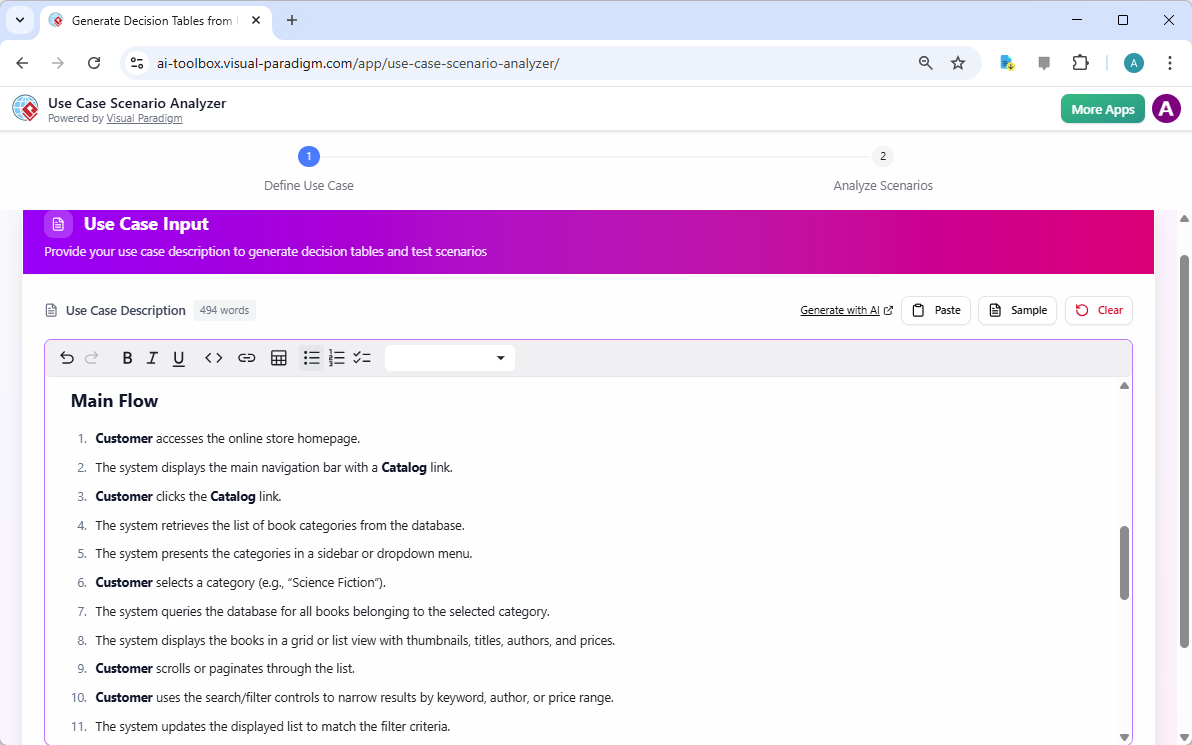
The descriptive narrative provided in the first step serves as the foundational data set for the AI’s analytical engine. By documenting the “Main Flow” alongside alternative paths, the user sets the stage for a thorough investigation of the system’s logical boundaries. This easy-to-use requirements validation tool focuses on identifying the specific interactions between the actor—in this case, the Customer—and the system’s backend processes, such as retrieving book categories or updating lists based on filter criteria. This structured input is the prerequisite for generating high-quality technical specifications that leave no room for developer misinterpretation.
Key Takeaways for Enhanced Requirements Engineering
-
Automated Logic Extraction: Transforms ambiguous natural language into precise, structured conditions and actions.
-
Exhaustive Scenario Coverage: Ensures that every logical permutation, including potential failure points, is accounted for in the system design.
-
Accelerated QA Preparation: Directly generates core test scenarios, allowing quality assurance teams to begin planning earlier in the cycle.
-
Improved Stakeholder Communication: Provides unambiguous visual representations (decision tables) that are easily understood by both technical and non-technical parties.
-
Seamless Tool Integration: Supports URL-based input to facilitate a fluid transition between various analytical tools in the Visual Paradigm ecosystem.
Once the narrative is submitted, the AI-powered Use Case Scenario Analyzer proceeds to the identification phase, where it deconstructs the text into its core logical components: Conditions and Actions. As illustrated in the analysis results for the “Browse Catalog” feature, the AI identifies specific triggers such as “Category Selected,” “Search Term Valid,” and “Database Connection Available.” Correspondingly, it maps these to distinct system responses, such as “Display Catalog,” “Display Error Message,” or “Truncate Search Input.” This granular decomposition is vital for professional software developers who require a discrete list of variables to implement robust error handling and feature logic.
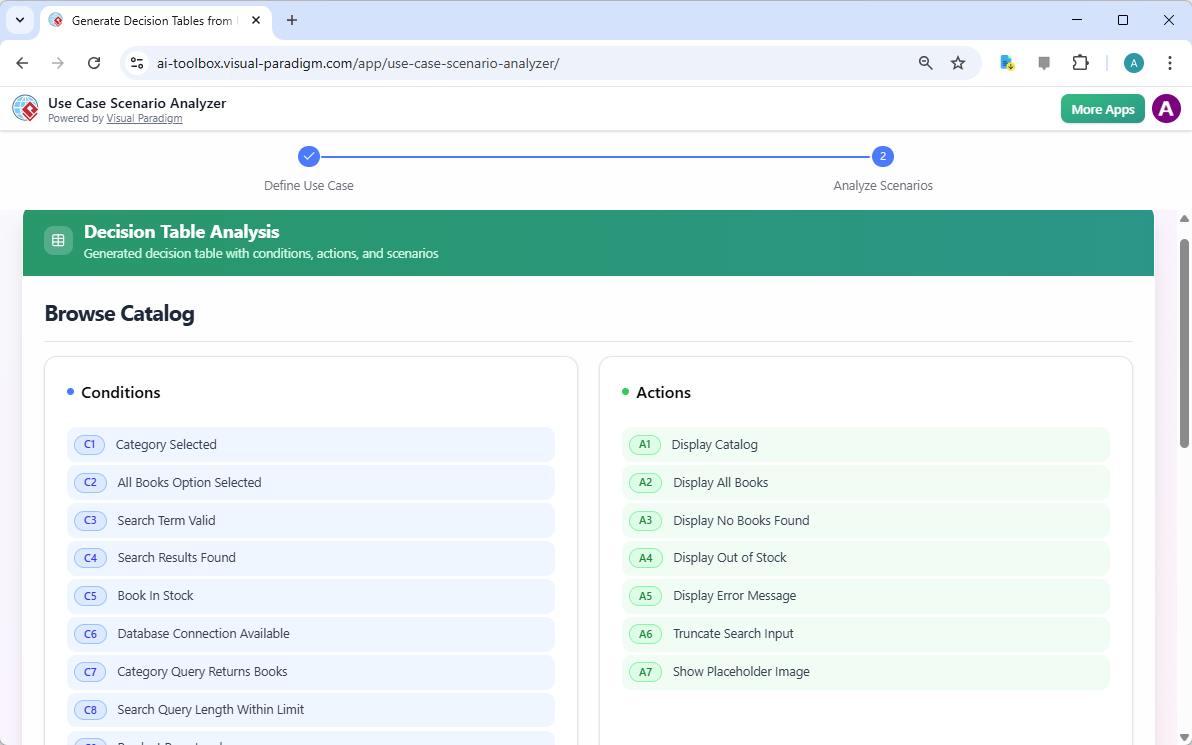
The identification of these conditions and actions is not merely a summary of the input text but a deep logical derivation. For instance, the system recognizes that the action “Show Placeholder Image” might be required if a specific condition regarding data availability is met. By categorizing these elements into “C” (Conditions) and “A” (Actions), the tool provides a standardized framework that mirrors the way code is structured. This best-in-class scenario analysis software ensures that the bridge between the business analyst’s vision and the developer’s execution is built on a foundation of rigorous logic rather than guesswork.
The Power of the Decision Matrix in System Design
The ultimate goal of use case analysis is to visualize how different variables interact. The most complex and valuable output of this process is the Decision Matrix. This matrix serves as a comprehensive map, where rows represent unique scenarios—ranging from the “Normal Flow” to various “Alternative Flows” and “Exception Flows”—and columns represent the full spectrum of conditions and actions identified in the previous step. In the context of the book retail system, the matrix explicitly defines what happens when a search query exceeds a maximum length or when a database connection fails during a catalog load.
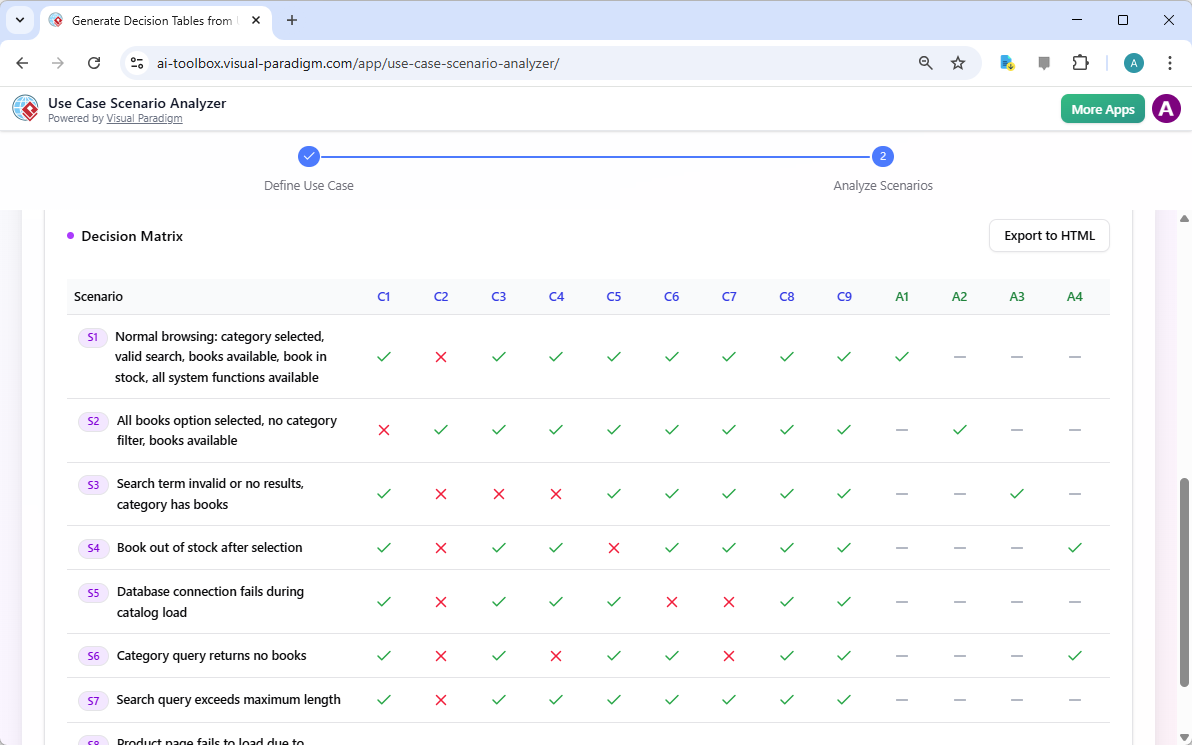
As seen in the detailed matrix, each scenario is assigned a specific set of checked conditions and resulting actions. For example, in Scenario S3, where a search term is invalid, the matrix clearly indicates that the action “Display No Books Found” (A3) is triggered. This advanced online decision table maker provides an exhaustive view of the system’s behavior, making it nearly impossible for a developer to miss a requirement. Furthermore, these rows serve as the “Core Test Scenarios” that QA engineers can use to validate the build. By having these scenarios pre-defined, the quality assurance process becomes a matter of verification against an established logical truth rather than an exploratory search for bugs.
For Business Analysts, this level of detail is indispensable for validating the completeness of requirements. If the matrix reveals a combination of conditions that does not lead to a clear action, it exposes a gap in the original requirement that must be addressed before development begins. This proactive approach to requirements quality improvement saves significant time and resources by preventing the “re-work” that often occurs when logic gaps are discovered only after the software has been built. The ability to export this data to HTML further enhances its utility, allowing the results to be integrated into broader project documentation or requirements management systems.
Enhancing Collaboration Across Development Teams
One of the primary challenges in software engineering is the “silo effect,” where requirements, development, and testing teams operate with slightly different interpretations of a feature. Visual Paradigm’s AI-powered Use Case Scenario Analyzer mitigates this risk by providing a single source of truth. Project Managers can use these analyses to assess the complexity of a feature based on the number of scenarios generated, while developers use the decision tables as a direct blueprint for coding business rules. This shared understanding fosters a supportive and efficient environment where the focus remains on delivering high-quality results.
The tool’s ability to work without the necessity of account creation or complex setups makes it an approachable solution for students and educators as well. It provides a practical, real-world application of scenario analysis and decision table theory, moving beyond academic exercises into tangible system design. By automating the tedious task of manual enumeration, users can spend more time on the creative aspects of design and implementation, confident that the underlying logic of their application is sound and fully accounted for.
In conclusion, the Visual Paradigm AI-powered Use Case Scenario Analyzer represents a significant advancement in how we approach software requirements. By transforming the “Browse Catalog” narrative of a book retail system into a structured decision matrix, we see how AI can bring clarity from ambiguity. This professional-grade scenario mapping tool empowers teams to deliver more reliable software by ensuring that all logical paths, conditions, and actions are meticulously documented and verified. As system complexities continue to grow, the adoption of automated, AI-driven analysis will remain a cornerstone of successful software delivery strategies.
Experience the precision of automated requirement validation for your next project. We invite you to explore the capabilities of this innovative tool and witness how it can streamline your development workflow. To begin your analysis, simply visit the application and input your use case description to generate comprehensive decision tables today.
Try the Use Case Scenario Analyzer now: Launch AI Scenario Tool
To learn more about the methodology and features: Visit the Use Case Scenario Analyzer Information Page
Related Links
-
Use Case: A use case is a description of interactions between users and a system to achieve a specific goal, commonly used in software engineering and requirements analysis.
-
What is a Use Case Scenario Analyzer? A Guide to AI-Powered Decision Making: This page explains how AI-powered scenario analysis enhances use case modeling by enabling intelligent decision-making and automated pattern recognition in system design.
-
Unraveling Scenarios with the Use Case Scenario Analyzer: A comprehensive guide on using the Use Case Scenario Analyzer to examine and refine use case flows for improved system clarity.
-
Comprehensive Guide to the Use Case Scenario Analyzer in Visual Paradigm: An in-depth tutorial on leveraging the Use Case Scenario Analyzer to validate and enhance use case scenarios in software projects.