
Now Reading: How Visual Paradigm’s AI C4 Studio Revolutionizes Architectural Diagramming: Bridging Probability and Precision
-
01
How Visual Paradigm’s AI C4 Studio Revolutionizes Architectural Diagramming: Bridging Probability and Precision


How Visual Paradigm’s AI C4 Studio Revolutionizes Architectural Diagramming: Bridging Probability and Precision
Introduction: The Challenge of Architectural Diagramming
In software development, clear and accurate architectural diagrams are essential for communication, planning, and documentation. However, creating these diagrams manually is time-consuming and error-prone. While generic AI tools (like large language models) can generate diagrams based on natural language prompts, they often fall short due to their probabilistic nature—leading to inconsistencies, incorrect notations, and non-compliant outputs.
Enter Visual Paradigm’s AI C4 Studio, a specialized tool designed to bridge the gap between natural language input and precise, standards-compliant architectural diagrams. By leveraging AI trained specifically on the C4 model (Context, Containers, Components, and Code), Visual Paradigm ensures that every element—boxes, labels, and relationships—adheres to official standards, reducing manual debugging and accelerating workflows.
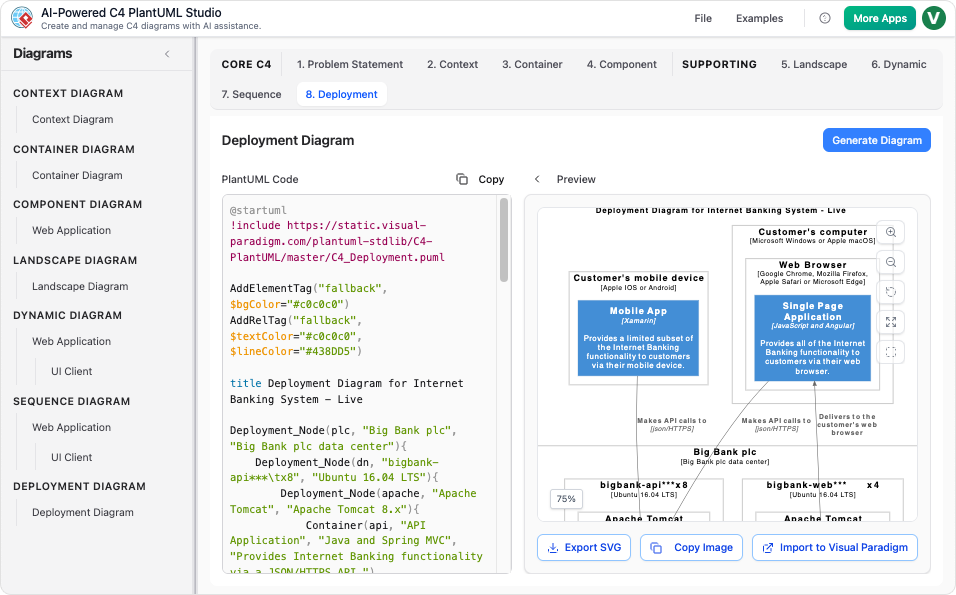
This article explores how AI C4 Studio addresses the core conflict between probability and precision, transforming the way architects, developers, and teams create and maintain software architecture diagrams.
The Core Conflict: Probability vs. Precision
1. Generic AI and Probabilistic Interpretation
Public AI models, such as generic large language models (LLMs), generate diagrams by interpreting text probabilistically. While impressive, this approach has limitations:
- Inconsistent Notations: Generic AI lacks a native understanding of architectural standards (e.g., C4, UML). As a result, it may produce diagrams with incorrect symbols, mislabeled elements, or improper relationships.
- Non-Compliant Syntax: Without specialized training, these models often generate PlantUML or Mermaid code that doesn’t conform to official standards, requiring extensive manual corrections.
- Hierarchical Errors: Relationships between containers, components, and systems may be misrepresented, leading to confusion rather than clarity.
Example: A generic AI might confuse a “container” with a “component” or use incorrect arrows to represent dependencies, violating C4 conventions.
2. Specialized AI and Architectural Enforcement
Visual Paradigm’s AI C4 Studio is purpose-built for architectural diagramming. Here’s how it solves the problems of generic AI:
- Standard-Specific Training: The AI is trained on the official C4 model, ensuring that every element and relationship follows the correct notation.
- Automated Compliance: The tool enforces C4 rules, automatically correcting errors and generating valid PlantUML code with over 95% accuracy.
- Reduced Manual Debugging: Developers spend less time fixing diagrams and more time refining architecture.
How AI C4 Studio Enhances Workflows
1. Natural Language to Accurate Diagrams
AI C4 Studio allows users to describe their architecture in plain English. The AI interprets the input and generates correct-by-construction diagrams, eliminating guesswork.
Example:
- Input: “Create a C4 diagram with a web app container, a database container, and a payment service component.”
- Output: A standards-compliant C4 diagram with properly labeled containers, components, and relationships.
2. Real-Time Validation and Suggestions
As users build diagrams, the AI provides:
- Instant feedback on notation errors.
- Smart suggestions for missing elements or relationships.
- Automatic corrections to ensure compliance.
3. Collaboration and Version Control
Teams can collaborate seamlessly with:
- Shared diagram libraries for consistency.
- Version history to track changes.
- Integration with DevOps tools (e.g., Jira, Confluence).
4. Export and Documentation
Diagrams can be exported in multiple formats (PlantUML, SVG, PNG) and embedded in documentation, ensuring alignment across teams.
Key Benefits of AI C4 Studio
| Feature | Generic AI | AI C4 Studio |
|---|---|---|
| Accuracy | ~70% (probabilistic) | >95% (standards-enforced) |
| Manual Debugging | High | Minimal |
| Compliance | Unreliable | Guaranteed |
| Learning Curve | Steep (requires manual fixes) | Low (AI guides users) |
| Collaboration | Limited | Built-in |
Use Cases: Who Benefits from AI C4 Studio?
1. Software Architects
- Rapidly prototype and validate architectures.
- Ensure compliance with C4 standards.
2. Development Teams
- Reduce miscommunication with accurate visualizations.
- Automate diagram updates as code evolves.
3. Technical Writers & Documentation Teams
- Generate up-to-date architecture diagrams for docs.
- Maintain consistency across projects.
4. Educators & Trainers
- Teach C4 modeling with AI-assisted guidance.
- Provide students with instant feedback on diagram correctness.
Conclusion: The Future of Architectural Diagramming
Visual Paradigm’s AI C4 Studio represents a paradigm shift in how software architecture is documented. By combining AI intelligence with strict standards enforcement, it eliminates the trade-off between speed and accuracy, empowering teams to: ✅ Create diagrams faster with natural language input. ✅ Reduce errors with automated compliance checks. ✅ Collaborate efficiently with built-in sharing and versioning.
For organizations adopting C4 modeling, AI C4 Studio is not just a tool—it’s a force multiplier for productivity and clarity.
Next Steps
- Try AI C4 Studio: Visual Paradigm’s Official Site
- Learn C4 Modeling: C4 Model Official Documentation
Question for Discussion: How has your team handled architectural diagramming challenges, and could AI-assisted tools like AI C4 Studio improve your workflow?
-
Ultimate Guide to C4 Model Visualization Using Visual Paradigm’s AI Tools: A comprehensive guide on leveraging Visual Paradigm’s AI-powered tools to automate and enhance C4 model visualization for faster, smarter software architecture design.
-
Leveraging Visual Paradigm’s AI C4 Studio for Streamlined Architecture Documentation: A detailed guide on using Visual Paradigm’s AI-enhanced C4 Studio to create clean, scalable, and maintainable software architecture documentation.
-
The Ultimate Guide to C4-PlantUML Studio: Revolutionizing Software Architecture Design – Visual Paradigm Blog: Software architecture documentation is often a bottleneck—time-consuming, error-prone, and quickly outdated.
-
A Comprehensive Guide to Visual Paradigm’s AI-Powered C4: Enter Visual Paradigm ’s AI-Powered C4 PlantUML Studio
-
C4-PlantUML Studio | AI-Powered C4 Diagram Generator – Visual Paradigm: An AI-powered tool to automatically generate C4 software architecture diagrams from simple text descriptions.
-
Comprehensive Tutorial: Generating and Modifying C4 Component : This tutorial is based on the official Visual Paradigm product demo video, demonstrating how to use the AI-powered Chatbot to create and iteratively refine a C4 Component Diagram for a car park booking system.
-
AI-Powered C4 Diagram Generator – Visual Paradigm AI:The AI-Powered C4 Diagram Generator supports the four core levels of the C4 Model (Context, Container, Component, Deployment) plus essential supporting views to provide comprehensive architectural documentation.
-
Visual Paradigm Full C4 Model Support Release: This release announcement details the integration of full C4 model support in Visual Paradigm, enabling users to create and manage architecture diagrams at multiple abstraction levels.
-
New: Full C4 Model Support Added to Visual Paradigm Desktop – ArchiMetric: The C4 Model: A Comprehensive Guide to Visualizing Software Architecture with AI-Powered Tools …
-
Visual-paradigm: Our AI supports a wide range of diagrams across various domains, including UML, C4 models for software architecture, and strategic frameworks like SWOT and PESTLE analysis.
-
Visual Paradigm AI Suite: A Comprehensive Guide to Intelligent Modeling Tools – Cybermedian: Strategic Frameworks: SWOT Analysis, PEST/PESTLE Analysis, Ansoff Matrix, and Blue Ocean Four Actions Framework. Systems Engineering: SysML Block Definition, Internal Block, and Requirement diagrams.
-
Visual-paradigm: Our AI supports a wide range of diagrams across various domains, including UML, C4 models for software architecture, and strategic frameworks like SWOT and PESTLE analysis.
-
PESTLE Analysis Explained: The Ultimate AI Guide: Visual Paradigm ’s AI chatbot supports the generation of diagrams for several key business frameworks, including SWOT, PESTLE , Ansoff, BCG, and C4 models. These are not standalone tools but components of a holistic strategic analysis toolkit.
-
AI Diagram Generator: Complete C4 Model Support: This page details the release of an AI-powered diagram generation feature in Visual Paradigm that enables automated creation of C4 model diagrams.
-
C4 Model AI Generator: Automate Context … – Ez Knowledge –: Visual Paradigm’s new AI Chatbot is purpose-built to automate the full C4 modeling lifecycle using conversational prompts, guaranteeing consistency
-
Comprehensive Review: Generic AI Chatbots vs. Visual Paradigm’s C4 Tools – ArchiMetric