
In the dynamic environment of software development, stability often clashes with immediacy. Teams frequently face the challenge of integrating urgent requests into their workflow without dismantling the structure that supports their delivery. This scenario is not unique to one organization; it is a universal tension within the Scrum framework. When an urgent task arises, the instinct is often to drop everything and address it immediately. However, doing so risks disrupting the sprint goal, inflating technical debt, and causing burnout.
The objective is not to reject all incoming requests but to manage them through a structured lens. By establishing clear protocols, teams can maintain their rhythm while remaining responsive to critical business needs. This guide details the mechanisms for handling interruptions effectively, ensuring that the integrity of the process remains intact while acknowledging the reality of the market.
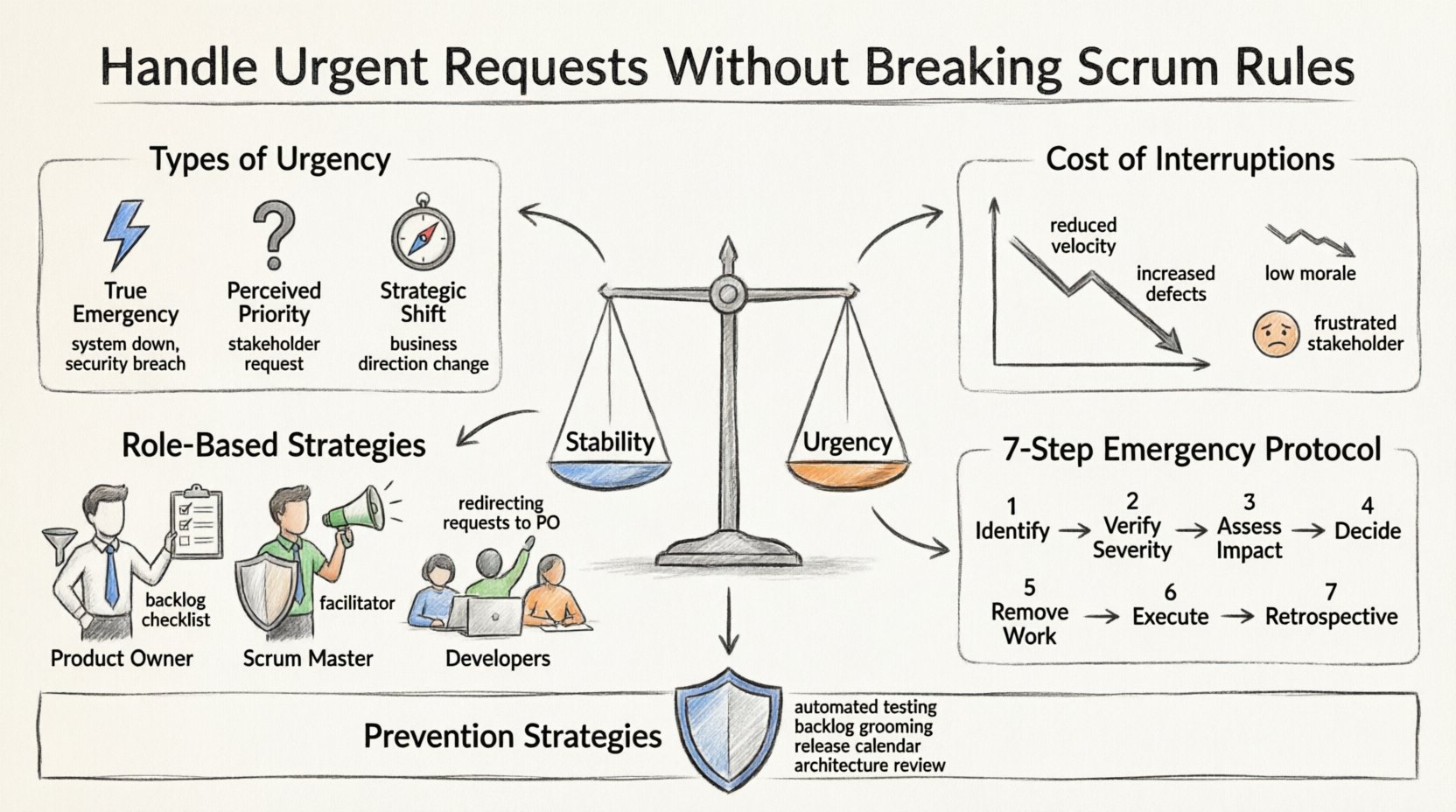
Understanding the Nature of Urgency 📋
Not all urgent requests are created equal. In many organizations, “urgent” becomes a default status for any item that does not fit the current plan. Distinguishing between a true emergency and a perceived priority is the first step in maintaining order. A true emergency requires immediate action to prevent significant harm, such as a security breach or a critical system outage. A perceived priority often stems from a stakeholder who has not had their needs addressed previously.
To navigate this, teams must adopt a mindset that values focus over reactivity. The Scrum framework is designed to protect the team’s capacity so they can deliver value predictably. Constantly shifting focus erodes this predictability. When a team is interrupted, the cost is not just the time spent on the new task, but the time required to regain context on the original work.
- True Emergency: A situation where the system is down, data is compromised, or a customer cannot use the product at all.
- Perceived Urgency: A request that feels important because it was just voiced, but does not meet the criteria of a critical failure.
- Strategic Shift: A change in business direction that invalidates the current sprint goal, requiring a formal decision rather than an ad-hoc insertion.
The Cost of Interruptions 🛑
Interruptions have a measurable impact on productivity. Research into cognitive load suggests that switching tasks can result in a significant loss of efficiency. This phenomenon is often referred to as context switching. When a developer stops working on a complex feature to address a small bug or a quick question, they must rebuild their mental model of the codebase every time they return. This cumulative effect can slow down velocity and increase the likelihood of errors.
Beyond individual productivity, the team’s ability to commit to a sprint goal is compromised. If the sprint goal is abandoned to accommodate a new request, the team fails to deliver on its promise. This erodes trust with stakeholders. Therefore, managing interruptions is not just about protecting the team; it is about protecting the reliability of the delivery process.
Consider the following impacts of unmanaged interruptions:
- Reduced Velocity: Planned work takes longer as attention is divided.
- Increased Defects: Rushed context switching leads to overlooked details.
- Team Morale: Constant fire-fighting creates a sense of chaos and lack of control.
- Stakeholder Frustration: Missed commitments due to scope creep lead to dissatisfaction.
Role-Based Strategies for Managing Requests 🤝
Handling urgent requests requires collaboration across all three Scrum roles. Each role has specific responsibilities in filtering, prioritizing, and executing urgent work. By defining these boundaries, the team can respond without breaking the framework.
The Product Owner’s Responsibility
The Product Owner acts as the gatekeeper of the backlog. They are responsible for ensuring that the backlog reflects the most valuable work. When an urgent request comes in, the Product Owner must evaluate its value against the current plan. They have the authority to decide whether a sprint can be interrupted or if the request should be added to the backlog for the next iteration.
- Filter Incoming Noise: The Product Owner should absorb initial requests and translate them into clear user stories.
- Assess Value: Determine if the urgent request provides more value than the current sprint goal.
- Manage Expectations: Communicate clearly why a request cannot be included immediately if that is the decision.
- Re-prioritize: If an urgent request is approved, the Product Owner must remove an equivalent amount of work from the sprint to maintain capacity.
The Scrum Master’s Responsibility
The Scrum Master protects the process. They ensure that the team adheres to the rules of Scrum and that external interference is minimized. When urgent requests disrupt the flow, the Scrum Master steps in to facilitate the removal of impediments and to shield the team from unnecessary distractions.
- Shield the Team: Act as a buffer between the team and stakeholders during a sprint.
- Facilitate Decision Making: Help the Product Owner and stakeholders reach a consensus on whether to interrupt.
- Monitor Flow: Track how often interruptions occur and bring this data to the retrospective.
- Enforce Boundaries: Remind stakeholders of the agreed-upon sprint boundaries and the impact of changes.
The Developers’ Responsibility
The Developers own the work. They are the ones who execute the tasks and must protect their focus. While they are responsive to the business, they should not accept direct requests that bypass the Product Owner.
- Direct Requests to PO: Politely redirect any new tasks to the Product Owner for prioritization.
- Monitor Capacity: Be honest about the team’s ability to take on extra work without sacrificing quality.
- Collaborate on Solutions: If an emergency occurs, collaborate to find the most efficient path to resolution.
- Document Disruptions: Log any interruptions in the team’s metrics to highlight patterns.
The Emergency Protocol 🚨
Even with the best planning, emergencies happen. Having a predefined protocol allows the team to react quickly without confusion. This protocol ensures that the decision to interrupt is deliberate and that the team understands the trade-offs involved.
The following table outlines the standard steps for handling a genuine emergency within a sprint:
| Step | Action | Responsible Role |
|---|---|---|
| 1 | Identify the Issue | Team Member |
| 2 | Verify Severity | Scrum Master & PO |
| 3 | Assess Impact on Sprint Goal | Product Owner |
| 4 | Decide to Cancel Sprint or Adapt | Stakeholders & PO |
| 5 | Remove Existing Work | Product Owner |
| 6 | Execute Emergency Task | Developers |
| 7 | Update Retrospective | Entire Team |
If the emergency is severe enough to warrant canceling the sprint, the Scrum Master must facilitate the decision. This is a rare occurrence and should only happen if the sprint goal is no longer achievable. If the team decides to continue the sprint, they must remove work of equal complexity to accommodate the new task. This maintains the capacity of the team and prevents overcommitment.
Managing Stakeholder Expectations 📈
Stakeholders often view the sprint as a flexible container for work. They may expect that any request can be inserted at any time. It is the responsibility of the Scrum team to educate stakeholders on how the process works. Transparency is key. Sharing metrics about velocity and the cost of interruptions helps stakeholders understand why a “quick fix” can take longer than expected.
Establishing a cadence for communication helps manage this. Regular sprint reviews allow stakeholders to see progress and raise concerns before they become emergencies. If a stakeholder identifies a critical issue, they should be encouraged to contact the Product Owner immediately, rather than approaching developers directly.
Key communication strategies include:
- Visual Management: Use boards to show what is in progress and what is blocked. This makes the cost of interruptions visible to everyone.
- Capacity Planning: Show stakeholders the available capacity. If a new request is added, show them what is being removed.
- Feedback Loops: Create channels for stakeholders to provide feedback that does not disrupt the team’s flow.
- Empathy: Acknowledge the pressure stakeholders face. Explain that protecting the team’s focus ultimately delivers better value to them.
Post-Incident Review and Adaptation 🔄
Once an urgent request has been handled, the work is not done. The team must analyze what happened to prevent similar issues in the future. This analysis takes place during the Sprint Retrospective. The goal is not to assign blame, but to improve the process.
Questions to ask during this review include:
- Was the request truly an emergency, or could it have waited?
- Did the emergency cause a loss of sprint goal?
- How long did it take the team to recover focus?
- Was there a process failure that allowed the emergency to arise?
If the team finds that emergencies are becoming frequent, they should consider adjusting their definition of “done” or refining their architecture. Often, urgent requests stem from technical debt. Addressing the root cause is more effective than managing the symptoms.
Long-term Prevention Strategies 🛡️
While having a protocol is necessary, the best way to handle urgent requests is to reduce their frequency. This requires a proactive approach to quality and planning.
- Invest in Quality: Automated testing and continuous integration reduce the likelihood of production bugs. When quality is high, the number of fire-fighting tasks decreases.
- Refine the Backlog: A well-groomed backlog ensures that the most valuable work is always ready. This reduces the need for reactive prioritization.
- Release Management: Establish a predictable release schedule. Stakeholders are less likely to demand urgent changes if they know when new features will be available.
- Architecture Review: Regularly review the technical architecture to ensure it can handle business changes without requiring major overhauls.
Conclusion on Stability and Flexibility 🌟
Scrum provides a framework for managing change, but it does not eliminate the need for change. The challenge lies in balancing the stability required for deep work with the flexibility needed to respond to business needs. By defining clear roles, establishing an emergency protocol, and maintaining open communication with stakeholders, teams can handle urgent requests without breaking their rules.
The goal is not to create a rigid environment where nothing can change. Instead, the goal is to create a resilient system where changes are managed deliberately. When a team feels in control of their work, they produce higher quality output. When stakeholders understand the process, they trust the delivery. This balance is the foundation of sustainable agile success.
Remember, the sprint is a commitment. Breaking it should be a conscious decision, not a default reaction. By respecting the process, teams respect the value they bring to the organization.