
Enterprise Architecture (EA) serves as the blueprint for an organization. It is the practice of translating business vision and strategy into effective enterprise change. Think of it as the master plan that guides how an organization functions, grows, and adapts to new challenges. Without this structure, departments often operate in silos, leading to redundant systems, wasted resources, and misalignment between what the business needs and what technology delivers.
This guide provides a deep dive into the fundamentals of Enterprise Architecture. We will explore the core components, the strategic value, and the practical steps involved in building a robust architectural framework. Whether you are an IT professional, a business leader, or a student, understanding these principles is essential for navigating modern digital landscapes. 🚀
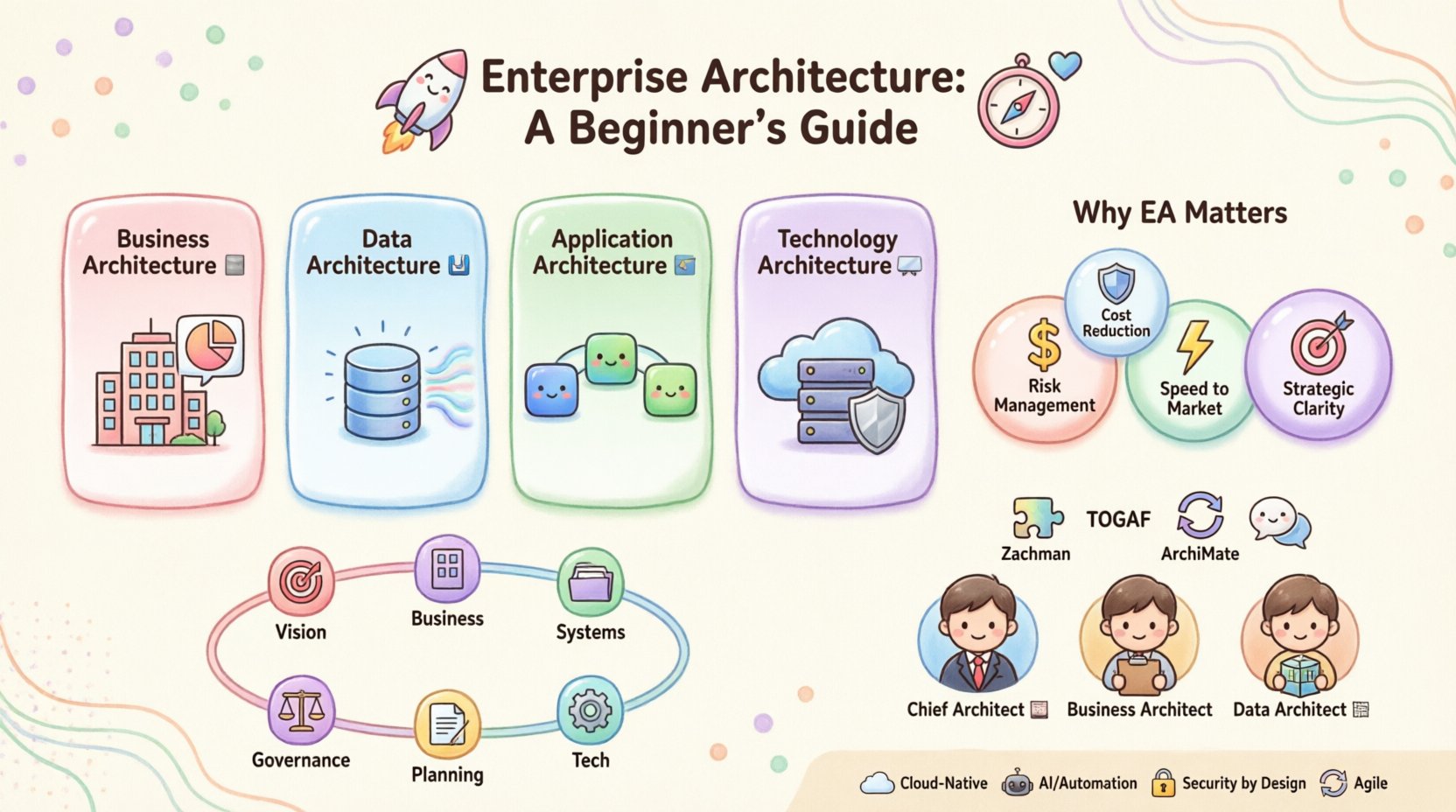
What Exactly is Enterprise Architecture? 🤔
At its simplest, Enterprise Architecture is a discipline that creates a holistic view of an organization. It connects the dots between business goals and the technical systems that support them. It is not merely about drawing diagrams or managing servers; it is about ensuring that every investment in technology contributes directly to the mission of the company.
Key characteristics include:
- Holistic View: It looks at the entire organization, not just isolated departments.
- Strategic Alignment: Technology decisions are driven by business needs.
- Standardization: It establishes common standards to reduce complexity.
- Agility: It enables the organization to respond quickly to market changes.
Many people confuse EA with IT management. While IT management focuses on the day-to-day operation of systems, EA focuses on the long-term direction. It answers questions like: “Where are we going?” “How do we get there?” and “Are we moving in the right direction?”
The Four Core Domains of Enterprise Architecture 🏛️
Enterprise Architecture is typically broken down into four distinct layers. Understanding these layers is crucial for grasping how the different parts of an organization interact. Each layer builds upon the one below it, creating a foundation for the business capabilities above.
1. Business Architecture 🏢
This is the foundation of the entire structure. It defines the business strategy, governance, organization, and key business processes. It answers the question: “What does the business do?” This domain ensures that the operational model supports the strategic goals. Without a clear business architecture, technology investments lack direction.
2. Data Architecture 📊
Data is the lifeblood of modern organizations. Data Architecture describes the structure of an organization’s logical and physical data assets and data management resources. It defines how data is stored, integrated, and accessed. Key considerations include data quality, security, and governance. In a world driven by analytics, this layer is increasingly critical.
3. Application Architecture 🖥️
This layer outlines the blueprint for the individual systems and their interactions. It describes how software applications are deployed and how they communicate with each other. The goal is to minimize redundancy and ensure that applications work together seamlessly. It defines the interfaces between applications and how they support business processes.
4. Technology Architecture 💻
The Technology Architecture describes the hardware and software infrastructure required to support the applications. This includes servers, networks, cloud platforms, and security protocols. It ensures that the underlying infrastructure is robust, scalable, and secure enough to handle the demands of the applications above it.
To visualize how these domains interact, refer to the table below:
| Domain | Primary Focus | Key Question | Output Example |
|---|---|---|---|
| Business Architecture | Strategy & Processes | What are our goals? | Process Maps, Org Charts |
| Data Architecture | Information Flow | How is data managed? | Data Models, Schema Diagrams |
| Application Architecture | Software Systems | Which tools do we use? | System Interfaces, Service Maps |
| Technology Architecture | Infrastructure | Where does it run? | Network Diagrams, Cloud Topology |
Why Enterprise Architecture Matters for Transformation 🔄
Digital transformation is a buzzword, but without an architectural foundation, it often fails. EA provides the structure needed to manage complexity during periods of rapid change. Here is why it is vital for successful transformation:
- Cost Reduction: By identifying redundant systems, organizations can consolidate tools and reduce licensing fees and maintenance costs.
- Risk Management: A clear view of the infrastructure helps identify security vulnerabilities and compliance gaps before they become issues.
- Speed to Market: Standardized platforms and reusable components allow development teams to build and deploy solutions faster.
- Strategic Clarity: Leadership gains a clear understanding of how IT investments align with revenue goals.
When an organization lacks EA, projects often become isolated “pet projects.” One department buys a CRM, another buys an ERP, and a third builds a custom tool. These systems do not talk to each other. EA ensures interoperability, allowing data to flow freely between departments.
Common Frameworks and Methodologies 📐
While there is no single “right way” to do Enterprise Architecture, several established frameworks provide guidance. These frameworks offer best practices, templates, and terminology to help organizations structure their thinking.
The Zachman Framework
One of the oldest frameworks, Zachman is essentially a classification scheme. It organizes architectural artifacts into a matrix defined by “What, How, Where, Who, When, and Why” across different perspectives (Planner, Owner, Designer, Builder, Subcontractor, User). It is less about process and more about ensuring nothing is missed in the description of the enterprise.
TOGAF (The Open Group Architecture Framework)
TOGAF is widely used and provides a detailed approach for developing an enterprise architecture. It focuses heavily on the Architecture Development Method (ADM). The ADM is a cycle that guides the creation of architecture from vision to implementation. It emphasizes stakeholder management, requirements analysis, and iterative refinement.
ArchiMate
ArchiMate is a modeling language often used in conjunction with other frameworks. It provides a standardized notation for describing, analyzing, and visualizing architecture. It allows architects to create diagrams that are easily understood by both technical and non-technical stakeholders.
Choosing a framework depends on the size and complexity of the organization. Smaller entities might find a full framework too heavy, while large enterprises often require the rigor of TOGAF to manage their scale.
The Enterprise Architecture Lifecycle 🔄
Building an architecture is not a one-time event. It is a continuous cycle of planning, designing, implementing, and governing. The lifecycle ensures that the architecture evolves alongside the business.
1. Architecture Vision 🎯
This phase sets the stage. It defines the scope, identifies stakeholders, and establishes the high-level strategy. The goal is to get buy-in from leadership and ensure everyone understands the purpose of the initiative.
2. Business Architecture 🏢
Here, the business landscape is mapped out. Processes are defined, and capabilities are identified. This ensures that the technology strategy is rooted in actual business needs rather than theoretical possibilities.
3. Information Systems Architecture 🗃️
This phase covers the Data and Application architectures. It defines the systems required to support the business processes. It involves selecting technologies and designing the logical structure of the information flow.
4. Technology Architecture ⚙️
The physical infrastructure is planned. This includes hardware, networks, and cloud environments. Security and performance standards are defined at this stage.
5. Implementation Planning 📝
How do we get from the current state to the target state? This phase involves creating migration plans, identifying gaps, and prioritizing projects. It ensures that the transition is managed in phases to minimize disruption.
6. Governance and Compliance ⚖️
Once the architecture is in place, it must be maintained. Governance ensures that new projects adhere to the established standards. It prevents the re-emergence of silos and ensures continuous alignment with the strategy.
Key Roles and Responsibilities 👥
A successful EA practice requires specific roles within the organization. While titles may vary, the responsibilities generally fall into these categories:
- Chief Enterprise Architect: The leader responsible for the overall vision and strategy. They act as a bridge between the C-suite and technical teams.
- Business Architect: Focuses on the Business Architecture domain. They understand processes, organizational structure, and value streams.
- Solution Architect: Designs specific solutions that fit within the broader enterprise context. They ensure individual projects align with the master plan.
- Data Architect: Responsible for data governance, models, and integration strategies.
- Technology Architect: Focuses on infrastructure, platforms, and technical standards.
- EA Governance Board: A group of stakeholders who review and approve major architectural decisions to ensure compliance with standards.
Collaboration between these roles is essential. For example, a Solution Architect cannot design a system in isolation; they must consult with the Data Architect to ensure data integrity and the Business Architect to ensure process alignment.
Common Challenges in Enterprise Architecture ⚠️
Implementing EA is not without obstacles. Many organizations struggle to get traction. Understanding these challenges can help mitigate risks.
- Perceived Bureaucracy: If EA is seen as a gatekeeper that slows down projects, it will face resistance. It must be viewed as an enabler that provides clarity.
- Lack of Executive Support: Without sponsorship from the top, EA initiatives often stall. Leadership must understand the value of long-term planning over short-term fixes.
- Resistance to Change: Architects often propose changes that disrupt existing workflows. Change management is critical to overcoming cultural inertia.
- Outdated Documentation: If the architecture models are not kept up to date, they become useless. Documentation must be a living process, not a one-time task.
- Scope Creep: Trying to map the entire organization at once is often overwhelming. It is better to start with a specific domain or critical business unit.
Measuring Success and Value 📈
How do you know if Enterprise Architecture is working? You need metrics that reflect both technical health and business value. Relying solely on uptime is insufficient.
Strategic Metrics
- Alignment Score: How many projects align with the strategic plan?
- Time to Market: Has the speed of delivery improved due to standardized components?
- Stakeholder Satisfaction: Do business leaders feel supported by IT?
Technical Metrics
- System Redundancy: Are we running multiple systems for the same function?
- Technology Debt: Is the technical debt decreasing or increasing?
- Integration Points: Are systems communicating effectively?
Tracking these metrics helps demonstrate the ROI of the EA function. It moves the conversation from “cost center” to “value creator.”
The Future of Enterprise Architecture 🌐
The landscape of EA is evolving. As technology becomes more complex, the role of the architect must adapt. Several trends are shaping the future of the discipline:
- Cloud-Native Architecture: Moving away from on-premise infrastructure to cloud-native designs requires new architectural patterns focused on microservices and scalability.
- AI and Automation: AI tools are beginning to assist in modeling and impact analysis. Architects will spend less time drawing and more time strategizing.
- Security by Design: Security is no longer an afterthought. It is integrated into the architecture from the very beginning of the design process.
- Agile Architecture: Traditional waterfall planning is being replaced by iterative approaches. Architecture must be flexible enough to accommodate rapid changes.
Getting Started with Your Own Practice 🛠️
If you are looking to introduce EA to your organization, start small. You do not need a massive transformation overnight. Follow these steps to build momentum:
- Assess the Current State: Understand what systems and processes exist today. Identify the pain points.
- Define the Vision: Work with leadership to define what success looks like in the future.
- Identify Quick Wins: Find low-hanging fruit where architectural improvements can yield immediate value.
- Establish Governance: Create a lightweight review process for new projects.
- Communicate Value: Regularly share success stories and metrics to build trust.
Patience is key. Building a culture of architecture takes time. It requires consistent communication and demonstration of value.
Final Thoughts on Strategic Alignment 🤝
Enterprise Architecture is more than a set of diagrams; it is a mindset. It is the commitment to thinking about the whole before the part. In a world of rapid technological change, having a clear architectural vision provides stability and direction.
By aligning business and technology, organizations can navigate complexity with confidence. They can innovate faster, reduce costs, and deliver better value to their customers. The journey of Enterprise Architecture is continuous, evolving as the business evolves. Embrace the process, focus on the value, and build a foundation that supports long-term success.