
Enterprise Architecture (EA) serves as the blueprint for an organization’s structure, processes, and systems. It is not merely a diagramming exercise but a strategic discipline that aligns business goals with technological capabilities. In a digital-first economy, understanding the granular components of EA is essential for sustainable growth and operational resilience. This guide explores the foundational layers, cross-functional concerns, and implementation strategies that define a robust enterprise framework.
The modern landscape demands agility. Organizations must navigate complex regulatory environments while innovating rapidly. A structured approach to architecture ensures that decisions made today do not create technical debt tomorrow. We examine the core pillars, detailing their specific functions and interdependencies.
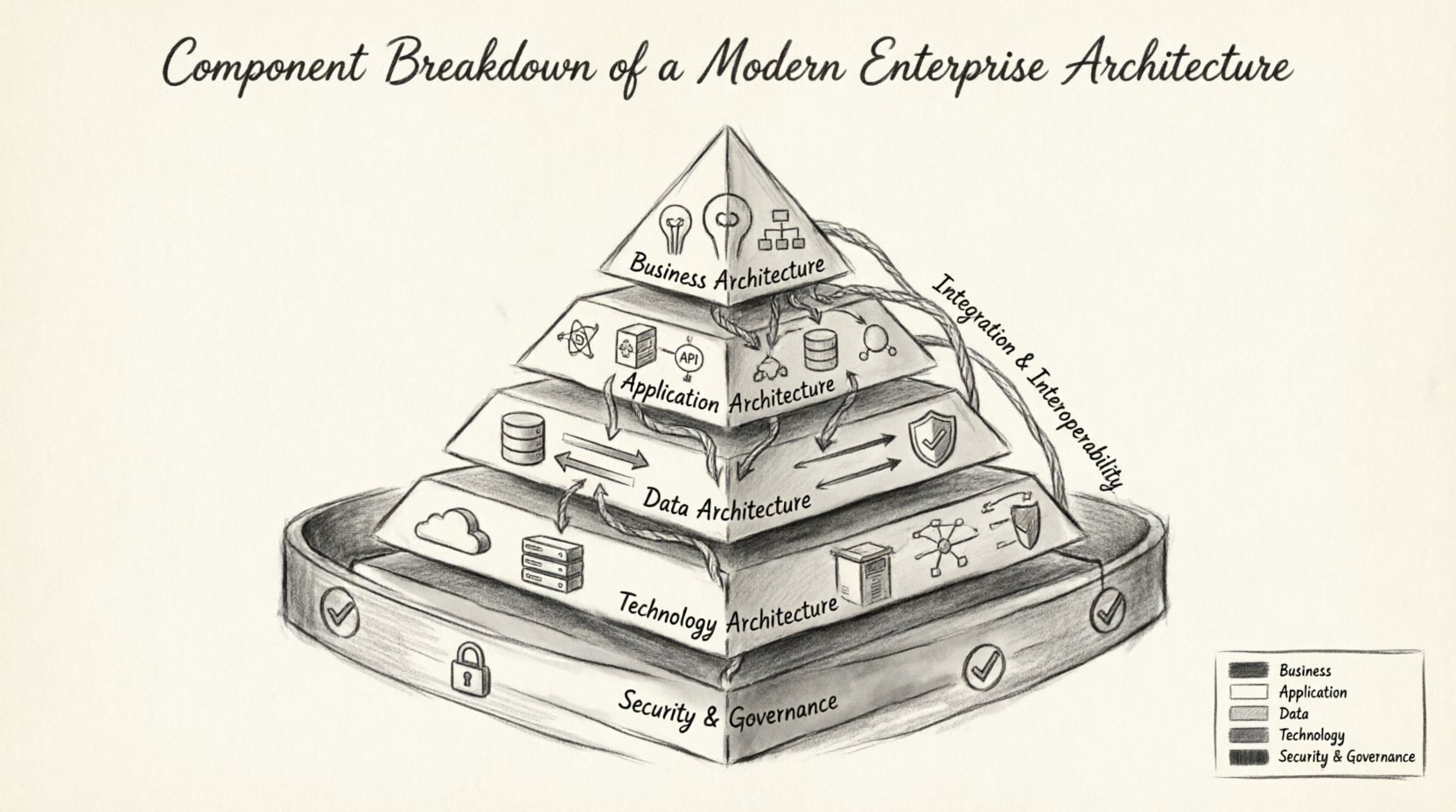
🧩 1. Business Architecture: The Strategic Foundation
Business architecture defines the structure of the organization and how it operates. It provides the context for all other architectural domains. Without a clear understanding of business goals, technology investments lack direction.
Key Components
- Business Capabilities: What the organization must be able to do to deliver value. This includes customer relationship management, supply chain logistics, and financial reporting.
- Value Streams: The series of steps an organization takes to create value for customers. Mapping these reveals inefficiencies and opportunities for automation.
- Organizational Structure: How teams are grouped and how authority is distributed. This affects communication flows and decision-making speed.
- Business Rules: Constraints that dictate how business operations must be conducted, often driven by compliance or policy.
When mapping capabilities, organizations often use a hierarchical model. This allows for a top-down view of strategy and a bottom-up view of execution. It ensures that every technology investment ties back to a specific business outcome.
💻 2. Application Architecture: The Functional Layer
Application architecture describes the structure of the software systems and their interactions. It focuses on the software components that support business capabilities. The goal is to ensure applications are scalable, maintainable, and interoperable.
Core Elements
- Application Portfolio: A catalog of all software systems. This includes legacy systems, custom builds, and third-party solutions. Rationalizing this portfolio is critical for cost reduction.
- Service Orientation: Designing applications as collections of services. This promotes reuse and reduces redundancy across the enterprise.
- Integration Patterns: The methods used for systems to communicate. Common patterns include synchronous APIs, event-driven messaging, and batch processing.
- Standards & Interfaces: Defined protocols that ensure different applications can exchange data without friction.
Modern application architecture leans heavily towards modularity. Monolithic structures are often replaced by distributed microservices. This shift allows teams to update specific functions without disrupting the entire system. However, it introduces complexity in data consistency and service discovery.
📊 3. Data Architecture: The Information Backbone
Data is a critical asset in the modern enterprise. Data architecture defines how data is collected, stored, managed, and used. It ensures that information is accurate, accessible, and secure across the organization.
Essential Pillars
- Data Models: Logical and physical representations of data structures. These define relationships between entities and ensure data integrity.
- Data Flow: The movement of data from source to consumption. This includes ingestion, transformation, and distribution.
- Storage Strategies: Decisions regarding where data resides. Options range from relational databases to data lakes and warehouses.
- Data Governance: The framework for managing data availability, usability, integrity, and security.
Effective data architecture supports analytics and decision-making. It moves beyond simple storage to enable insights. Organizations must balance the need for real-time access with the requirements of historical analysis. This often involves separating transactional workloads from analytical workloads.
🖥️ 4. Technology Architecture: The Infrastructure
Technology architecture covers the hardware, networks, and platforms that support applications and data. It provides the environment in which the digital systems operate. This layer deals with the physical and logical infrastructure.
Infrastructure Components
- Compute Resources: Processing power, whether on-premise servers or cloud instances.
- Network Topology: How devices are connected. This includes LANs, WANs, and cloud connectivity.
- Platform Services: Middleware and operating systems that manage resources.
- Security Controls: Firewalls, encryption, and identity management systems embedded in the infrastructure.
The shift to cloud computing has transformed this layer. Infrastructure is no longer just about physical racks. It is about provisioning resources on demand. This requires a new set of skills focused on orchestration and automation. Managing hybrid environments, where some workloads remain on-premise while others move to the cloud, adds significant complexity.
🔒 5. Security & Governance: The Protective Layer
Security and governance are not separate domains; they are woven into every layer of the architecture. They ensure that the system operates within acceptable risk parameters and complies with regulations.
Key Responsibilities
- Risk Management: Identifying and mitigating potential threats to the architecture.
- Compliance: Adhering to laws and standards such as data privacy regulations or industry-specific mandates.
- Identity & Access Management (IAM): Controlling who can access which resources.
- Audit Trails: Logging activities to ensure accountability and traceability.
Governance provides the decision-making framework. It establishes standards and enforces adherence. Without governance, architectural drift occurs, where systems become inconsistent and difficult to manage. A strong governance model empowers teams to make autonomous decisions within defined boundaries.
🔗 6. Integration & Interoperability
Enterprise systems rarely exist in isolation. They must communicate with partners, customers, and internal tools. Integration architecture defines how these connections are established and maintained.
Integration Strategies
- API Management: Exposing functionality through standardized interfaces.
- Enterprise Service Bus (ESB): A middleware approach for connecting disparate systems.
- Event-Driven Architecture: Systems reacting to changes in state in real-time.
- Data Synchronization: Ensuring data consistency across different platforms.
Integration is often the most challenging aspect of EA. Legacy systems may lack modern interfaces. New systems may require complex configuration. A strategic approach involves defining an integration standard early and adhering to it. This reduces the cost of connecting new capabilities to the existing ecosystem.
📋 7. Comparison of Architectural Domains
Understanding the distinctions between these domains helps in assigning ownership and defining responsibilities. The table below summarizes the focus of each layer.
| Domain | Primary Focus | Key Artifacts | Stakeholders |
|---|---|---|---|
| Business | Capabilities & Value | Capability Maps, Value Streams | Executives, Business Analysts |
| Application | Software Systems | App Portfolios, Service Diagrams | Developers, Product Owners |
| Data | Information Flow | Data Models, Flow Diagrams | Data Engineers, Analysts |
| Technology | Infrastructure | Network Topology, Server Specs | Infrastructure Engineers, Ops |
| Security | Risk & Compliance | Policy Documents, Risk Registers | CISO, Auditors, Legal |
🔄 8. Implementation & Lifecycle Management
Architecture is a living discipline. It evolves as the business changes. Implementation involves translating architectural designs into tangible systems. Lifecycle management ensures the architecture remains relevant over time.
Management Practices
- Roadmapping: Planning the evolution of the architecture over time. This includes migration paths for legacy systems.
- Metrics & KPIs: Measuring the health and performance of the architecture. Examples include system uptime, deployment frequency, and technical debt levels.
- Review Cycles: Regular audits of architectural decisions to ensure alignment with strategy.
- Change Management: Processes for approving and implementing changes to the architecture.
Successful implementation requires collaboration between architects and delivery teams. Architects provide the guardrails, while delivery teams build within them. Continuous feedback loops allow the architecture to adapt to real-world constraints and new requirements.
🎯 9. Strategic Alignment
The ultimate purpose of Enterprise Architecture is alignment. It bridges the gap between business strategy and IT execution. Misalignment leads to wasted resources and missed opportunities.
Alignment mechanisms include:
- Strategic Planning Workshops: Bringing business and IT leaders together to define goals.
- Architecture Boards: Committees that review projects for compliance with standards.
- Capability Mapping: Linking IT investments directly to business capabilities.
When alignment is strong, IT becomes a competitive advantage. It enables faster time-to-market and better customer experiences. When alignment is weak, IT is viewed as a cost center and a bottleneck. The architecture function must constantly demonstrate value through tangible outcomes.
⚠️ 10. Common Pitfalls to Avoid
Building an EA program is difficult. Many initiatives fail due to common mistakes. Awareness of these pitfalls can help organizations navigate the complexity.
- Over-Engineering: Creating complex models that no one uses. Keep documentation practical and accessible.
- Lack of Stakeholder Buy-In: If business leaders do not value the architecture, it will be ignored. Involve them early in the process.
- Ignoring Culture: Architecture changes often require cultural shifts. Resistance to change can derail even the best plans.
- Focusing on Tools: EA is a discipline, not a software purchase. Tools support the process but do not define it.
- Static Models: Architecture must evolve. Static diagrams become obsolete quickly. Use dynamic views where possible.
🚀 11. Future Considerations
The landscape of enterprise architecture continues to shift. Emerging technologies and changing work patterns require new approaches.
- Cloud-Native Design: Architectures built specifically for cloud environments, leveraging elasticity and serverless capabilities.
- AI Integration: Incorporating artificial intelligence into business processes and data pipelines.
- Hybrid Work: Designing systems that support distributed teams and remote collaboration seamlessly.
- Sustainability: Considering the environmental impact of technology choices, including energy consumption of data centers.
Staying informed about these trends allows organizations to prepare for the future. It is not about predicting the future perfectly, but building the flexibility to adapt when changes occur.
🔍 12. Metrics for Success
How do you know if your Enterprise Architecture is working? You need measurable indicators. These metrics help justify the investment and guide improvement.
- Reuse Rates: How often are services or components reused across projects?
- Time to Market: Does the architecture enable faster delivery of features?
- System Availability: Are the systems meeting uptime requirements?
- Technical Debt Reduction: Is the backlog of known issues being addressed?
- Stakeholder Satisfaction: Do business leaders feel supported by the technology?
Regularly tracking these metrics provides a clear picture of architectural health. It moves the conversation from subjective opinions to objective data. This data-driven approach strengthens the credibility of the architecture function.