
Organizations often struggle to reconcile the iterative nature of product development with the rigid financial expectations of traditional investment models. When shifting to a framework like Scrum, the question of Return on Investment (ROI) becomes more complex but also more relevant. Traditional methods often assume a fixed scope and timeline, whereas Agile thrives on change and adaptability. This guide details how to calculate ROI for Agile products accurately without losing sight of value delivery.
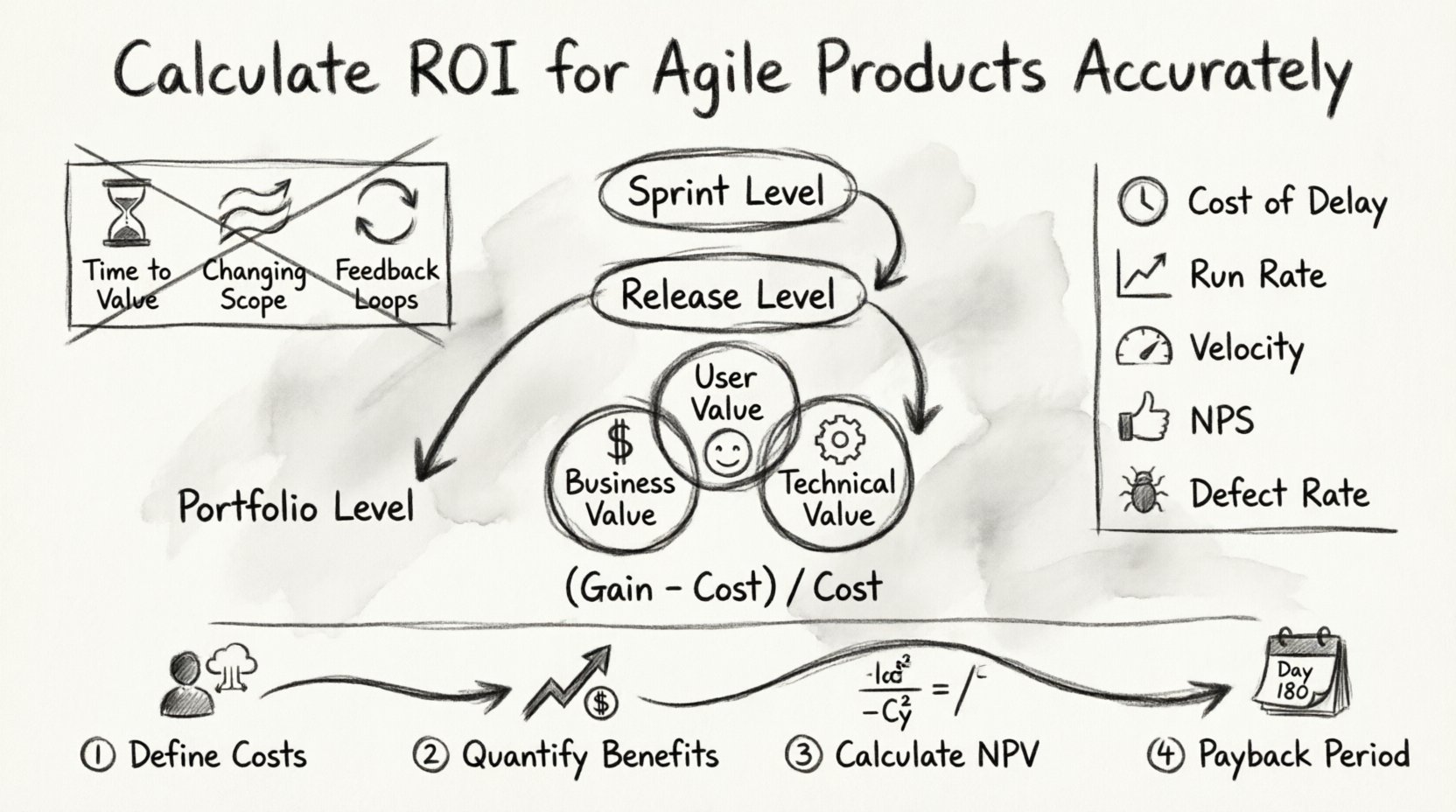
Why Traditional ROI Models Fail in Agile 🚫
Standard financial models calculate ROI based on a final output delivered at the end of a long project lifecycle. This approach creates a false sense of security regarding value until the very end. In a product context, this means teams might deliver a solution that no longer meets market needs because the window of opportunity has closed.
- Time to Value: Agile prioritizes early delivery. Traditional models delay ROI calculation until project completion.
- Changing Scope: Requirements evolve. Fixed-cost models cannot accommodate pivots without significant friction.
- Feedback Loops: Agile relies on continuous feedback. Traditional ROI ignores the value of learning.
To address this, organizations must adopt a dynamic calculation method that accounts for iterations, learning, and shifting priorities. This ensures that every Sprint contributes to a measurable financial outcome.
Understanding Value in Scrum 🏗️
Before calculating numbers, one must define what constitutes value. In a product environment, value is not merely code written or features shipped. It is the benefit realized by the customer or the organization. This distinction is crucial for accurate financial modeling.
Value can be categorized into three main areas:
- Business Value: Revenue generation, cost savings, or market share growth.
- User Value: Improved experience, reduced friction, or higher satisfaction scores.
- Technical Value: Reduced debt, improved stability, or faster deployment times.
Each category requires a different approach to measurement. Focusing solely on revenue ignores the foundational work required to sustain growth. Balancing these metrics provides a holistic view of investment performance.
The Framework for Agile ROI Calculation 🧮
Calculating ROI in this context requires adjusting the standard formula: (Gain from Investment – Cost of Investment) / Cost of Investment. The challenge lies in defining the “Gain” over an iterative timeline rather than a single endpoint.
We recommend a tiered approach that evaluates value at the Sprint level, Release level, and Portfolio level.
1. Sprint Level Measurement
At the Sprint level, ROI is often negative due to the upfront effort of setup and discovery. However, this is where the foundation for future gains is laid. Focus on velocity and predictability rather than immediate revenue.
- Track story points completed versus estimated.
- Monitor defect rates to assess quality investment.
- Measure stakeholder feedback frequency.
2. Release Level Measurement
Releases represent a tangible increment of value. This is the primary point for financial assessment. Calculate the cost of the Release against the benefits realized within the first few weeks of availability.
3. Portfolio Level Measurement
Over the long term, aggregate the results of all releases. This smooths out the volatility of individual Sprints and provides a stable view of the product’s financial health.
Key Metrics for Accurate Tracking 📉
To perform accurate calculations, specific metrics must be tracked consistently. Relying on a single number can lead to skewed perceptions of performance.
| Metric | Definition | Relevance to ROI |
|---|---|---|
| Cost of Delay | The economic penalty of not delivering a feature immediately | High |
| Run Rate | Projected revenue based on current performance | High |
| Velocity | Work completed per iteration | Medium |
| Net Promoter Score (NPS) | Customer loyalty and satisfaction | Medium |
| Defect Escape Rate | Errors found in production vs. testing | Medium |
Cost of Delay is particularly vital. It quantifies the opportunity cost of not acting. If a feature delays revenue by one month, that lost income is a direct cost to the investment.
Step-by-Step Calculation Process 🛠️
Implementing this calculation requires a structured process. The following steps outline how to move from concept to financial insight.
Step 1: Define Investment Costs
Identify all costs associated with the product. This includes more than just salaries.
- Personnel: Development, design, and management time.
- Infrastructure: Cloud costs, licenses, and hardware.
- Opportunity Costs: What could the team be building instead?
- Overhead: Office space, utilities, and administrative support.
Ensure these costs are allocated accurately to specific time periods, such as monthly or quarterly.
Step 2: Quantify Benefits
Benefits are often harder to measure than costs. Use data to assign monetary value to outcomes.
- Direct Revenue: Sales generated by new features.
- Cost Savings: Automation that reduces manual labor.
- Retention: Value of keeping a customer for another year.
If a feature reduces support tickets by 20%, calculate the hourly cost of support agents and the number of tickets avoided.
Step 3: Calculate Net Present Value (NPV)
Money today is worth more than money tomorrow. Apply a discount rate to future benefits to calculate their present value. This prevents overestimating long-term gains.
Formula: NPV = Σ (Cash Flow / (1 + r)^t)
Where r is the discount rate and t is the time period.
Step 4: Determine Payback Period
How long does it take for the benefits to equal the costs? In Agile, this period should shorten over time as the product matures.
- Short payback periods indicate high efficiency.
- Long payback periods require justification for continued investment.
Handling Intangible Value 🌟
Not all value is easily converted into currency. Technical debt reduction, brand reputation, and employee morale contribute to long-term success but lack immediate line items on a balance sheet.
Assigning a score to these factors helps in decision-making without breaking the financial model.
- Technical Health Score: Rate the stability and maintainability of the codebase.
- Team Morale: Survey staff to gauge satisfaction and burnout levels.
- Brand Sentiment: Monitor social media and review platforms for positive trends.
When these factors are low, they often lead to higher costs later. Investing in them now is a strategic move to prevent future ROI erosion.
Challenges in Agile Financial Modeling ⚠️
Several obstacles can hinder accurate ROI calculation. Awareness of these challenges allows teams to mitigate risks.
- Scope Creep: Uncontrolled growth in requirements dilutes investment focus.
- Measurement Lag: Benefits may take months to materialize after a release.
- Attribution Issues: It is difficult to isolate the impact of a single feature from overall market trends.
- Resource Volatility: Team composition changes can affect velocity and cost.
To combat scope creep, enforce strict prioritization during backlog refinement. For attribution issues, use control groups or A/B testing where possible to isolate variable impacts.
Reporting to Stakeholders 🗣️
Financial data must be communicated effectively to leadership. Avoid jargon that obscures the meaning of the numbers. Use visual aids to show trends over time.
Best Practices for Communication
- Focus on Trends: Show whether ROI is improving or declining over quarters.
- Contextualize Numbers: Explain what the numbers mean for the business strategy.
- Highlight Risks: Be transparent about factors that could negatively impact future returns.
- Use Consistent Units: Ensure all stakeholders understand the currency and timeframes used.
Regular cadence is essential. Monthly reviews allow for course correction before small issues become significant financial drains.
Iterative Improvement of ROI 🔄
The goal is not just to measure ROI but to improve it continuously. This aligns with the core principle of Agile: inspection and adaptation.
- Retrospectives on Value: Discuss financial outcomes in addition to process outcomes.
- Backlog Re-evaluation: Regularly check if items still align with current ROI goals.
- Experimentation: Treat new ideas as experiments with defined success metrics.
By treating value as a variable to be optimized rather than a static target, teams can respond faster to market changes. This agility often leads to higher overall returns compared to rigid planning.
Final Considerations for Sustainable Growth 🌱
Accurate ROI calculation is a continuous journey. It requires discipline, transparency, and a willingness to adapt financial models to the reality of product development. By focusing on early delivery, measuring both tangible and intangible value, and communicating clearly, organizations can justify their investment in Agile practices.
Remember that the ultimate goal is sustainable value creation, not just a high number on a spreadsheet. Balancing financial health with product quality ensures longevity and market relevance.
Adopting this framework empowers Product Owners and stakeholders to make informed decisions. It transforms the product from a cost center into a strategic asset that drives measurable growth.
Start by auditing your current tracking methods. Identify gaps in data collection. Implement the steps outlined above gradually. Over time, you will build a robust system for understanding the true value of your work.