
One of the most persistent challenges in software delivery is the divide between those who define value and those who create it. Business leaders focus on market needs, ROI, and strategic timelines. Developers focus on code quality, architecture, and technical feasibility. When these two groups operate in silos, friction increases, delivery slows, and morale drops. This guide explores how to build trust between business leaders and developers within the context of Scrum.
Trust is not an abstract concept. It is a functional asset that accelerates delivery. When business leaders trust the technical team, they understand capacity constraints and technical debt. When developers trust the business, they understand the “why” behind the work and feel empowered to propose solutions. In Scrum, this trust is built through transparency, inspection, and adaptation.
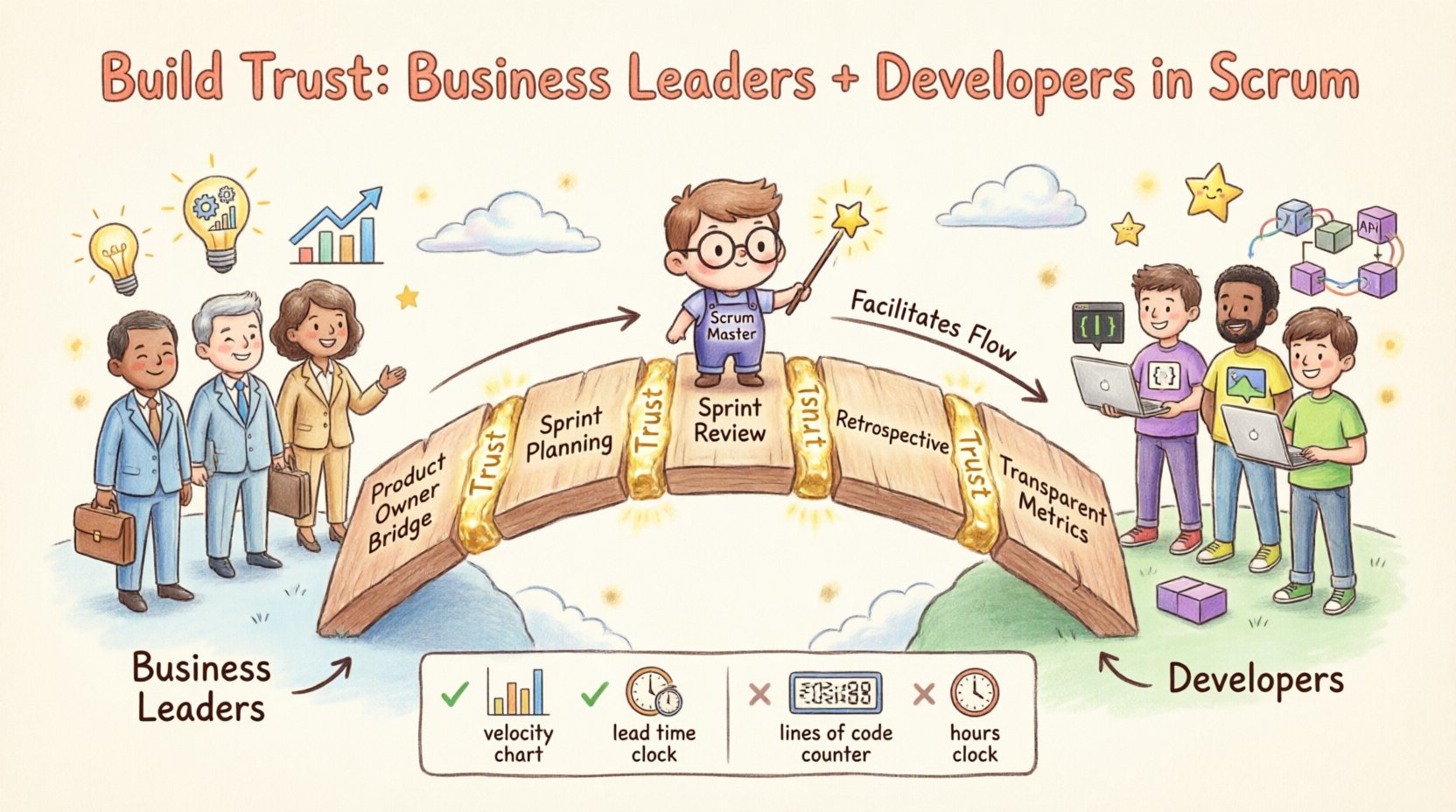
🧱 Understanding the Root Causes of Distrust
Before bridging the gap, it is necessary to understand where the disconnect originates. Distrust rarely stems from malice. It usually arises from mismatched expectations and communication failures.
- Misaligned Incentives: Business teams are often rewarded for speed and feature count. Development teams are often judged on stability and bug rates. Without a shared goal, these incentives conflict.
- Jargon Barriers: Technical terms like “refactoring” or “technical debt” can sound like excuses to business stakeholders who just want to ship. Conversely, business requests like “make it pop” can be vague to engineers.
- Hidden Work: Developers often struggle with invisible tasks like maintenance, testing, and deployment. If stakeholders only see the final feature, they underestimate the effort required.
- Estimation Anxiety: When estimates are treated as promises, pressure mounts. If a deadline is missed, blame is assigned rather than understanding the variance.
Addressing these root causes requires a shift from a transactional relationship to a partnership. This partnership is the core of effective Scrum implementation.
🛠 The Scrum Framework as a Solution
Scrum is designed specifically to manage complexity and uncertainty. It provides a structure where business and technical stakeholders interact frequently. The framework does not force trust, but it creates the environment where trust can grow.
1. The Product Owner as a Bridge
The Product Owner (PO) is the critical link. They represent the voice of the customer and the business. A strong PO translates business goals into user stories that developers can understand. They also translate technical constraints back to the business in terms of risk and value.
- Collaborative Backlog Refinement: The PO and developers should work together to refine the backlog. This ensures that stories are clear and feasible before they enter a Sprint.
- Value over Features: The PO should prioritize based on value, not just urgency. This helps developers focus on what matters most, reducing wasted effort.
- Accessibility: The PO must be available to answer questions during the Sprint. Long delays in clarification create bottlenecks and frustration.
2. The Development Team as Experts
Developers are not order-takers. They are professionals who bring technical expertise to the table. When they are consulted early, they can suggest better solutions or identify risks that business leaders might not see.
- Estimation Ownership: The team decides how much work they can commit to. This autonomy builds accountability. When the team owns the estimate, they are more likely to deliver.
- Definition of Done (DoD): The team defines what “finished” means. This prevents business leaders from accepting incomplete work that looks good on the surface but breaks under pressure.
- Technical Visibility: Developers should communicate technical debt clearly. It is not a hidden burden; it is a risk factor that impacts future speed.
🗣️ Communication and Ceremonies
Communication in Scrum is not just about meetings. It is about creating predictable touchpoints for alignment. The ceremonies are the mechanisms through which trust is negotiated and reinforced.
Sprint Planning
This is where alignment happens. The goal is not just to assign tasks, but to agree on the goal for the Sprint. Business leaders (or their representatives) should be available to clarify priorities. Developers should be honest about capacity.
- Clear Goals: Agree on a Sprint Goal that benefits the business but is achievable by the team.
- Capacity Planning: Account for holidays, support work, and meetings. Overloading the team leads to burnout and missed deadlines.
- Questions Allowed: Create a safe space to ask “dumb” questions. If a requirement is unclear, it must be clarified before work starts.
Sprint Review
The Review is often mistaken for a demo. It is actually a feedback session. The team shows what they have built, and stakeholders provide immediate feedback. This closes the loop between business expectations and technical output.
- Inspect the Increment: Focus on the working software, not the slides.
- Open Dialogue: Stakeholders should feel comfortable saying “this is not what I expected.” Developers should be willing to pivot based on this feedback.
- Future Planning: Discuss next steps immediately. This keeps momentum high.
Retrospective
The Retrospective is for the team, but business leaders who are part of the Scrum Team (like the PO) should participate. It is where process issues are discussed. If communication is breaking down, this is where it is addressed.
- Psychological Safety: Blame must be removed. The focus is on the process, not the person.
- Actionable Improvements: Identify one or two changes to make in the next Sprint. Trust grows when you see changes happen.
📊 Transparency and Metrics
Trust is built on facts, not feelings. Both parties need to see the same data. However, the metrics chosen must reflect reality, not just vanity.
Metrics That Build Trust
- Velocity: A measure of capacity, not performance. It helps predict how much work can be done in the future. It should not be used to pressure the team.
- Lead Time: How long it takes from request to delivery. This helps business leaders understand the speed of the organization.
- Defect Rate: Indicates stability. If quality is poor, business leaders need to know to adjust expectations.
- Cycle Time: The time from start to finish of a specific task.
Metrics That Break Trust
- Lines of Code: This measures output, not value. It encourages bloated code.
- Hours Worked: This encourages presenteeism and ignores efficiency.
- Commit Misses: Using this as a KPI creates fear and leads to padded estimates.
Table: Misunderstandings vs. Realities
| Perception | Reality | How to Address |
|---|---|---|
| Developers are slow. | Work is complex and unpredictable. | Use historical data (Velocity) to predict capacity. |
| Business changes requirements too often. | Market conditions change, requiring adaptation. | Embrace change in the Sprint Review, not mid-Sprint. |
| Technical debt is just an excuse. | Debt slows future speed and increases risk. | Allocate a percentage of capacity to maintenance. |
| Deadlines are fixed. | Scope is variable; time and resources are fixed. | Use Timeboxed Sprints and negotiate scope based on priority. |
| Agile means no planning. | Agile means frequent replanning. | Ensure regular refinement and planning sessions. |
🧠 Psychological Safety and Culture
Technical trust is fragile. It can be broken by a single harsh comment or a public blame session. Psychological safety is the belief that one will not be punished for making a mistake. This is essential for honest communication.
Creating a Safe Environment
- Blameless Post-Mortems: When things go wrong, focus on “what” happened, not “who”. Analyze the process failure.
- Admitting Uncertainty: Allow developers to say “I don’t know”. This leads to research and learning, which builds long-term competence.
- Respecting Time: Avoid interrupting deep work with unnecessary meetings. Trust includes respecting focus time.
Handling Conflict
Conflict is inevitable. It is not a sign of failure; it is a sign of engagement. The goal is to resolve conflict constructively.
- Focus on Interests, Not Positions: Instead of arguing over a feature, discuss the underlying business need. There may be multiple technical ways to solve the need.
- Use the Scrum Master: If a deadlock occurs between business and developers, the Scrum Master facilitates. They help find common ground.
- Escalation Paths: Have a clear path for resolving disagreements that the team cannot settle. This prevents resentment from building.
🔄 Long-term Alignment and Evolution
Trust is not a one-time achievement. It is a daily practice. As the team and the business grow, the relationship must evolve.
Continuous Improvement
Just as the product evolves, the way the team works together must evolve. Regularly ask: “Is our current way of working still serving us?”
- Feedback Loops: Shorten the feedback loop. The faster the business sees value, the more they trust the team.
- Cross-Training: Business leaders should learn basic technical concepts. Developers should learn basic business concepts. This empathy reduces friction.
- Shared Wins: Celebrate successes together. When a release is successful, both the business and the team should feel pride.
Navigating Change
Organizations change. Leadership changes. Projects pivot. Trust allows teams to navigate these changes without collapsing.
- Change Management: When the business pivots, communicate the reason clearly. Developers need context to prioritize correctly.
- Stability: While scope may change, the team’s stability is key. Avoid frequent turnover in the development team or the PO role.
- Adaptability: Be willing to adapt the process. If a ceremony is not adding value, change it.
🏗️ Managing Technical Debt Together
One of the biggest sources of friction is technical debt. Business leaders often see it as a delay. Developers see it as a necessity for quality.
Reframing Debt
Treat technical debt like financial debt. It has an interest rate. If you don’t pay it down, it slows you down. If you pay it down, you speed up.
- Visible Debt: Make debt visible in the backlog. It should be items that can be prioritized alongside features.
- Trade-offs: Have honest conversations about trade-offs. “We can deliver Feature X faster if we accept this debt, but it will cost us in two months.”
- Investment: Agree to allocate a portion of capacity (e.g., 20%) to debt reduction and infrastructure. This is an investment in speed.
🔍 Summary of Best Practices
Building trust is a continuous journey. Here are the key takeaways for maintaining a healthy relationship between business leaders and developers.
- Transparency: Share all information. Do not hide bad news. Bad news delivered early is manageable; late is catastrophic.
- Respect: Respect the expertise of the other party. Business knows the market; Devs know the code.
- Communication: Use the Scrum ceremonies to maintain alignment. Do not skip them.
- Empathy: Understand the pressures on the other side. Business faces market pressure; Devs face technical pressure.
- Consistency: Be consistent in your promises and delivery. Reliability breeds trust.
🚀 Conclusion
The gap between business and technology is not a wall; it is a bridge waiting to be built. In Scrum, the framework provides the materials for that bridge. The mortar is trust.
When business leaders and developers trust each other, they move faster. Decisions are made with confidence. Risks are managed proactively. Innovation flourishes because the team feels safe to experiment. This is not about magic; it is about discipline, communication, and mutual respect.
Start today. Look at your next Sprint Planning as an opportunity to connect, not just to plan. Ask questions. Listen to concerns. Share the vision. Over time, these small interactions compound into a culture of high performance.
Trust is the foundation of high-performing agile teams. Build it, maintain it, and watch your delivery transform.