

Visual Paradigm‘s AI Cloud Architecture Studio is transforming how teams design complex cloud systems. This AI-powered tool takes a simple natural language description—like “A high-performance big data analytics pipeline on Google Cloud”—and instantly generates a detailed, production-ready architecture diagram. The result? A professional, scalable blueprint that eliminates the guesswork and accelerates cloud design. This article showcases a real-world example of this process in action, demonstrating how the AI Cloud Architecture Studio turns a high-level vision into a concrete technical plan.
Quick Summary: Key Benefits of AI Cloud Architecture Studio
-
Accelerated Design: Generate a complete cloud architecture in seconds from a single sentence.
-
Democratized Design: Non-experts can create standard-compliant diagrams without deep cloud knowledge.
-
Strategic Alignment: Choose from pre-defined strategies (MVP, High Availability, Enterprise) to match your business goals.
-
Proactive Risk Mitigation: The AI identifies critical requirements like compliance and scalability early.
-
Real-Time Collaboration: Stakeholders can modify the diagram instantly using natural language commands.
Visualizing a Complex Big Data Pipeline
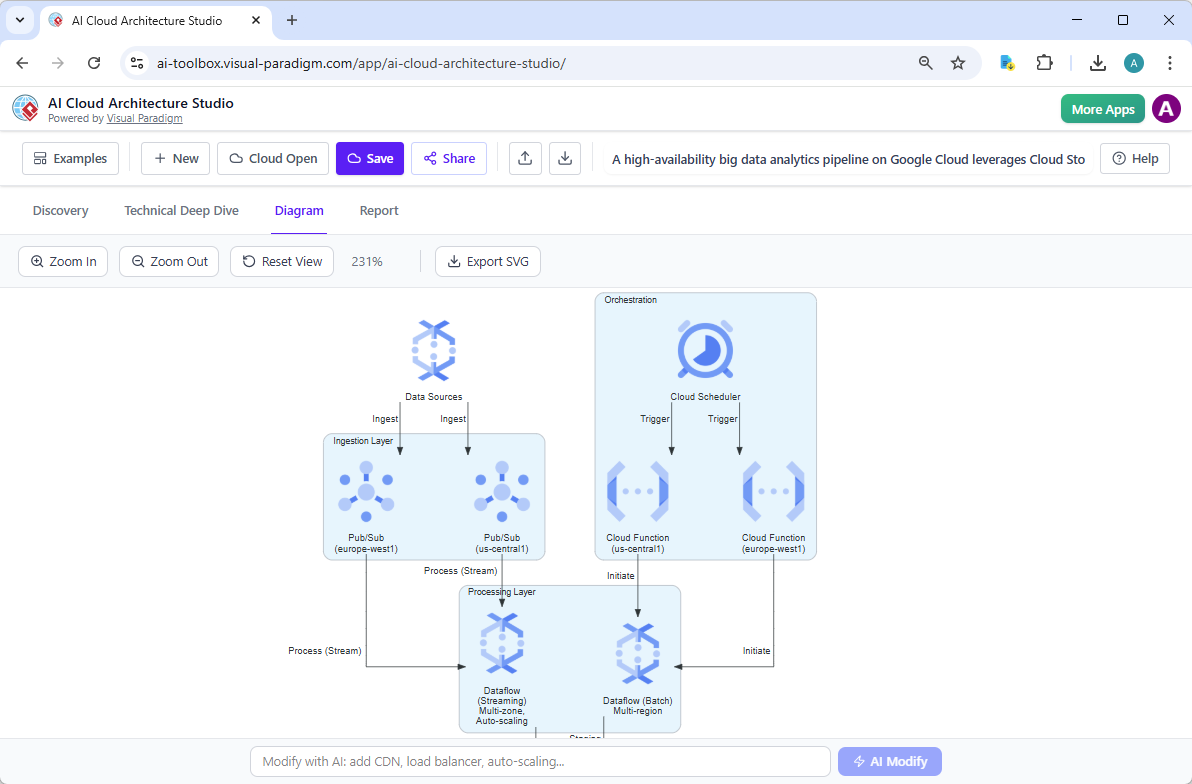
As seen in the screenshot, the AI Cloud Architecture Studio has generated a comprehensive architecture for a high-performance big data analytics pipeline on Google Cloud. The diagram is not just a static image; it’s a dynamic, interactive blueprint that reflects the tool’s core functionality. The architecture is clearly structured into three main layers: Ingestion, Processing, and Orchestration, each composed of specific Google Cloud services.
The Ingestion Layer shows data sources feeding into Pub/Sub in the US-West1 region, which is a common pattern for high-throughput, real-time data streams. This is followed by a Processing Layer that leverages Dataflow for both streaming and batch processing, with features like multi-zone deployment and auto-scaling to ensure performance and reliability. Finally, the Orchestration Layer uses Cloud Scheduler to trigger Cloud Functions, which can initiate various tasks in response to scheduled events.
AI Cloud Architecture Studio has intelligently mapped these components to their appropriate Google Cloud services, creating a cohesive and scalable design. This level of detail is typically the result of days of research and planning by a senior architect, but here it’s generated instantly.
How the AI Cloud Architecture Studio Works
Creating a diagram like this is a straightforward process, designed to be accessible to users of all skill levels. The workflow begins in the Discovery phase, where the user simply enters a project statement. In this case, the statement was “A high-performance big data analytics pipeline on Google Cloud.” The user then selects the cloud provider (Google Cloud) and an architecture strategy. For a high-performance pipeline, a “High Availability” or “Enterprise Grade” strategy would be appropriate to ensure redundancy and robustness.
After the initial input, the AI moves to the Technical Deep Dive stage. Here, the system doesn’t just generate a diagram; it acts as an auditor, asking clarifying questions to ensure all critical requirements are met. For a big data pipeline, these might include questions about data volume, processing speed, compliance needs, or disaster recovery requirements. This step is crucial for catching “hidden requirement” traps before the design is finalized.
Once the requirements are refined, the system generates the full diagram. The user can then interact with it in the Diagram tab, using the AI Modify feature to make changes on the fly. For example, a stakeholder could request, “Add a WAF in front of the load balancer,” and the AI would instantly redraw the architecture to reflect this change.
From Diagram to Documentation: A Unified Source of Truth
One of the most powerful aspects of the AI Cloud Architecture Studio is its ability to generate professional documentation automatically. After the diagram is finalized, users can navigate to the Reports tab and generate a variety of reports tailored to different stakeholders. For instance, the CTO can receive an Executive Summary, the security team can get a Security & Identity report, and the engineering team can access an Implementation Guide. This ensures everyone is working from the same approved architectural blueprint, eliminating the common problem of “documentation rot.”
For the big data analytics pipeline shown in the image, the tool could generate a Cost Optimization report to analyze the pricing of the selected services, or a Disaster Recovery report to outline failover strategies. This automated documentation process saves teams significant time and ensures that critical information is always up-to-date.
Conclusion: The Future of Cloud Design
The AI Cloud Architecture Studio is not just a diagramming tool; it’s a powerful, intelligent assistant that democratizes cloud architecture design. By transforming a simple text description into a complex, production-ready architecture, it dramatically accelerates the time-to-market for cloud projects. The ability to instantly visualize and modify designs, coupled with automated, role-specific documentation, creates a seamless workflow that aligns stakeholders and reduces risk.
Whether you’re a system architect, a developer, or a product manager, the AI Cloud Architecture Studio can help you turn your vision into reality, faster and with greater confidence. Try the AI Cloud Architecture Studio today to experience the power of AI-powered cloud design firsthand.