

Enterprise Architecture (EA) serves as the blueprint for an organization’s structure, processes, and technology infrastructure. It bridges the gap between business strategy and IT execution. Despite its strategic value, many organizations encounter significant hurdles when attempting to implement or maintain effective architecture practices. These challenges often stem from misalignment, rigid governance, technical debt, and cultural resistance.
This guide addresses the core friction points within enterprise architecture. It provides a structured approach to identifying root causes and implementing practical solutions. By focusing on clarity, governance, and stakeholder engagement, organizations can stabilize their architectural foundations and drive sustainable innovation.
🤝 Business-IT Alignment Issues
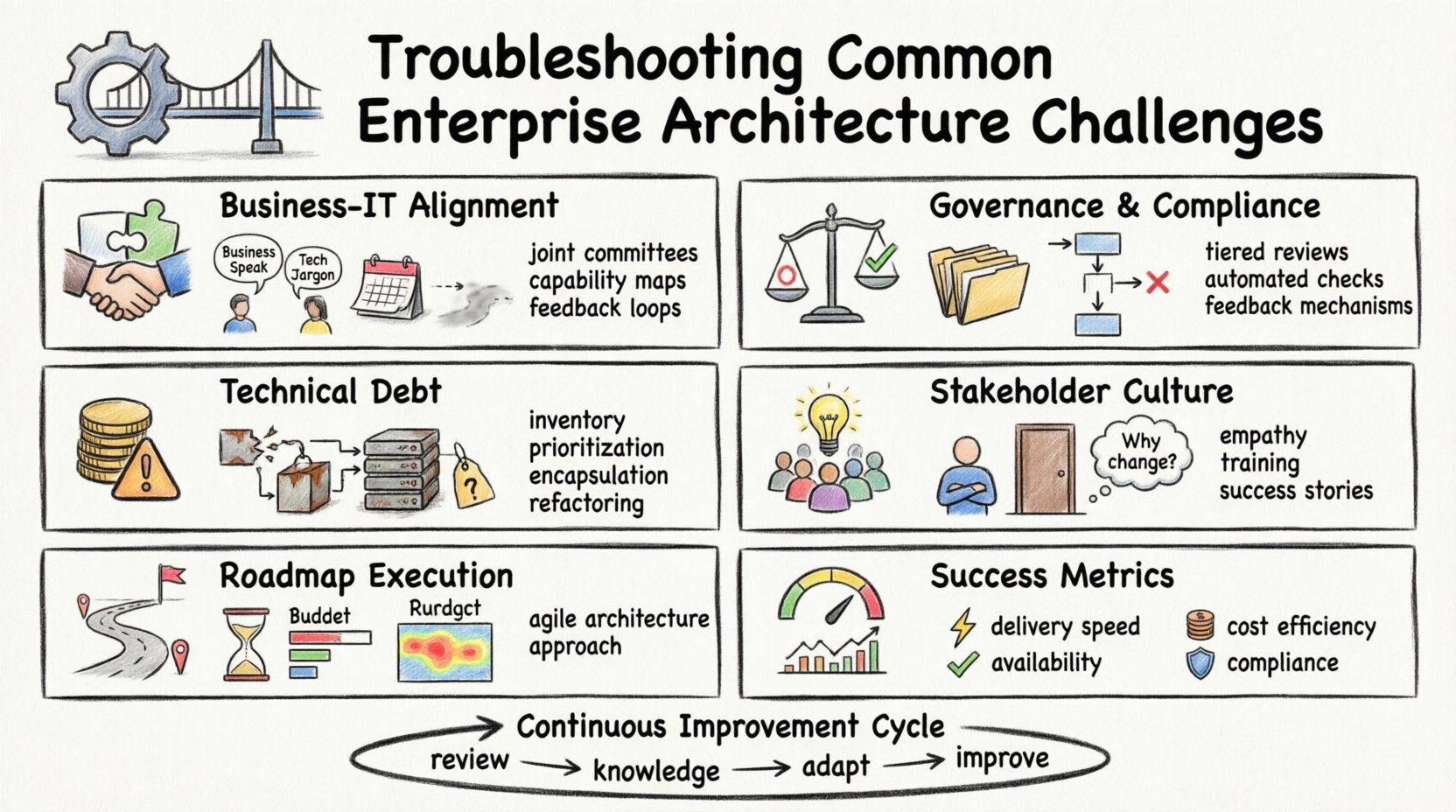
One of the most persistent challenges in enterprise architecture is the disconnect between business objectives and IT capabilities. When business leaders define goals without understanding technical constraints, and IT teams build solutions without grasping strategic intent, the result is inefficiency and wasted resources.
Root Causes of Misalignment
- Language Barriers: Business stakeholders use financial and operational terminology, while architects use technical jargon. This semantic gap prevents clear communication.
- Disconnected Planning Cycles: Business planning often occurs annually, whereas IT projects may run in shorter sprints or longer development cycles. Misaligned timelines lead to missed opportunities.
- Lack of Visibility: Business units frequently do not see the full scope of IT initiatives, leading to duplicate efforts or shadow IT adoption.
Strategies for Resolution
To resolve alignment issues, organizations must establish a shared vocabulary. This involves creating glossaries that translate business outcomes into technical requirements. Regular joint planning sessions should be instituted to synchronize roadmaps.
Consider the following actionable steps:
- Establish Joint Steering Committees: Create a body comprising both business and IT leadership to review architectural decisions.
- Map Capabilities to Outcomes: Develop capability maps that explicitly link technology assets to business value drivers.
- Implement Feedback Loops: Ensure that post-implementation reviews include business stakeholders to validate value realization.
When alignment improves, technology becomes an enabler rather than a bottleneck. Projects move faster because requirements are clearer, and resources are allocated to high-priority areas.
⚖️ Governance and Compliance Friction
Governance is essential for maintaining order and ensuring compliance, but it can easily become a source of friction if implemented poorly. Rigid processes that slow down delivery without adding value are a common complaint in enterprise environments.
Common Governance Pitfalls
- Excessive Bureaucracy: Architecture Review Boards (ARB) that require too many sign-offs create bottlenecks.
- Lack of Standardization: Inconsistent application of policies across different departments leads to fragmentation.
- Static Policies: Rules that do not evolve with new technologies or market conditions become obsolete quickly.
Optimizing Governance Models
Effective governance balances control with agility. It should facilitate decision-making rather than obstruct it. The focus must shift from policing to enabling safe innovation.
Key improvements include:
- Tiered Review Processes: Categorize projects by risk. Low-risk initiatives should undergo streamlined reviews, while high-risk projects require detailed scrutiny.
- Automated Compliance Checks: Where possible, use tools to validate standards automatically before human review is needed.
- Feedback Mechanisms: Allow project teams to appeal decisions and provide data on how governance impacts delivery speed.
By treating governance as a service, organizations can maintain security and standards while keeping momentum high.
💾 Managing Technical Debt and Legacy Systems
Technical debt refers to the implied cost of additional rework caused by choosing an easy solution now instead of a better approach that would take longer. In enterprise architecture, legacy systems often accumulate this debt over years of patching and workarounds.
Identifying the Debt
Debt is not always visible in code. It manifests as:
- High maintenance costs relative to new functionality.
- Difficulty in integrating with modern systems.
- Security vulnerabilities that are hard to patch.
- Reliance on staff who are retiring or leaving.
Mitigation Strategies
Addressing technical debt requires a strategic plan. It is rarely feasible to replace everything at once. A phased approach is necessary.
- Inventory and Assessment: Catalog all systems and assess their business criticality and technical health.
- Risk-Based Prioritization: Tackle systems that pose the highest risk to security or stability first.
- Encapsulation: Wrap legacy functionality in modern interfaces to allow integration without immediate replacement.
- Refactoring Cycles: Dedicate a percentage of every development cycle to paying down debt.
Organizations must accept that some debt is strategic. The goal is to manage it, not necessarily eliminate it entirely overnight.
👥 Stakeholder Engagement and Culture
Architecture is often viewed as a theoretical exercise by operational teams. Resistance to change is a significant hurdle. When architects are seen as gatekeepers, adoption of architectural standards drops.
Building Buy-In
To overcome resistance, architects must demonstrate value. This involves showing how architectural decisions save time, reduce cost, or improve reliability.
- Empathy and Communication: Understand the pressures faced by development and operations teams. Tailor communication to address their specific pain points.
- Training and Enablement: Provide workshops and documentation that help teams understand the “why” behind standards.
- Success Stories: Publicize examples where following architecture guidelines prevented a major outage or accelerated a launch.
Cultural Shifts
Creating an architecture-aware culture requires leadership support. Leaders must reinforce that architectural quality is a shared responsibility, not just the job of the architecture team.
🗺️ Roadmap Realism and Execution
A roadmap is a plan for the future. However, many enterprise roadmaps fail because they are too optimistic or lack flexibility. They often assume ideal conditions that do not exist in complex organizations.
Ensuring Roadmap Feasibility
- Resource Constraints: Account for actual availability of skilled personnel, not just theoretical headcount.
- Dependency Mapping: Identify external dependencies that could delay projects.
- Iterative Planning: Treat the roadmap as a living document that is updated regularly based on progress and changing priorities.
Agile Architecture
Adopting agile principles within architecture allows for better responsiveness. Instead of a five-year static plan, use a rolling wave planning approach where detailed plans exist only for the immediate future.
📊 Measuring Success and Metrics
Without metrics, it is difficult to prove the value of enterprise architecture. Organizations often struggle to define what success looks like beyond “systems work.”
Key Performance Indicators (KPIs)
- Delivery Speed: Time from concept to production for new initiatives.
- System Availability: Uptime and reliability of critical services.
- Cost Efficiency: Reduction in infrastructure or maintenance costs.
- Compliance Rate: Percentage of projects adhering to standards.
📋 Common Challenges and Solutions Matrix
| Challenge | Primary Symptom | Mitigation Strategy |
|---|---|---|
| Business-IT Misalignment | Duplicate projects, missed deadlines | Joint steering committees, shared glossaries |
| Governance Bottlenecks | Slow approvals, frustrated teams | Tiered review, automated checks |
| Legacy Technical Debt | High maintenance cost, security risks | Encapsulation, refactoring cycles |
| Stakeholder Resistance | Shadow IT, ignored standards | Enablement training, success stories |
| Unrealistic Roadmaps | Missed targets, scope creep | Iterative planning, resource audits |
🔄 Continuous Improvement Framework
Enterprise architecture is not a destination; it is a continuous journey. As the business landscape shifts, the architecture must evolve to support new strategies. A framework for continuous improvement ensures that the architecture practice remains relevant.
Review Cycles
Conduct regular architectural reviews at set intervals. These reviews should assess the current state against the target state. Identify gaps and create action items to close them.
Knowledge Management
Maintain a central repository of architectural assets. This includes diagrams, decision logs, and standards documentation. Ensuring knowledge is accessible prevents loss when personnel change.
Adaptability
Be prepared to pivot. If a new technology emerges that offers significant advantages, the architecture should be flexible enough to incorporate it without breaking existing foundations.
🔍 Deep Dive: The Role of Standards
Standards provide the guardrails for enterprise architecture. Without them, every team builds their own way, leading to fragmentation. However, standards must be practical.
Defining Effective Standards
- Minimal Viable Standards: Define only what is necessary for interoperability and security.
- Clear Exceptions: Establish a process for requesting exceptions when a standard does not fit a specific use case.
- Evolution Path: Define how standards will be updated over time.
When standards are well-defined and enforced consistently, they reduce complexity. Teams spend less time debating decisions and more time building value.
🛠️ Practical Implementation Steps
Implementing these troubleshooting strategies requires a systematic approach. Follow these steps to begin the transformation.
- Assess Current State: Conduct a thorough audit of existing architecture practices, tools, and documentation.
- Identify Pain Points: Gather feedback from stakeholders to understand where the process breaks down.
- Define Target State: Establish clear goals for what the architecture function should look like.
- Prioritize Quick Wins: Implement changes that deliver immediate value to build momentum.
- Scale Gradually: Roll out new practices across departments in phases.
- Monitor and Adjust: Track metrics and refine the approach based on results.
🚀 Looking Forward
The landscape of enterprise architecture continues to evolve with the rise of cloud computing, artificial intelligence, and distributed systems. Organizations that can troubleshoot their foundational challenges today will be better positioned to leverage these technologies tomorrow.
Success lies in balancing structure with flexibility. It requires a commitment to clarity, communication, and continuous improvement. By addressing alignment, governance, debt, and culture, organizations can build an architecture function that truly drives business value. The path forward is clear, provided the necessary steps are taken with discipline and focus.