

Enterprise Architecture (EA) serves as the strategic blueprint for an organization’s IT infrastructure, business processes, and information systems. It is intended to align technology investments with business goals, ensuring scalability, efficiency, and adaptability. However, despite its theoretical benefits, many organizations struggle to realize the value of EA. This gap often stems from recurring errors in planning, execution, and governance.
Understanding these pitfalls is essential for architects and leaders aiming to build robust, future-proof systems. Below is a detailed examination of frequent errors in enterprise architecture, their consequences, and actionable strategies to prevent them.
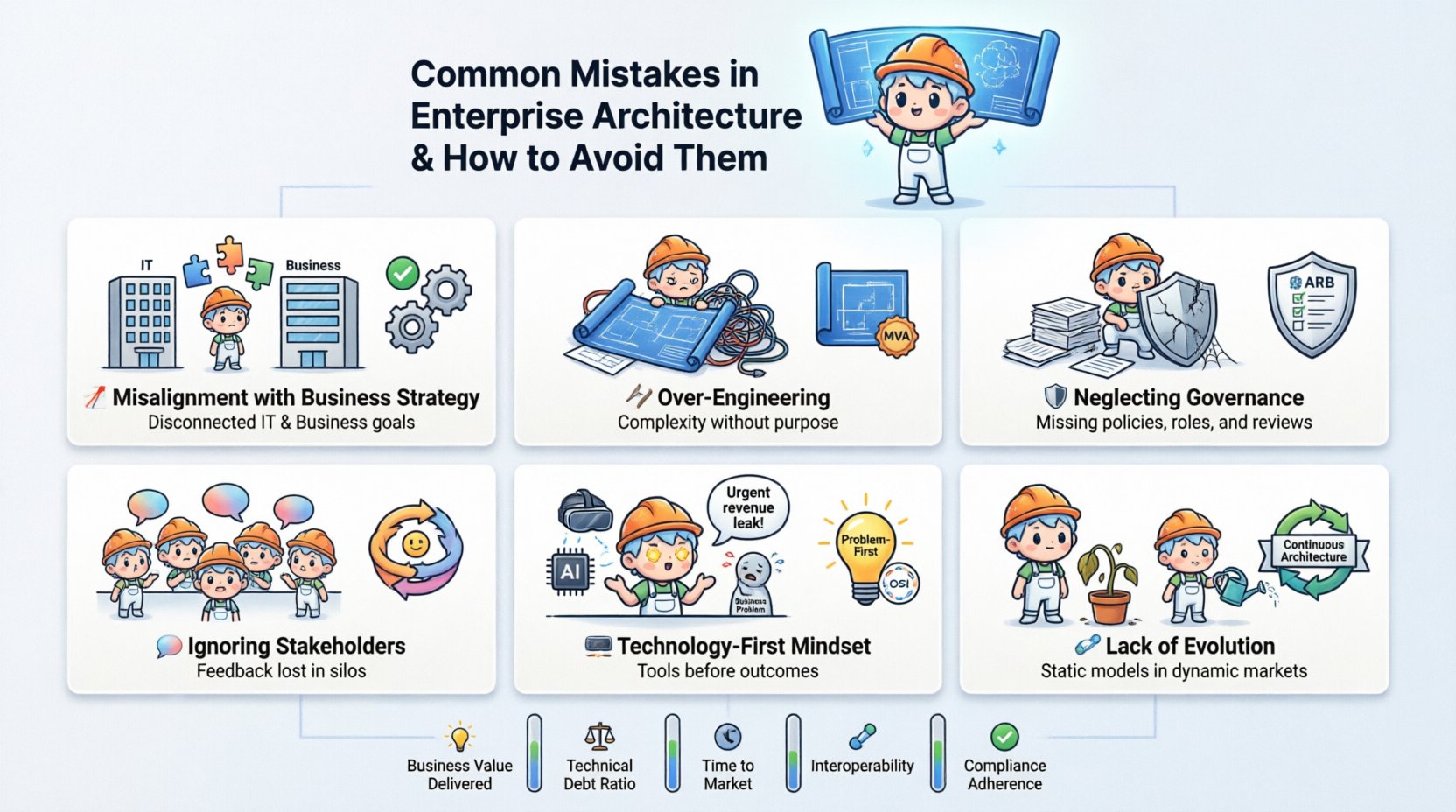
1. Misalignment with Business Strategy 🎯
One of the most critical failures in EA is the disconnect between architectural decisions and the overarching business strategy. When architecture teams operate in isolation, they risk creating systems that are technically sound but business-irrelevant. This misalignment leads to wasted resources, delayed time-to-market, and systems that fail to support core operational objectives.
Why This Happens
- Lack of Communication: Architects do not engage with business stakeholders early in the planning phase.
- Focus on Technology: Prioritizing technical elegance over business utility.
- Static Roadmaps: Architectural plans that do not adapt to shifting market conditions.
Impact
- Investment in tools that do not solve actual business problems.
- Reduced agility in responding to competitive pressures.
- Lower ROI on IT initiatives due to unused capabilities.
How to Avoid It
- Integrate Planning Cycles: Ensure EA roadmaps are synchronized with annual business planning cycles.
- Establish Business Capability Models: Map IT capabilities directly to business outcomes.
- Regular Reviews: Conduct quarterly reviews with senior leadership to validate alignment.
- Use Business Case Validation: Require every architectural initiative to demonstrate a clear business value proposition before approval.
2. Over-Engineering the Blueprint 📐
While thoroughness is a virtue, excessive complexity in architecture design can paralyze execution. Over-engineering involves creating detailed specifications for scenarios that may never occur, or designing for a level of flexibility that is unnecessary for the current scale. This leads to high maintenance costs and slow deployment velocities.
Why This Happens
- Fear of Failure: Attempting to anticipate every possible edge case.
- Theoretical Perfectionism: Prioritizing ideal models over practical implementation.
- Lack of Context: Designing for a hypothetical enterprise rather than the actual organization.
Impact
- Increased development time and complexity.
- Higher costs for maintenance and updates.
- Difficulty for developers to understand and implement the design.
- Stifled innovation due to rigid structures.
How to Avoid It
- Adopt an Iterative Approach: Build and refine architecture in phases rather than attempting a perfect initial design.
- Focus on Minimum Viable Architecture: Define only the necessary components to support immediate business needs.
- Embrace Simplicity: Choose the simplest solution that meets current requirements without sacrificing future extensibility.
- Review Design Decisions: Regularly audit designs to remove unnecessary complexity or unused components.
3. Neglecting Governance and Standards 🛡️
Governance provides the framework for decision-making and compliance within an architecture. Without defined standards, teams may build disparate systems that cannot communicate, leading to data silos and integration nightmares. A lack of governance often results in shadow IT, where departments adopt solutions without architectural oversight.
Why This Happens
- Perceived Bureaucracy: Viewing governance as a barrier rather than an enabler.
- Absence of Clear Roles: No defined architecture review boards or decision authorities.
- Weak Enforcement: Standards exist on paper but are not enforced during development.
Impact
- Inconsistent security postures across the enterprise.
- High costs for integrating incompatible systems.
- Compliance risks and regulatory violations.
- Technical debt accumulation.
How to Avoid It
- Define Clear Policies: Establish documented standards for technology selection, data management, and security.
- Create an Architecture Review Board (ARB): Form a cross-functional team to review significant architectural changes.
- Automate Compliance: Use tools to scan for violations of standards before code reaches production.
- Train Teams: Ensure development and operations teams understand the rationale behind standards.
4. Ignoring Stakeholder Engagement 🗣️
Architecture is not solely a technical discipline; it is a social one. Failing to engage stakeholders from business, operations, security, and legal departments leads to solutions that face resistance during implementation. Without buy-in, even the best designs may be abandoned or modified in ways that compromise their integrity.
Why This Happens
- Technical Silos: Architects working without input from end-users.
- Assumed Needs: Assuming requirements without validation.
- Late Communication: Involving stakeholders only after the design is finalized.
Impact
- Low adoption rates of new systems.
- Reactive changes during implementation phases.
- Loss of trust between IT and business units.
- Project delays due to unanticipated requirements.
How to Avoid It
- Identify Key Influencers: Map out all stakeholders who will be impacted by architectural changes.
- Conduct Workshops: Facilitate collaborative sessions to gather requirements and validate designs.
- Communicate Benefits: Clearly articulate how the architecture improves daily work for stakeholders.
- Create Feedback Loops: Establish channels for continuous feedback during the design and implementation phases.
5. Technology-First Mindset 💻
A common error is starting the architecture process with a preferred technology stack rather than a business problem. This approach, often called “solutioneering,” forces a business to fit into a technology mold. It limits flexibility and can lead to vendor lock-in, where the organization becomes dependent on a specific platform.
Why This Happens
- Vendor Pressure: Sales teams pushing specific products.
- Technical Curiosity: Choosing tools because they are new or trendy.
- Comfort with Known Tech: Relying on familiar stacks regardless of fit.
Impact
- Systems that do not scale as needed.
- High costs associated with migrating away from the technology later.
- Reduced ability to innovate with new tools.
- Misallocation of budget to technology rather than value.
How to Avoid It
- Problem-First Approach: Define the business problem before selecting any tools.
- Technology Agnosticism: Evaluate solutions based on functional fit rather than brand preference.
- Open Standards: Prioritize interoperability and open protocols over proprietary ecosystems.
- Proof of Concept: Test potential technologies against real-world scenarios before full commitment.
6. Lack of Continuous Evolution 🔄
Enterprise architecture is not a one-time project; it is a continuous lifecycle. Treating it as a static document or a single planning event leads to obsolescence. The business environment changes, technology evolves, and threats emerge. An architecture that does not evolve becomes a liability.
Why This Happens
- Project Mindset: Viewing architecture as a deliverable with a finish date.
- Resource Constraints: Lack of dedicated personnel for maintenance and updates.
- Documentation Decay: Allowing diagrams and specs to go out of sync with reality.
Impact
- Systems that cannot support new business initiatives.
- Increased technical debt over time.
- Security vulnerabilities in outdated components.
- Inability to leverage new market opportunities.
How to Avoid It
- Implement Continuous Architecture: Treat architecture as an ongoing process of refinement.
- Regular Audits: Schedule periodic reviews of the current state against the target state.
- Dynamic Documentation: Maintain living documentation that updates with changes.
- Feedback Integration: Incorporate lessons learned from operations and incidents into the architecture.
Summary of Key Pitfalls ⚠️
Reviewing these mistakes side-by-side helps organizations identify where their current EA practices may be faltering. The table below summarizes the core issues and their primary solutions.
| Mistake | Primary Impact | Key Avoidance Strategy |
|---|---|---|
| Misalignment with Strategy | Wasted investment, low ROI | Synchronize planning cycles with business goals |
| Over-Engineering | High complexity, slow delivery | Adopt iterative, minimal viable approaches |
| Neglecting Governance | Security risks, silos | Define standards and enforce via review boards |
| Ignoring Stakeholders | Low adoption, resistance | Engage users early and continuously |
| Technology-First | Vendor lock-in, rigidity | Start with business problems, not tools |
| Lack of Evolution | Obsolescence, technical debt | Treat architecture as a continuous lifecycle |
Building a Resilient Architecture Framework 🏛️
Correcting these mistakes requires a structured approach to rebuilding or refining the architecture framework. It is not enough to identify errors; the organization must implement mechanisms to prevent recurrence. This involves cultural shifts as well as technical adjustments.
Establishing a Culture of Architecture
- Leadership Support: Executives must champion the value of architecture, treating it as a strategic asset rather than a cost center.
- Shared Ownership: Encourage developers and operations teams to take ownership of architectural quality.
- Knowledge Sharing: Create communities of practice where architects and engineers share learnings and patterns.
Implementing Feedback Loops
- Metrics Collection: Define key performance indicators (KPIs) for architecture health, such as deployment frequency or defect rates.
- Post-Implementation Reviews: Analyze projects after completion to identify architectural successes and failures.
- Incident Analysis: Use operational incidents to update architectural constraints and patterns.
Measuring Success 📊
Without metrics, it is difficult to prove that the architectural changes are effective. Organizations should track specific indicators that reflect improved alignment, reduced complexity, and increased agility.
Key Metrics to Track
- Business Value Delivered: Percentage of IT projects that meet business objectives.
- Technical Debt Ratio: Effort spent on maintenance versus new features.
- Time to Market: Reduction in the time required to deploy new capabilities.
- System Interoperability: Number of successful integrations between previously siloed systems.
- Compliance Adherence: Percentage of systems meeting defined security and governance standards.
Final Thoughts on Architectural Maturity 🧭
Achieving maturity in Enterprise Architecture is a journey that requires patience and persistence. It involves moving away from rigid, document-heavy processes toward dynamic, value-driven practices. By avoiding the common mistakes outlined above, organizations can build architectures that are not only technically robust but also capable of driving business innovation.
The goal is to create an environment where technology serves the business, rather than the business serving technology. This shift requires disciplined governance, active stakeholder engagement, and a commitment to continuous improvement. When these elements are in place, Enterprise Architecture becomes a catalyst for sustainable growth and operational excellence.
Remember that the best architecture is one that remains adaptable. As the market evolves, so must the blueprint. By staying alert to these pitfalls, leaders can ensure their organizations remain resilient in the face of change.