

Enterprise Architecture (EA) serves as the strategic blueprint for organizations aiming to align their business goals with their technology infrastructure. Without a structured approach, digital transformation efforts often become disjointed, leading to redundant systems and missed opportunities. This guide explores the core methodologies used to design, plan, and govern enterprise ecosystems. We examine established frameworks, practical implementation strategies, and the critical success factors necessary for sustainable growth. 🚀
🔍 Understanding Enterprise Architecture
Enterprise Architecture is not merely about drawing diagrams or managing servers. It is a discipline that provides a holistic view of an organization. It bridges the gap between business strategy and technical execution. By defining the structure and operation of an enterprise, EA ensures that investments in technology deliver actual business value. 📊
At its core, EA involves:
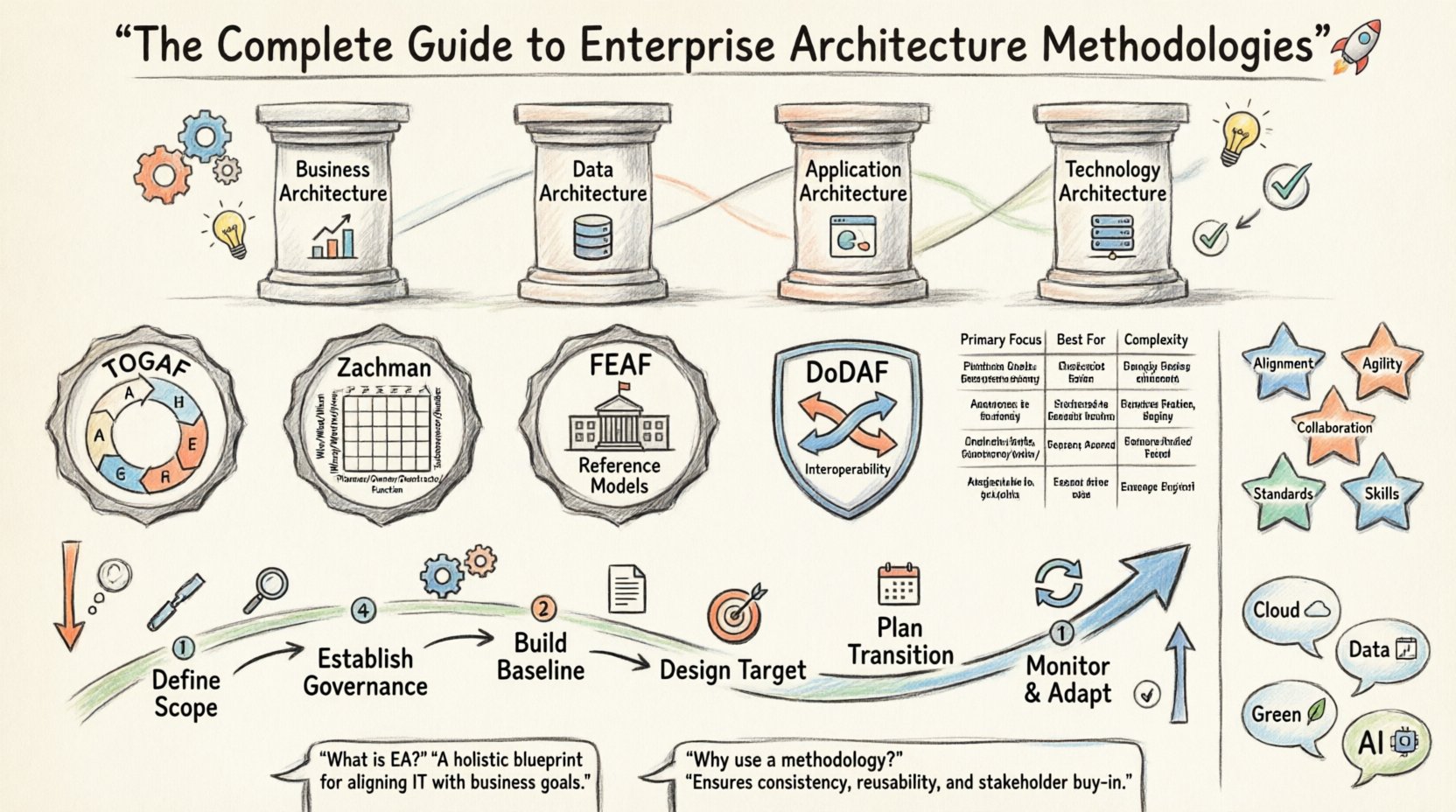
- Business Architecture: Defining the business strategy, governance, organization, and key business processes.
- Data Architecture: Describing the structure of an organization’s logical and physical data assets and data management resources.
- Application Architecture: Providing a blueprint for individual application systems, their interactions, and relationships to the core business processes.
- Technology Architecture: Describing the logical software and hardware capabilities required to support the deployment of business, data, and application services.
🏗️ Major Enterprise Architecture Frameworks
Selecting the right methodology depends on organizational size, industry, and specific goals. Below are the most widely recognized frameworks used globally.
1. The Open Group Architecture Framework (TOGAF)
TOGAF is arguably the most popular framework in the industry. It provides a comprehensive approach for designing, planning, implementing, and governing enterprise information architecture. The framework is centered around the Architecture Development Method (ADM), a cycle that guides the architecture work. 🔄
Key Phases of the TOGAF ADM:
- Phase A: Architecture Vision: Defining the scope, constraints, and stakeholders. This sets the stage for the entire project.
- Phase B: Business Architecture: Developing the business architecture to support the vision.
- Phase C: Information Systems Architectures: Addressing data and application architectures.
- Phase D: Technology Architecture: Defining the hardware and software infrastructure.
- Phase E: Opportunities and Solutions: Identifying implementation projects and migration plans.
- Phase F: Migration Planning: Creating a detailed plan to move from the baseline to the target architecture.
- Phase G: Implementation Governance: Ensuring the project adheres to the architecture.
- Phase H: Architecture Change Management: Managing changes to the architecture over time.
TOGAF is highly adaptable. It does not prescribe specific tools but offers a structured process. Organizations often tailor the ADM cycle to fit their specific operational context. This flexibility makes it suitable for large enterprises with complex needs. 💼
2. The Zachman Framework
Developed by John Zachman, this framework is less a process and more an ontology. It provides a schema for organizing architectural artifacts. The framework is structured as a 6×6 matrix, representing six perspectives (What, How, Where, Who, When, Why) across six roles (Planner, Owner, Designer, Builder, Subcontractor, User). 🧩
Rows (Perspectives):
- Scope (Planner): Contextual view. What is the business scope?
- Concept (Owner): Conceptual view. What are the business concepts?
- Logical (Designer): Logical view. How is the system defined?
- Physical (Builder): Physical view. How is the system built?
- Distributed (Subcontractor): Out-of-context view. How is it delivered?
- Functioning (User): Instantiated view. How does it operate?
Columns (Questions):
- Data (What): Objects of interest.
- Function (How): Processes and functions.
- Location (Where): Network and distribution.
- People (Who): Organization and roles.
- Time (When): Cycles and events.
- Motive (Why): Goals and motivations.
The Zachman Framework helps ensure that no critical aspect of the architecture is overlooked. It is particularly useful for auditing existing systems and ensuring completeness. However, it does not offer a step-by-step implementation guide like TOGAF. 📝
3. Federal Enterprise Architecture Framework (FEAF)
Originally designed for the United States government, FEAF is adapted for public sector organizations. It focuses on the integration of business and information technology to achieve performance goals. The framework emphasizes cross-agency collaboration and shared services. 🏛️
Key components include:
- Performance Reference Model (PRM): Measures organizational performance.
- Business Reference Model (BRM): Defines the business functions.
- Service Reference Model (SRM): Identifies shared services.
- Data Reference Model (DRM): Describes data elements.
- Infrastructure Reference Model (IRM): Defines IT infrastructure.
4. DoDAF (Department of Defense Architecture Framework)
DoDAF is used primarily for defense and security-related projects. It focuses on interoperability and systems engineering. The framework ensures that complex systems work together seamlessly. It is heavily documentation-driven and requires rigorous adherence to standards. 🛡️
📊 Comparing Architecture Frameworks
Choosing the right path requires understanding the strengths and limitations of each methodology. The table below summarizes the key distinctions.
| Framework | Primary Focus | Best For | Complexity |
|---|---|---|---|
| TOGAF | Process & Lifecycle | Large Enterprises | High |
| Zachman | Ontology & Completeness | System Auditing | Medium |
| FEAF | Public Sector Integration | Government Agencies | Medium |
| DoDAF | Defense & Interoperability | Defense Projects | High |
🛠️ Implementing Enterprise Architecture
Adopting an architecture methodology is a significant undertaking. It requires commitment from leadership and a cultural shift across the organization. Follow these steps to guide the implementation process.
Step 1: Define Scope and Objectives
Before starting, clarify what the architecture aims to achieve. Is it cost reduction? Agility? Compliance? Clear objectives prevent scope creep. 🎯
Step 2: Establish Governance
Create an architecture review board. This group evaluates projects against the defined architecture. Governance ensures compliance and consistency without stifling innovation. ⚖️
Step 3: Build the Baseline
Document the current state of the enterprise. This includes existing applications, data flows, and infrastructure. You cannot plan a future state without understanding the present state. 🗺️
Step 4: Design the Target State
Develop the future architecture. This should align with strategic business goals. Consider technology trends and potential disruptions. 🏗️
Step 5: Plan the Transition
Map the journey from baseline to target. Identify quick wins and long-term initiatives. Prioritize projects based on value and risk. 🗓️
Step 6: Monitor and Adapt
Architecture is not static. Regularly review the architecture to ensure it remains relevant. Adjust plans as business needs evolve. 🔄
⚠️ Common Challenges and Solutions
Implementing EA methodologies often faces resistance. Understanding these hurdles helps in mitigating them effectively.
Challenge: Lack of Executive Support
Solution: Demonstrate value early. Show how EA reduces costs or accelerates time-to-market. Secure a champion at the C-level.
Challenge: Resistance from Departments
Solution: Involve stakeholders early. Ensure their concerns are addressed in the design process. Communication is key. 🗣️
Challenge: Complexity of Documentation
Solution: Keep documentation lean. Focus on artifacts that drive decision-making. Avoid unnecessary paperwork.
Challenge: Keeping Up with Technology
Solution: Adopt a modular architecture. This allows specific components to be updated without overhauling the entire system. 🔧
📈 Key Success Factors
To ensure the methodology delivers results, focus on these critical areas:
- Alignment: Ensure IT strategy mirrors business strategy. There should be no disconnect.
- Agility: The architecture must support change. Rigid structures fail in dynamic markets.
- Collaboration: Break down silos between business and IT teams.
- Standards: Establish technical standards to reduce redundancy.
- Skills: Invest in training. Architects need both technical and business acumen.
🌐 Future Trends in Enterprise Architecture
The landscape of EA is evolving. New paradigms are emerging to address modern challenges.
1. Cloud-Native Architectures
Organizations are moving away from monolithic structures to microservices. EA frameworks must adapt to support distributed systems and cloud environments. ☁️
2. Data-Centric Design
Data is becoming the primary asset. Architectures are shifting to prioritize data governance, privacy, and analytics capabilities. 📈
3. Sustainability (Green IT)
Energy consumption is a growing concern. Future architectures will need to account for carbon footprints and energy efficiency. 🌱
4. AI Integration
Artificial Intelligence is changing how systems operate. EA must define how AI models are integrated into business processes securely and ethically. 🤖
🤔 Frequently Asked Questions
Q: Do I need to use a specific software tool?
No. While tools can assist in modeling and governance, the methodology itself is independent of any specific software product. The process matters more than the tool. 🛠️
Q: How long does an EA implementation take?
This varies widely. A basic framework adoption might take months, while a full transformation could span years. It depends on the organization’s size and complexity. ⏳
Q: Can small businesses use these frameworks?
Yes. Large frameworks can be scaled down. The principles of alignment and documentation apply to organizations of all sizes. 🏢
Q: Is TOGAF the same as Zachman?
No. TOGAF is a process framework (how to do it). Zachman is an ontology framework (what to consider). They can be used together. 🤝
🔚 Final Thoughts
Enterprise Architecture is a strategic discipline that requires patience and precision. It is not a one-time project but an ongoing practice. By selecting the appropriate methodology and adhering to governance principles, organizations can build resilient systems. The goal is not perfection, but continuous improvement and alignment. 🏆
Start by understanding your current state. Choose a framework that fits your culture. Engage your stakeholders. And remember, the best architecture is the one that enables business success. 🌟