

In the complex landscape of modern business technology, Enterprise Architecture (EA) serves as the critical bridge between organizational strategy and technical execution. At the heart of this discipline lie Enterprise Architecture Principles. These are not merely documents stored in a repository; they are the fundamental truths and guidelines that dictate how an organization builds, manages, and evolves its technological capabilities. Without a solid framework of principles, IT initiatives often become siloed, redundant, and misaligned with business goals.
This guide provides a deep dive into defining, implementing, and governing these principles. We will explore the categories that form the bedrock of EA, the lifecycle of principle development, and the governance models required to ensure they remain relevant. By adhering to these core tenets, organizations can achieve greater agility, reduce complexity, and ensure that every investment delivers tangible value.
🎯 Why Principles Matter in Enterprise Architecture
Principles act as guardrails. They provide a consistent set of rules that guide decision-making across the enterprise. When a new project is proposed, architects and stakeholders refer to these principles to determine feasibility and alignment. This prevents the creation of duplicate systems and ensures interoperability between disparate units.
- Consistency: Principles ensure that different departments follow similar standards when selecting technologies or designing data structures.
- Efficiency: By enforcing reuse and standardization, organizations reduce costs and accelerate delivery timelines.
- Strategic Alignment: They ensure that technology investments directly support the broader business objectives.
- Scalability: Well-defined principles allow systems to grow without becoming unmanageable technical debt.
Without these guiding stars, architecture becomes reactive. Teams solve immediate problems without considering long-term implications, leading to fragmentation. Principles shift the focus from short-term fixes to sustainable, long-term design.
🧩 Core Characteristics of Effective Principles
Not all guidelines qualify as principles. To be effective, an architecture principle must meet specific criteria. Vague statements like “Use good technology” do not provide actionable direction. Instead, principles must be clear, concise, and enforceable.
A robust principle typically possesses the following attributes:
- Necessity: The principle must address a real problem or constraint within the organization.
- Sufficiency: It must be strong enough to guide decisions without needing excessive interpretation.
- Distinctness: It should not overlap significantly with other principles, avoiding confusion.
- Actionability: It must be possible to apply the principle in real-world scenarios.
- Clarity: The language used must be unambiguous to all stakeholders.
For example, a weak principle is “Ensure security.” A strong principle is “Data must be encrypted both in transit and at rest for all customer information.” The latter provides specific direction that can be audited and implemented.
📊 Categories of Architecture Principles
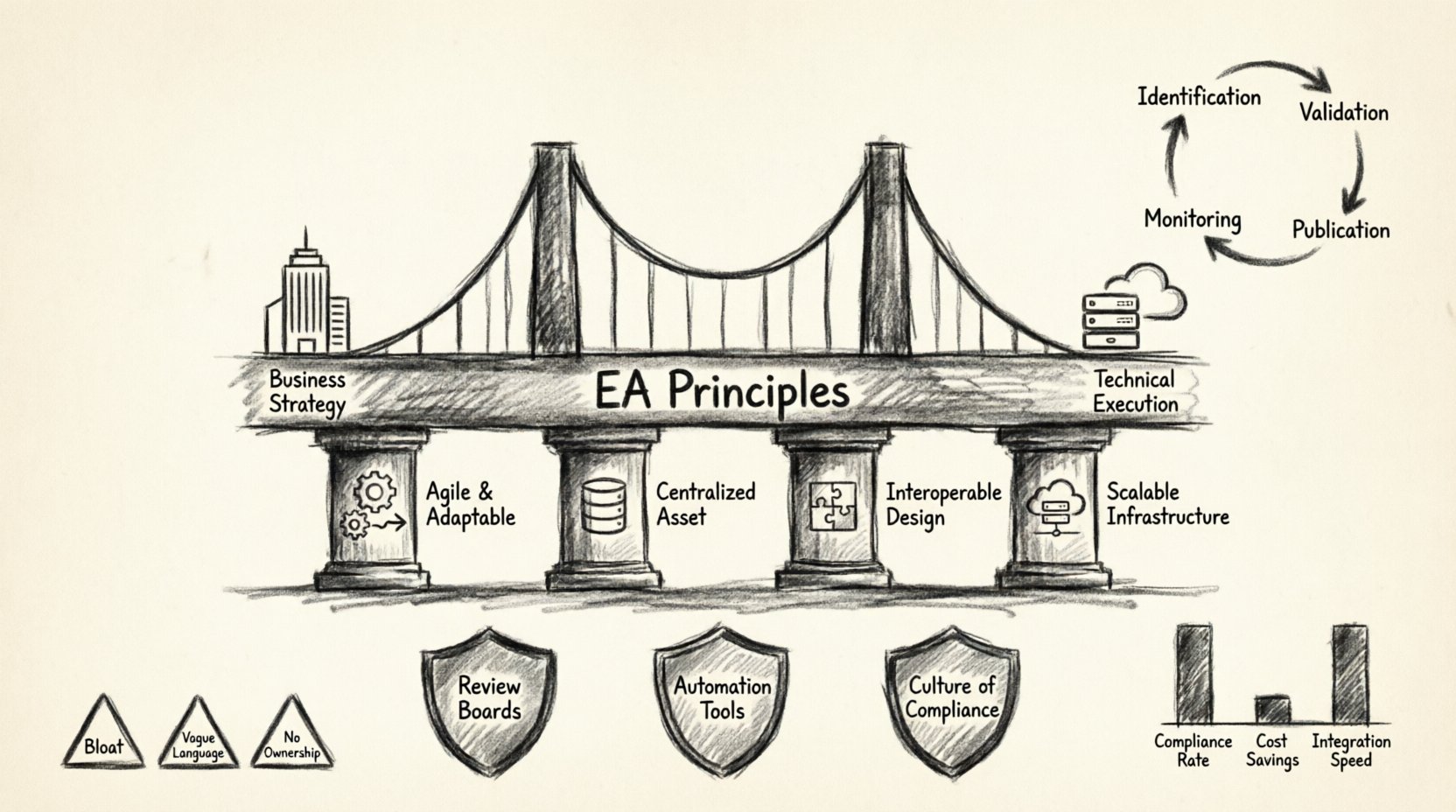
Enterprise Architecture is multidimensional. To cover the entire spectrum of organizational capabilities, principles are typically categorized into four distinct domains. Each domain addresses specific aspects of the enterprise ecosystem.
| Category | Focus Area | Example Principle |
|---|---|---|
| Business | Alignment of processes with strategy | “Business processes must be agile and adaptable to market changes.” |
| Data | Information integrity and accessibility | “Data is an organizational asset and must be managed centrally.” |
| Application | Software capabilities and integration | “Applications must be interoperable and support service-oriented design.” |
| Technology | Infrastructure and platform standards | “Infrastructure must be scalable and support virtualization.” |
Understanding these categories helps architects ensure that no aspect of the enterprise is overlooked. A principle in the Data domain might dictate how information flows, while a Technology principle dictates the hardware or cloud standards used to store it. Both must work in harmony.
🛠️ The Lifecycle of Principle Development
Creating principles is not a one-time event. It requires a structured lifecycle to ensure they remain valid as the business evolves. This process involves identification, validation, publication, and maintenance.
1. Identification and Drafting
The journey begins with gathering input from key stakeholders. Architects interview business leaders, technical staff, and compliance officers to identify recurring challenges and desired outcomes. Drafting these into principle statements requires careful wording to avoid ambiguity. Workshops are often held to refine the language.
2. Validation and Approval
Once drafted, principles must be reviewed by a governance body. This ensures they align with the organization’s vision and do not conflict with legal or regulatory requirements. Approval grants them authority. Without executive backing, principles are often ignored in favor of immediate project needs.
3. Publication and Communication
A principle is useless if no one knows it exists. It must be published in a central repository and communicated across the enterprise. Training sessions, newsletters, and integration into project initiation workflows help embed the principles into the daily culture.
4. Monitoring and Maintenance
Business environments change. Technology evolves. Principles that were relevant five years ago may now hinder innovation. Regular reviews are necessary to retire outdated principles or update them to reflect new realities. This keeps the architecture relevant and effective.
⚖️ Governance and Enforcement
Defining principles is only half the battle. Enforcement is where value is realized. However, enforcement must be balanced. Overly rigid governance can stifle innovation, while a lack of enforcement renders the principles meaningless.
The Role of Architecture Review Boards
Architecture Review Boards (ARBs) are the primary mechanism for enforcement. These groups review project proposals to ensure compliance with established principles. When a project deviates from a principle, the ARB evaluates the trade-offs. If the deviation is justified by a specific business need, a waiver can be granted, provided the risk is documented.
Automation and Tools
Manual reviews can be slow. Integrating principles into automated tools helps streamline compliance. For instance, scanning code repositories for specific patterns or checking infrastructure configurations against standards can provide immediate feedback. This shifts compliance from a gatekeeping step to a continuous check.
Building a Culture of Compliance
The most effective governance is cultural. When architects and developers understand the “why” behind a principle, they are more likely to adhere to it voluntarily. Education is key. Explaining how a principle reduces technical debt or improves security helps teams see the benefit rather than viewing it as bureaucracy.
🚧 Common Pitfalls and Challenges
Many organizations struggle to implement EA principles effectively. Recognizing these common pitfalls can help avoid similar mistakes.
- Principle Bloat: Creating too many principles dilutes their impact. If everything is a priority, nothing is. Focus on the most critical tenets that drive the business forward.
- Vague Language: Ambiguous principles lead to inconsistent application. Clear, measurable language is essential.
- Lack of Ownership: If no one is responsible for maintaining the principles, they become stale. Assign clear ownership to specific roles.
- Ignoring the Business: Principles that focus solely on technology without considering business value will fail. Ensure business stakeholders are involved in the creation process.
- Static Documents: Treating principles as a static document rather than a living guideline leads to obsolescence. Regular reviews are mandatory.
🚀 Adapting Principles for Modern Environments
The rise of cloud computing, microservices, and artificial intelligence has changed the architecture landscape. Traditional principles may need adaptation to fit these new paradigms.
Cloud-Native Considerations: Old principles emphasizing on-premise hardware may need to be updated to reflect cloud elasticity and serverless computing. Principles should encourage the use of managed services where appropriate to reduce operational overhead.
Agility and DevOps: In DevOps environments, speed is critical. Principles must support rapid deployment without compromising security. This might mean shifting security checks earlier in the pipeline rather than at the end.
Data Privacy: With increasing regulations, data principles must be stricter. They should mandate compliance with privacy laws like GDPR or CCPA, ensuring data is handled with care regardless of where it is stored.
📈 Measuring the Impact of Principles
How do you know if your principles are working? Metrics are essential to demonstrate value. Tracking compliance rates can show adoption levels. Monitoring technical debt reduction can show long-term health. Measuring time-to-market can show the impact on agility.
- Compliance Rate: Percentage of projects adhering to core principles.
- System Redundancy: Reduction in duplicate systems or data silos.
- Integration Speed: Time taken to integrate new systems with existing ones.
- Cost Savings: Reduction in licensing or infrastructure costs due to standardization.
Regularly reporting these metrics to leadership keeps the architecture program visible and justified. It proves that the principles are not just theoretical but deliver measurable business outcomes.
🔍 Final Thoughts on Architectural Governance
Enterprise Architecture Principles are the invisible infrastructure of a successful organization. They provide the stability needed to support rapid change. By defining clear, actionable, and relevant guidelines, organizations can navigate the complexities of modern technology with confidence.
Success requires commitment from leadership, active participation from the architecture team, and a culture that values long-term thinking over short-term gains. When principles are living documents that evolve with the business, they become a powerful asset. They transform architecture from a cost center into a strategic driver.
As you begin to refine your own architectural framework, remember that the goal is not control, but enablement. Principles should empower teams to build better solutions faster. Focus on clarity, relevance, and continuous improvement. With the right foundation, your enterprise architecture will support your business goals for years to come.