

In the landscape of modern software development, a persistent challenge remains: the disconnect between business objectives and technical execution. Stakeholders articulate visions in terms of market value, user satisfaction, and revenue growth. Developers articulate feasibility in terms of system architecture, latency, and code maintainability. When these two languages do not intersect, projects suffer from scope creep, missed deadlines, and features that miss the mark.
The Scrum framework provides a mechanism to address this friction. It is not merely a project management methodology; it is a social contract for collaboration. By leveraging specific roles, events, and artifacts, teams can create a continuous flow of information that translates business intent into technical reality. This guide details the practical steps to align these two worlds without relying on specific software tools, focusing instead on human interaction and process discipline.
🤝 Understanding the Two Worlds
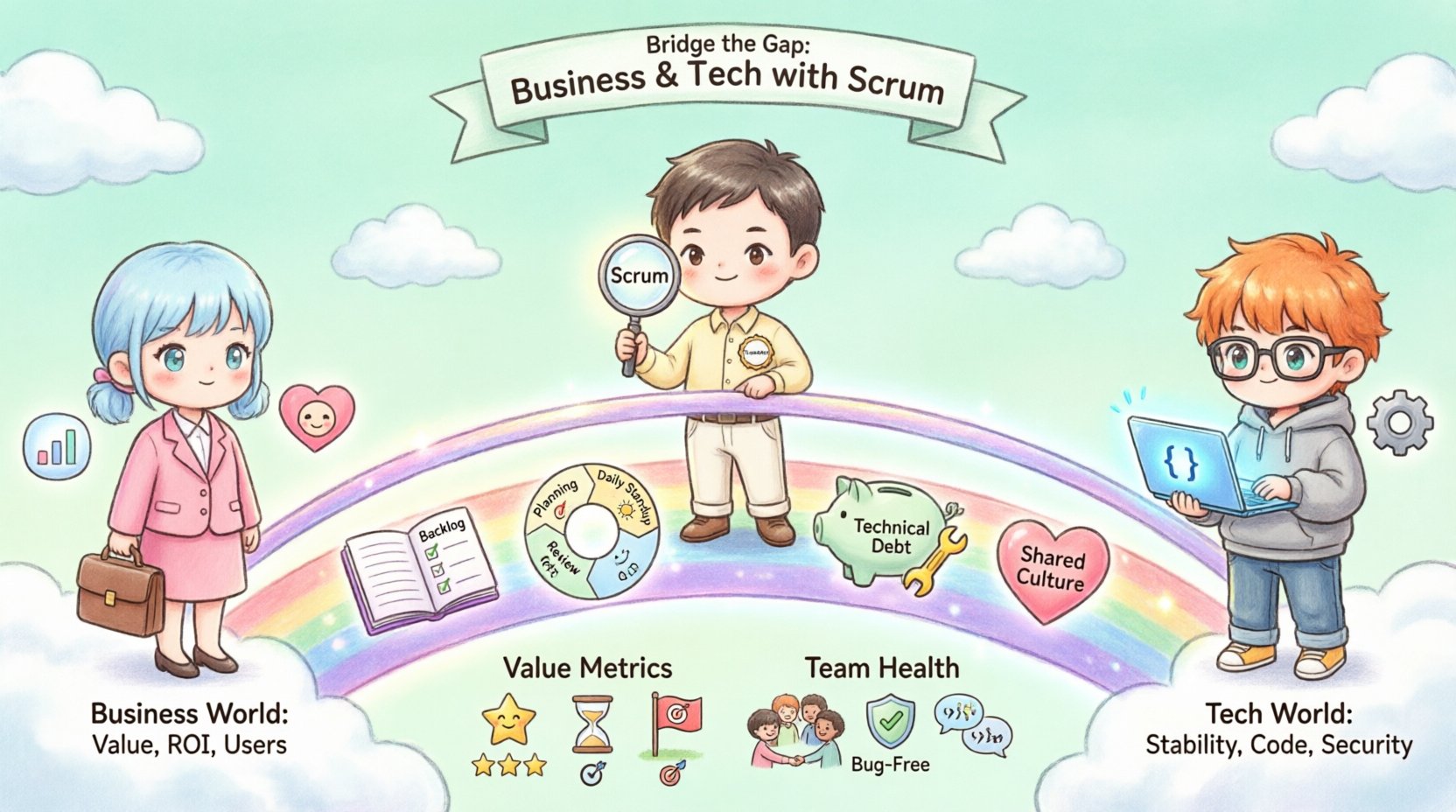
To bridge a gap, you must first understand the terrain on both sides. The business side and the technical side often operate with different success metrics. Recognizing these differences is the first step toward alignment.
Business Perspective
- Focus: Value delivery, market fit, and customer satisfaction.
- Timeframe: Often short-term wins mixed with long-term vision.
- Language: ROI, user stories, features, and release dates.
- Primary Concern: Will this solve a problem for the customer?
Technical Perspective
- Focus: Stability, scalability, security, and maintainability.
- Timeframe: Immediate sprint goals mixed with technical debt reduction.
- Language: APIs, database schemas, refactoring, and deployment pipelines.
- Primary Concern: Can we build this reliably and sustainably?
Neither perspective is wrong. However, when they operate in silos, the result is a product that either works poorly technically or solves no business problem. The bridge is built through shared vocabulary and regular touchpoints.
🧠 The Product Owner: The Primary Translator
The Product Owner (PO) role is critical in this dynamic. The PO acts as the bridge, responsible for maximizing the value of the product resulting from the work of the Scrum Team. However, this is not a translation job in the traditional sense. It requires deep engagement with both sides.
Responsibilities for Alignment
- Articulating the Vision: The PO must ensure the backlog reflects the strategic goals of the organization, not just a wish list of features.
- Understanding Constraints: The PO needs to understand technical constraints. If the system requires refactoring to support a new feature, this must be communicated as a business investment, not a technical chore.
- Prioritization: Deciding what to build next involves weighing business value against technical effort. This is a negotiation, not a command.
- Stakeholder Management: The PO filters noise from stakeholders, ensuring the team focuses on high-value items rather than ad-hoc requests.
When the Product Owner effectively fulfills these duties, the team gains clarity. They understand why they are building something, not just what they are building. This context empowers developers to make better architectural decisions that serve the business goal.
📋 Backlog Management: The Foundation of Clarity
The Product Backlog is the single source of truth for what needs to be done. It is the primary artifact where business needs meet technical effort. A well-managed backlog reduces ambiguity and sets the stage for successful sprints.
Criteria for Effective Backlog Items
- Clear User Stories: Each item should follow a standard format (e.g., “As a [user], I want [feature], so that [benefit]”). This forces the business need into a user-centric context.
- Acceptance Criteria: These define the boundaries of the solution. They must be testable and agreed upon by both business and technical stakeholders.
- Estimation: Effort estimates should be relative, not absolute. This helps manage expectations regarding time and resources.
- Dependencies: Identifying cross-team or external dependencies early prevents bottlenecks later.
The Refinement Process
Refinement (formerly grooming) is where the magic happens. It is a collaborative activity where the team breaks down large initiatives into smaller, actionable tasks. During refinement sessions:
- Clarification: Ambiguous requirements are questioned and clarified.
- Technical Discovery: Developers identify potential technical hurdles before committing to a sprint.
- Size Adjustment: Large items are split into smaller chunks that can be completed within a sprint.
- Collaborative Planning: Questions are asked by developers to business representatives to understand edge cases.
Without refinement, the team is forced to guess during sprint planning. This leads to commitment failures and technical debt. A refined backlog ensures that when a sprint begins, the work is understood and actionable.
📅 Sprint Events: The Rhythm of Alignment
Scrum events provide the cadence for communication. They are not just meetings; they are designed to inspect and adapt. Each event offers a specific opportunity to check if business needs are still being met by the technical solutions.
Sprint Planning
This is the commitment ceremony. The team selects items from the backlog to complete in the upcoming sprint. The goal is to agree on a Sprint Goal that satisfies business value while remaining technically feasible.
- Part 1: Discuss the “What” (Business value and requirements).
- Part 2: Discuss the “How” (Technical approach and task breakdown).
Both parts require input from the whole team. If the business value is unclear, the team cannot plan effectively. If the technical complexity is underestimated, the goal may be missed.
Daily Scrum
While primarily for the team, the Daily Scrum ensures progress is being made toward the Sprint Goal. If the team realizes a requirement is not being met technically, they raise it immediately. Early detection prevents a large deviation at the end of the sprint.
Sprint Review
This is the most critical event for bridging the gap. It is a demo of the work to stakeholders. The goal is not to show off code, but to show value.
- Feedback Loop: Stakeholders see the product and provide immediate feedback.
- Validation: The team learns if their technical solution actually solves the business problem.
- Adaptation: Based on feedback, the Product Backlog is updated. This ensures the next sprint aligns with current market needs.
Sprint Retrospective
Here, the team inspects itself. While this is internal, it often reveals process issues that cause the business-technical gap. Did the team understand the requirements? Was the technical debt too high to deliver value? Addressing these process issues improves future alignment.
⚙️ Technical Considerations in Business Context
One of the biggest friction points is technical debt. Business stakeholders often do not understand why they cannot just add a new feature every week. They see code as a static asset, not a living organism that requires maintenance.
Making Technical Debt Visible
To align business and tech, technical debt must be treated as a business risk. It should be included in the backlog.
- Transparency: Explain the cost of debt. High debt slows down future feature delivery.
- Trade-offs: Present options. “We can build Feature X now, but we will need to spend two sprints refactoring later.” Or “We can spend one sprint refactoring, then build Feature X faster.”
- Investment: Frame refactoring as an investment in speed and stability, not a cost.
Non-Functional Requirements
Business needs are not just about features. Performance, security, and compliance are often non-negotiable. These must be defined early.
- Performance: How many users will access the system?
- Security: What data is being protected?
- Compliance: Are there legal requirements?
Ignoring these leads to rework. Including them in the definition of done ensures they are met from the start.
🔍 Common Pitfalls and How to Avoid Them
Even with good processes, gaps can occur. Identifying common pitfalls helps teams navigate them before they cause damage.
| Pitfall | Consequence | Mitigation Strategy |
|---|---|---|
| Waterfall Mindset | Business expects a full specification before work starts. | Emphasize iterative delivery and feedback loops. |
| Over-Promising | Committing to too much in sprint planning. | Focus on capacity and past velocity, not desire. |
| Hidden Complexity | Technical challenges discovered too late. | Conduct spike sessions for unknown requirements. |
| Communication Silos | Stakeholders talk to developers directly, bypassing the PO. | Enforce the PO as the single point of contact. |
| Undefined Done | Features delivered but not usable. | Establish a clear Definition of Done (DoD). |
📊 Measuring Success: Metrics That Matter
To ensure the bridge remains strong, you need metrics that reflect alignment, not just output. Velocity is useful for capacity planning, but it does not measure value.
Value-Based Metrics
- Customer Satisfaction Score (CSAT): Are users happy with the delivered features?
- Lead Time: How long does it take from idea to production?
- Change Failure Rate: How often do deployments cause issues?
- Business Goal Achievement: Did the sprint goal contribute to the quarterly objective?
Team Health Metrics
- Engagement: Are team members feeling understood and supported?
- Code Quality: Are we introducing bugs or fixing them?
- Collaboration: Are business and tech teams talking regularly?
Tracking these metrics helps identify when the gap is widening. If velocity drops while business value remains high, the team might be overworking. If business value drops, the team might be building the wrong things.
🚀 Cultivating a Shared Culture
Processes and tools are enablers, but culture is the engine. A culture of trust allows for honest conversations about risk and capability. In this environment:
- Psychological Safety: Team members can admit when they do not understand a requirement without fear of blame.
- Shared Ownership: Success is a team effort. The business owns the value, the tech owns the quality, but the team owns the outcome.
- Continuous Learning: Both sides learn about each other’s challenges. Business learns about technical constraints; Tech learns about market dynamics.
This culture is built over time. It requires patience and consistency. It is not about fixing a broken process; it is about building a relationship between the people who define the problem and the people who build the solution.
🛠️ Practical Steps to Start Today
You do not need to overhaul your entire organization to start bridging the gap. Small, consistent changes yield results.
- Invite Stakeholders to Refinement: Let them ask questions directly to the team during backlog prep.
- Review the Definition of Done: Ensure it includes business criteria, not just code passing tests.
- Visualize Work: Use boards to make progress transparent to everyone.
- Hold Regular Check-ins: Schedule informal syncs between PO and Tech Lead.
- Demonstrate Early: Show prototypes or partial features to get feedback before full development.
By taking these steps, you create a environment where business needs and technical solutions are not opposing forces, but partners in creating value. The goal is not perfection, but continuous improvement. As you refine your communication and processes, the gap will narrow, and the delivery of value will become smoother.
🔗 Final Thoughts
Bridging the gap between business needs and technical solutions is a dynamic challenge. It requires constant attention, empathy, and a commitment to transparency. Scrum provides the framework, but the people within it provide the fuel. When the Product Owner, the Development Team, and the Stakeholders work in unison, the result is software that is not only functional but valuable.
Focus on the conversation. Focus on the shared goal. Focus on the value delivered to the customer. When these elements are present, the technology serves the business, and the business empowers the technology. This is the essence of successful Agile delivery.