

Scrum is designed around the concept of self-organization. Teams are expected to manage their own work, handle their own conflicts, and drive their own improvements. However, the ideal state of autonomous efficiency rarely exists without friction. In the dynamic environment of agile delivery, there comes a moment where stepping back is not the best option. Understanding the precise timing and nature of intervention is a critical skill for any Scrum Master or project lead.
This guide explores the nuances of when to step in, when to hold back, and how to navigate the delicate balance between empowering the team and ensuring project stability. We will look at specific triggers, organizational dynamics, and the signs that a sprint is drifting off course.
The Principle of Self-Organization 🤝
Before discussing intervention, it is vital to understand the baseline. The Scrum Guide states that the Development Team is self-organizing. They choose how best to accomplish their work. This does not mean they work in isolation; it means they have the authority to make decisions regarding the implementation of the product.
Intervention is not about taking control. It is about removing barriers or correcting course when the self-organizing mechanism fails due to external forces or internal dysfunction. If a leader intervenes too early, they risk creating dependency. If they intervene too late, the sprint goal may be lost.
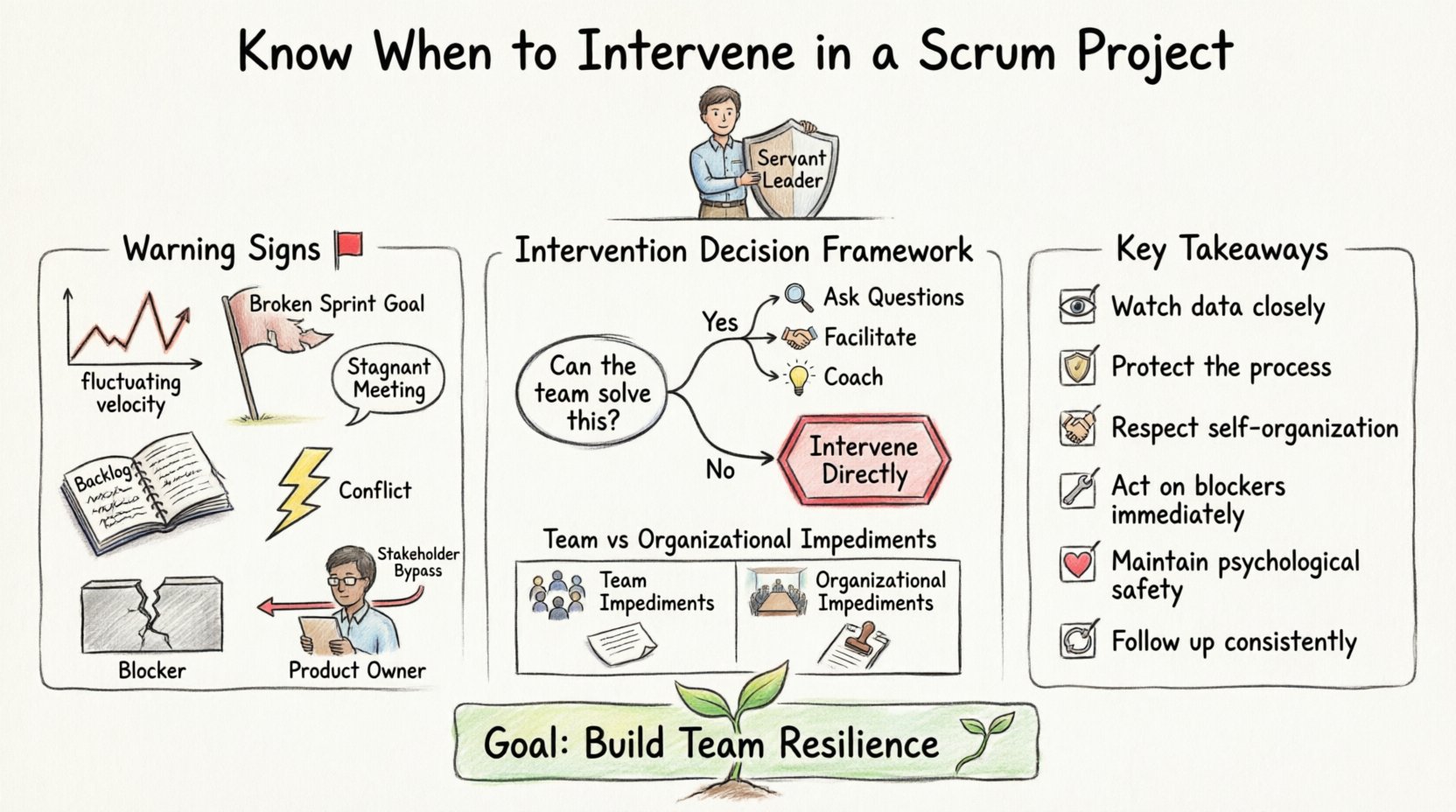
Recognizing the Warning Signs 🚩
Intervention is often reactive. You wait for a signal that something is wrong. These signals can be quantitative, visible in the data, or qualitative, visible in the team’s behavior. Below are the primary indicators that suggest a need for action.
- Velocity Volatility: If the team’s velocity fluctuates wildly from sprint to sprint without a clear reason (like a change in scope), it may indicate poor estimation or hidden technical debt.
- Missed Sprint Goals: If the sprint goal is compromised two sprints in a row, there is a systemic issue requiring investigation.
- Stagnant Daily Scrums: If the Daily Scrum becomes a status report to management rather than a planning session for the team, the rhythm is broken.
- Artifacts in Disrepair: The Product Backlog is not refined, or the Definition of Done is not being met. This creates chaos in delivery.
- Visible Conflict: Arguments that halt progress or create a hostile environment require immediate mediation.
- Technical Impediments: When a blocker prevents work for more than a day without a resolution path, it needs escalation.
- Stakeholder Pressure: If external stakeholders demand changes that bypass the Product Owner, the Scrum Master must intervene to protect the process.
Impediments that Require Immediate Action ⚡
Not all impediments are equal. Some can be ignored by the team; others can bring the entire project to a halt. Distinguishing between the two is a matter of impact analysis.
Team-Level Impediments
These are issues the team should ideally resolve themselves. However, if they persist, intervention is needed.
- Environment Issues: Slow laptops, lack of test servers, or permission issues.
- Knowledge Gaps: If a key skill is missing and training cannot be arranged.
- Resource Contention: Team members are pulled away to support other departments.
Organizational Impediments
These are issues the team cannot fix. They require a leader to intervene with upper management or other departments.
- Compliance Bottlenecks: Security or legal reviews that take weeks.
- Infrastructure Budgets: Lack of funding for necessary tools.
- Policy Restrictions: HR policies that prevent hiring necessary talent.
When Stakeholders Cross the Line 📉
One of the most common reasons for intervention is external interference. Stakeholders often want to see progress and may try to bypass the Product Owner to get features done faster. This undermines the Scrum process.
If a stakeholder sends a task directly to a developer, the Scrum Master must step in. The workflow is broken. The Product Backlog is the single source of truth. Any new work must go through the Product Owner for prioritization.
Common Stakeholder Interference Patterns
- Ad-Hoc Requests: “Can you just do this small thing?” during the sprint.
- Scope Creep: Adding features mid-sprint without removing equal value.
- Direct Management: Asking team members for status updates outside the Daily Scrum.
- Micro-Management: Dictating how a specific task should be coded or designed.
Intervention here involves coaching the stakeholder on the value of the process. It requires explaining that interruptions reduce focus and quality. The goal is to protect the team’s flow while maintaining a good relationship with the business.
The Scrum Master as a Servant Leader 🛡️
The role of the Scrum Master is to serve the team. This means serving them by coaching them to solve problems themselves. However, it also means serving them by removing obstacles they cannot remove. The decision to intervene rests on the question: “Can the team solve this, or do I need to help?”
Intervention should follow a hierarchy of support:
- Ask Questions: “What do you think is blocking you?”
- Facilitate: Bring the right people into the room to discuss the issue.
- Coach: Suggest approaches or frameworks to solve the problem.
- Intervene: Take direct action to remove the barrier if the team is stuck.
Jumping straight to intervention can be disempowering. It signals that you do not trust the team’s capability. It is better to start with facilitation and only escalate to direct action when necessary.
Decision Matrix for Intervention 📊
To make objective decisions, use a framework. The table below outlines common scenarios and the recommended level of action.
| Scenario | Severity | Recommended Action |
|---|---|---|
| Team member is sick | Low | Allow team to adjust workload naturally. |
| Major technical blocker | High | Scrum Master escalates to engineering management. |
| Stakeholder demands feature | Medium | Coach stakeholder on backlog refinement process. |
| Team conflict affecting output | High | Facilitate a conflict resolution session. |
| Product Backlog not refined | Medium | Coach Product Owner on backlog grooming. |
| Missing Definition of Done | High | Intervene to enforce quality standards. |
| Velocity drop due to context switching | High | Intervene to negotiate focus time with leadership. |
Handling Sprint Goal Deviation
The Sprint Goal is the target for the sprint. If the team realizes they cannot achieve it, they must communicate this early. Intervention becomes critical when the team hides this information.
During the Sprint Review, if the goal is not met, the Product Owner and the team must analyze why. If the reason is a lack of focus or external distraction, the Scrum Master must intervene in the next sprint planning to ensure focus is re-established.
- Transparency: Ensure the team is not afraid to admit failure.
- Adaptability: Be willing to cancel the sprint if the goal becomes obsolete.
- Learning: Use the deviation as a lesson for the next planning session.
Team Dynamics and Psychological Safety
Intervention is often necessary when psychological safety is compromised. If team members are afraid to speak up during the Retrospective, the improvement process is dead. This is a high-risk area for a project.
Signs of unsafe dynamics include:
- Silence in Meetings: No one volunteers for tasks or raises concerns.
- Blame Culture: Focus on who made the mistake rather than what happened.
- Exclusion: Certain members are ignored in discussions.
- Aggression: Disrespectful language or tone during work sessions.
In these cases, the Scrum Master must intervene immediately. This might involve one-on-one coaching, setting ground rules for meetings, or bringing in an external facilitator. The priority is restoring an environment where the team can function effectively.
Post-Intervention Follow Up
Intervention is not a one-time fix. It requires follow-up to ensure the change is sustainable.
- Verify Resolution: Check if the impediment is actually gone.
- Monitor Behavior: Watch for signs that the team is reverting to old habits.
- Document Lessons: Record what caused the intervention to prevent recurrence.
- Empower Again: Once the issue is resolved, step back and let the team take ownership.
Building Resilience Over Time 🌱
The goal of intervention is to make it unnecessary. Over time, the team should become more robust. They should be able to handle minor impediments without help. This resilience is built through:
- Continuous Training: Ensuring the team has the skills to solve their own problems.
- Clear Processes: Establishing rules for communication and escalation.
- Trust: Building a relationship where the team trusts the leader to support them, and the leader trusts the team to handle their work.
Intervention is a tool, not a crutch. Used correctly, it keeps the project on track. Used incorrectly, it creates a bottleneck. The key is awareness and timing.
Conclusion on Leadership in Agile
Knowing when to intervene is a skill that develops with experience. It requires observing the team, understanding the process, and knowing the boundaries of authority. By focusing on removing obstacles and protecting the team’s focus, leaders can ensure the Scrum project delivers value without unnecessary disruption.
Remember, the best intervention is often the one that teaches the team how to solve the problem themselves next time. Maintain a balance between guidance and autonomy to keep the project moving forward effectively.
Key Takeaways for Intervention
- Watch the Data: Velocity and sprint goal achievement are early warning systems.
- Protect the Process: Ensure stakeholders do not bypass the Product Owner.
- Respect Self-Organization: Let the team solve their own problems first.
- Act on Blockers: Do not let impediments sit for days without a resolution plan.
- Maintain Safety: Ensure the team environment remains respectful and open.
- Follow Up: Verify that interventions led to real change.
By adhering to these principles, project leaders can navigate the complexities of Scrum with confidence and clarity.